With the onset of the design of Archives II, NARA needs to continue planning the division of its operations between the two facilities. NARA would appreciate comments and suggestions concerning this report from our constituents, particularly concerning the locations of its textual records. Please send all inquiries and suggestions to the Archives II Project (NAA), National Archives and Records Administration, Washington, DC 20408,or call Adrienne C. Thomas; 202/523-3076.
The National Archives Building, located on Pennsylvania Avenue in Washington, DC, was completed in 1935. This building reached its records storage capacity of approximately 800,000 cubic feet in the late 1960s. To alleviate space storage, over 500,000 cubic feet of archival records received since 1970 and various administrative support activities have been diverted to several federally owned and leased buildings in the Washington, DC area.
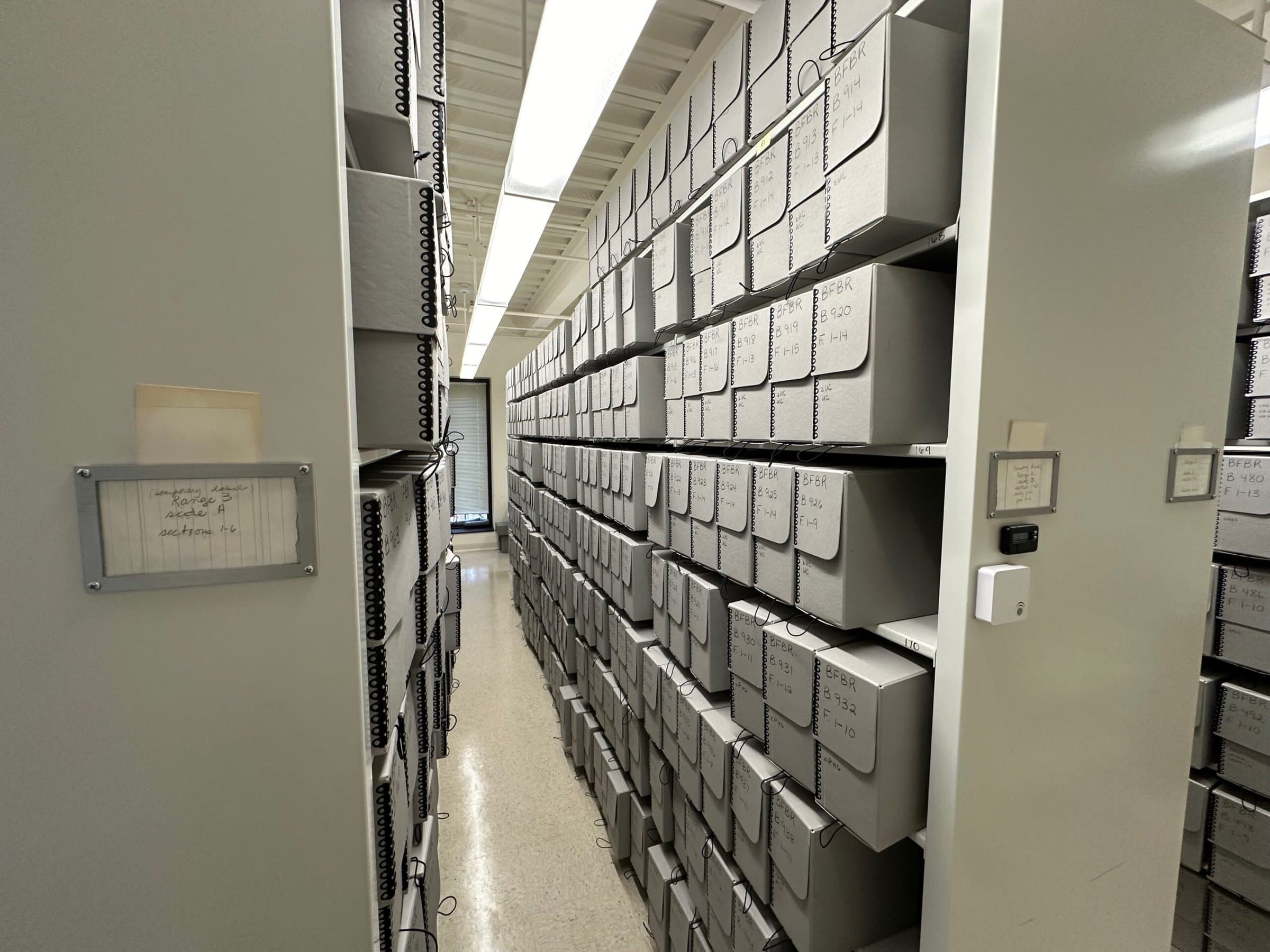
Some of the nation’s historically valuable records are currently stored in environmental conditions not designed to prolong the life of these important documents. In the future, more records will have to be stored in archivally unsuitable space unless a new archival facility is constructed that meets the environmental requirements for archival records recommended by the National Bureau of Standards. Further dispersal of records to additional sites will increase operational inefficiencies, including the duplication of various support activities (e.g. research rooms and laboratories), and will further impede researchers wishing to use the records.
Additionally, a study of the National Archives Building completed in 1985 by Shepley, Bulfinch, Richardson, and Abbott, Inc., recommended renovations to the National Archives Building to correct deficiencies in environmental and records storage conditions and to expand currently inadequate public use areas. These essential renovations will require that records be temporarily stored offsite during work to the National Archives Building.
Planning for Archives II—Within this context, Summer Consultants, Inc. (engineers) and Cooper-Lecky Architects, P.C., experts infacility planning, began work in July 1987 on a major study for a new archival building. Completed in January 1988, the Design Program for a National Archives Facility in Maryland identifies NARA’s program requirements, documents functional relationships, and recommends the type and configuration of a building that meets NARA’s special needs. The planners also prepared design and construction cost estimates and evaluated alternative building sites in College Park and Suitland, Maryland.
HOK/Ellerbe Becket will begin the design work in September 1988, to be completed in early 1990. Construction of Archives II is scheduled to begin in early 1990 and be completed in the late fall of 1998. NARA will begin to move into Archives II in 1994.
The design program describes an archival facility of 1.7 million square feet for records storage and program support areas. A facility of this size will meet NARA’s requirements to the year 2004. The building, however, will be specially designed to allow the addition of new wings to meet future storage needs. These wings, providing additional records storage and processing space totaling 375,000 square feet, should fulfill NARA’s space needs to 2025.
Archives II will provide state-of-the-art storage, reference, and laboratory facilities. Current standards established by the National Bureau of Standards and the National Academy of Sciences will serve as the basis for the building’s environmental controls. Both national and international guidance relating to reference services, general building security, and classified records security systems will be reviewed, aod the best of these guidelines incorporated into the building design.
In addition to the archival functions, Archives II will provide space for offices and general facilities, including a theater, conference rooms, and a cafeteria. The new facility is expected initially to house approximately 600 professional and technical employees and 150–200 contract workers for security, maintenance, and food services. The building will accommodate the projected 50,000 researchers expected each year.
After much searching for suitable land in the District of Columbia aod surrounding suburbs. NARA selected a University of Marylaod site for the new facility. The proposed site is approximately thirty-three acres on the northwest end of the University of Maryland campus in College Park. A major benefit of this site is that the federal government will receive the use of this land without charge.
In NARA’s search for a suitable site, easy access for researchers was a top priority. Current plans for Washington’s subway construction include a College Park station on the Metro Green Line (scheduled for completion in late 1993). In addition there will be parking available at the facility for researchers. While NARA realizes that there will be some inconvenience for researchers who will need to use records in both the downtown building and a suburb building, centralizing the records in one facility is not an option. NARA currently ensures that researchers have easy access to the three sites in the Washington, DC area, where archival records are stored, by running a free shuttle service and plans to provide this same shuttle service to and from the College Park subway station.
Archives II will not replace the current National Archives Building in downtown Washington, DC. Both buildings will operate as archival facilities but will emphasize different programs. NARA will continue to use the downtown facility as a public use and records storage facility. Since Archives II will be located outside the District of Columbia, the focus of most public activities will remain in the renovated National Archives Building. Expanded public-use areas will include a new Genealogical Research Center and special areas for lectures, conferences, tours, exhibits, and film festivals. Archives II will host periodic historical and archival conferences, symposia, and educational lectures. The new archival facility will complement the renovated National Archives Building in preserving and providing public access to the historical memory of this nation.
Archival records will be located both in the downtown National Archives Building and Archives II. After renovation, the National Archives Building will house approximately 800,000 cubic feet of textual records, the same as is housed there today. Archives II will house all special media records, including motion pictures, photographs, maps, drawings, and machine readable records, in addition to over one million cubic feet of textual records.
In order to determine the space requirements for Archives II, the National Archives made some planning assumptions regarding the division of its textual records between the two facilities.
First, the downtown building has a finite amount of records storage space and its small loading dock is not adequate for bringing in large amounts of new records. Therefore NARA wants to minimize the amount of ac cessions that will come into the National Archives Building. Archives II will have a large, modern loading dock and the space to accommodate growing records groups.
Second, NARA wants to ensure that records series will not be split between the two facilities.
Third, those records that are housed in the National Archives Building should complement each other as much as possible.
Fourth, the downtown facility will remain NARA’s main public activity center and consequently should contain records that complement those activities.
Based on the above planning assumptions, NARA has tentatively decided to consolidate genealogically-related records, Congressional and Supreme Court records, and pre-1947 military records in the downtown building. This will ensure that the core records needed for genealogical research are together and convenient to researchers using the new Genealogical Research Center. Congressional and Supreme Court records will continue to grow although their projected growth can be managed for many years within the confines of the National Archives Building. While 1947 is used as the general cut-off date for the military records to be located in the downtown facility, in reality not all military records can be split at that precise date. NARA will be dividing the military records series where appropriate breaks appear after World War II. All other textual records housed by NARA will be located at Archives II.
Conclusion—With the construction of Archives II, the National Archives will be able to vacate ten leased facilities in the Washington, DC area and consolidate its operations in the National Archives Building and Archives II. Most importantly, Archives II will enable NARA to do a better job of preserving the nation’s records and serve the citizens who use these records.