In the spring of 1984, the AHA’s Research Division, as part of its oversight responsibilities for the American Historical Review, commissioned a membership survey of opinions and attitudes toward the AHR. The survey was included in the September 1984 issue of Perspectives, which was mailed to the approximately 12,000 members of the Association and 500 departments of history.
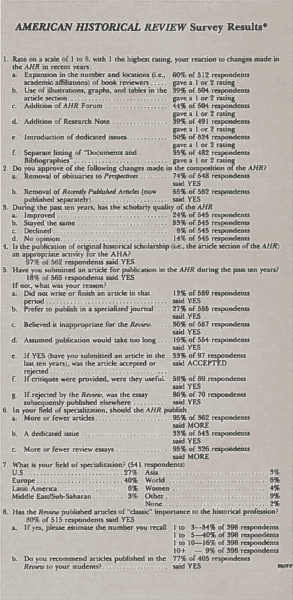
Consisting of thirteen questions, the survey polled members on their views of recent changes in the AHR (e.g., the addition of new sections), their valuation of sections of the Review (e.g., the importance of articles, book reviews, review essays, etc.), and the kinds of changes or modifications they would like to see in the future. The headquarters office received 570 responses, yielding a survey response rate of about 5 percent. The data was coded in the headquarters and tabulated by the University of Maryland’s (College Park) computer center with assistance from Maryland’s department of history.*
The fields of interest of those responding tended to track the distribution of fields in the wider membership. About 95 percent of those responding identified their fields of specialization. Of this group, 40 percent identified a field in European history, 27 percent identified a field in US history, and the remainder were about equally apportioned (between 3 and 6 percent each) in Latin American, Asian, world, Middle East/Sub-Saharan, and women’s history. Almost one-in-five of the respondents had had direct contact with the Review’s offices in the last ten years by submitting an article for publication. Doubtless many more had published book reviews in the AHR. (Questions 5 and 7.)
Generally, the responses evidenced strong support for the Review. Three-fourth of the respondents believed that the scholarly quality of the Review had remained the same or improved in the last decade, About one-in four noted a positive change in scholarly quality. (Question 3.)
Regarding the many changes made in the AHR in recent years, the responses were varied. There was very strong support for the expansion in the number and geographic locations of book reviewers, and for the removal of the Obituaries segment from the Review to Perspectives. The introduction of the “dedicated” issue was seen as an important change, as was the addition of the AHR Forum. Close to half of the respondents rated these changes as a “1” or “2” on a scale of six, with “1” the highest rating. There was less enthusiastic support for the use of illustrations, graphs, and tables in the article section, and for the addition of the Research Note. The separate listing of Documents and Bibliographies elicited the least positive response (only 35 percent gave a “1” or “2” rating). (Even in these less enthusiastically supported changes, there were few “5” or “6” ratings.) Of all the changes made, one in particular had markedly split support. Slightly more than half of the respondents favored the separate publication of Recently Published Articles; or stated in the negative, nearly half of the respondents would like to see a return of RPA to the pages of the Review. (Questions 1 and 2.)
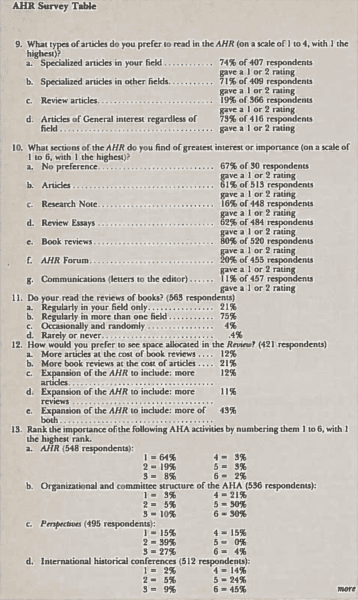
The article and book review sections—and here we have the most conspicuous findings of the survey—were seen as the Review’s most important contribution to scholarship and service to the profession. There was little sense in the survey that these two sections were in conflict or competition with each other, or that space in the Review was unsatisfactorily apportioned between the two sections. Almost all respondents believed that the publication of “original historical scholarship” was an appropriate activity of the AHA. Most also observed that the Review has published articles of “classic” importance to tl1e profession, and three-in-four recommended Review articles to their students. Readers showed no particular preference for article subject matter. About the same percentage of respondents (ranging from 71 percent to 74 percent) checked off a preference for “specialized articles in your field,” “specialized articles in other fields,” and “articles of general interest.” In other words, members were interested in reading a range of articles in each of the three categories. There was much less interest (19 percent) in reading ”review articles,” though in some respects this finding was in conflict with responses given in other questions. For example, Question 10 asked “What sections of the AHR do you find of greatest interest or importance . . . ?” Almost two-thirds gave the review essay a “1” or “2” rating on a scale of “1” to “6,” with “1” the highest rating. (Questions 4, 8, 9, and 10.)
The book review section was probably the most popular single feature of the Review, with 80 percent of the respondents rating this section “1” or “2” in “importance” or of “greatest interest” when compared with other sections. Most of those who read the book reviews (99 percent of all respondents said they did) read regularly in more than one field (75 percent), When asked how they would “prefer to see space allocated in the Review,” slightly more preferred to see more space given to book reviewing at the expense of space for articles (21 percent) than the reverse—more space for articles and less for book reviews (12 percent). About an equal number (12 percent and 11 percent respectively) expressed a preference for an expansion of the Review (i.e., an increase in the total number of printed pages in each Review issue) to enlarge either the article section or the book review section. These results, at best, seem inconclusive. A more revealing bit of information was contained in the last part of Question 12 (“How would you prefer to see space allocated in the Review?”) in which 43 percent of the respondents wanted to see more pages given to both articles and book reviews. (Questions 10, 11 and 12.)
Question 10 invited respondents to rank the various sections of the Review based on a “1” to “6” rating. The book review section garnered the highest combined “1” and “2” ratings, followed by review essays and articles. There was lesser interest, comparatively, for AHR Forum, Research Note, and Communications. It should be kept in mind that Question 10 invited comparisons and was not necessarily a measure of a section’s value. Question 10 should be read with Question 1 (“Rate on a scale of 1 to 6, with 1 the highest rating, your reaction to changes made in the AHR in recent years”) to gain a fuller picture. Thus, while the AHR Forum and Research Note ranked low by comparison with other sections in Question 10, standing independently there was a showing of support for both sections in Question 1. Forty-four percent and 39 percent respectively gave the Forum and Research Note a “1” or “2” rating in judging the addition of these two new sections. (Questions 1 and 10.)
The survey also provided useful information on the relationship between field specialization and Review coverage. There was fairly strong interest in the recently introduced “dedicated” issue—an issue containing several articles on a single conceptual (e.g., women’s history) or geographic (e.g., African history) area of history. One-half of the respondents gave the introduction of dedicated issues a rating of “1” or “2,” as one of the recent changes made in the AHR. Paradoxically, fewer (39 percent) of the respondents wished to see a dedicated issue in their own fields of specialization. By contrast, 95 percent of the respondents did wish to see more articles in their fields of specialization and more review essays. (Questions 1 and 6.)
It should also be remembered, as noted previously, that there was very strong support for all kinds of articles, specialized as well as articles of general interest. Perhaps the best way to characterize the response to field coverage is to say that readers welcomed the introduction of dedicated issues, but that this should not squeeze out “solo” articles of special or general interest. The Review can be seen as the profession’s central journal and forum for the publication of specialized articles for a general audience—and also as one of the primary scholarly forums for the publication of general historical essays. In this regard, again it is noteworthy that most readers of book reviews read reviews in more than one field.
More than 100 of the survey respondents had submitted an article for publication in the Review in the past ten years. The acceptance rate was one-in-three. More than half who received critiques found them useful. Most of those who submitted articles that were not accepted subsequently were able to publish their articles elsewhere. The most common reason given for not submitting an article to the Review was that the author thought the article was inappropriate. A lesser number preferred to publish in a specialized journal, some believed it would take too long to publish an article with the Review, and fewer still noted that they did not write or complete an article during the past ten years. (Question 5.)
In summary, the AHR survey results would suggest—at least based on the views of those who chose to fill out and return the survey—that the Review is functioning about as it should. Its scholarly quality has remained constant or, in the opinion of some, has improved over the last decade. Several of the more recent changes have met with approval, though some of the changes have been judged as more valuable than others. The publication of original scholarship in article form is seen as an appropriate activity of the Review. Readers are interested in both specialized and general articles, and would welcome more articles and review essays in their own fields of specialization. There is also support for the new dedicated issue feature, though sentiment seems to be in favor of maintaining balance between dedicated and nondedicated issues. Book reviews are apparently the most popular feature of the Review; the majority of respondents read the reviews regularly in more than one field. Articles and review essays rank about equally as the second-most-valued sections. There was some sentiment for expanding the article section at the cost of space for book reviews, but more sentiment for expanding the book review section at the cost of space for articles. A more common preference (among the options for expansion and contraction of space) was for an expansion of both sections.
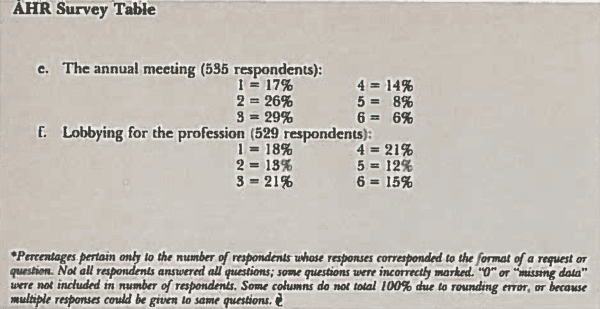
Finally, when asked to rank the activities of the AHA on a scale of “1” to “6,” the Review received the highest rating, with more persons (64 percent of the respondents) rating it as a “1” than any other activity. Based on the frequency of “1” rankings only (the order would change slightly if “2” rankings were combined with the ”1”s), the Review was followed by lobbying for the profession, the annual meeting, Perspectives, the association’s organizational and committee structure, and international historical conferences. (Question 13.)
*The association wishes to express its appreciation to Professor Emory Evans, chair of the history department, for his assistance.