
Efforts to manifest connections to the American Revolution through the material world have a long history; they began in the moment—with people saving objects ranging from tent fragments to furniture—and persist into the present day. Commemorative milestones have provided reasons to revisit and to reimagine the American Revolution through both old and new objects, the impulse for doing so shape-shifting along the way.
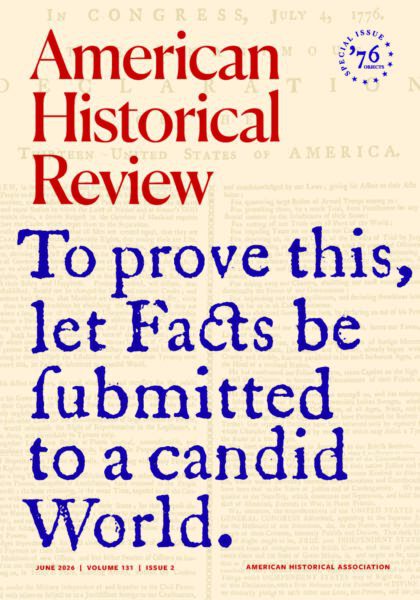
The cover of this American Historical Review special issue, which marks the 250th anniversary of the signing of the US Declaration of Independence, draws from the language of the original document, telling readers: “To prove this, let Facts be submitted to a candid World.” In ’76 Objects, material culture takes center stage as a method of historical inquiry through essays that collectively offer new insights into revolutionary America and capture a diversity of experiences through their focus on both ordinary and extraordinary objects.
These commemorative milestones often have come at fraught moments in the nation’s history. The United States was still deeply divided and roiling in the aftermath of the Civil War during the Philadelphia Centennial Exposition of 1876. The bicentennial occurred as the nation was emerging from the Watergate scandal. And we find ourselves at the semiquincentennial in a deeply polarized political moment in which history has become a major flash point amid a presidential administration’s movement to flatten, and in some cases erase, narratives of US history.
Institutions across the United States have produced programming, exhibits, and teaching materials, contributing complexity to our understanding of the founding of the United States and the intervening 250 years. Schoolchildren and adults alike are watching The American Revolution, a new documentary by Ken Burns, Sarah Botstein, and David Schmidt. And, as in the past, the commemorative landscape is awash with memorabilia. America250, for instance, has an entire line of merchandise, from key chains to a branded cowbell, to (in a nod to the 2020s) charcuterie boards, wine totes, and pickleball paddles emblazoned in a signature red, white, and blue logo.
But the semiquincentennial is not only a moment for public commemoration. It offers us a distinct moment in time at which to deeply assess the nation’s past, to grapple with its complexities and contradictions, to take stock of our scholarship, and to do so not only alongside other historians but also in conversation with students and the general public.
In ’76 Objects, a special issue of the American Historical Review, material culture of the revolutionary era takes center stage as a method of historical inquiry. This is the first issue of the AHR in its more than 130-year history to focus entirely on material culture. In fact, material culture, despite having been a flourishing field of scholarly study for nearly five decades, is still relatively underutilized when it comes to the academic discipline of history. While the scholarship of historians of ancient and premodern eras has long been informed by the study of physical artifacts, those who study more recent eras have tended to privilege textual sources. In a 2005 AHR article, Leora Auslander offered an explanation as to why: “Historians,” she wrote, “are, by profession, suspicious of things. Words are our stock-in-trade.”
The three-dimensional nature of objects—their style, construction, materials, and tactile qualities—is important to understanding both their roles in people’s lives and their historical significance. So, too, are the cultural, social, and political meanings that are embedded within and created by objects’ design, production, use, destruction, and preservation. Objects have communicative, emotive, expressive, performative, and, at times, violent effects in the world. The authors of the 64 short essays in this special issue each focus on an individual object, taking various approaches to explore the context and significance of items ranging from furniture, to portraits, to shoe leather scraps. Zara Anishanslin (Univ. of Delaware), Kenneth Cohen (National Museum of American History), Nathan Perl-Rosenthal (Univ. of Southern California), and Ashli White (Univ. of Miami) contribute longer essays to round out the issue.
The authors of the 64 short essays in this special issue each focus on an individual object, taking various approaches to explore its context and significance.
Teasing out material culture’s many interpretations can be challenging. The meanings accessible through documents often prove easier to evoke through a textual quotation than through the level of description required to interpret an object, but the pervasiveness of text—and of literacy itself—is, in the grand scheme of things, really quite modern. And so, by decentering text, we can open portals into the past as it was lived in all its texture.
Material culture requires us to use the power of description to help people to see something, feel it, smell it, know it. Sometimes, as Anishanslin explores in her essay, words are all we have left of a thing. Those “absent objects, and the reasons for their absence,” she writes, “offer important historical and historiographical insights.” In those instances, we must piece together our understanding through not only the words but also the objects we do still have. There is much to be gained by mobilizing material objects in our scholarship to serve as meaningful sources that, in all their three-dimensionality, pose questions and problems with which historians must reckon. And numerous historians of multiple fields and time periods are grappling with such questions. The essays in this issue build on decades of innovative scholarship conducted in both historical and interdisciplinary contexts. They take stock of where we have been and gesture toward where we might go.
This special issue is not intended to define or advocate for a specific methodology by which to study material culture; no single approach is privileged. Instead, it highlights a range of approaches through which to study a wide variety of material objects. While each essay is grounded in an individual object, how an author uses that object varies. Sometimes the object is at the center, showcasing what we can learn from intensive object-centered research; sometimes an object is used as a touchstone to relate a history grounded primarily in documents, an object-driven one in which the material itself is less central, but nevertheless important to posing a historical question. Some essays are deeply rooted in material analysis, while others situate an object within a broader array of objects, images, and texts to draw out its meanings. In some instances, the objects themselves no longer exist. Artifacts, Cohen reminds us, “can serve as nexuses or prompts as much as evidence.” Our goal has been to be inclusive—methodologically, chronologically, and geographically—to show the variety of ways a historian might use material culture to uncover insights into the history of the revolutionary era and to capture a diversity of experiences through both ordinary and extraordinary objects.
What story does an object tell best? The answer depends on the questions you ask of it. Our knowledge of objects, as White observes, “rests on the formidable expertise of many specialists.” I still have research questions about the ways in which these objects, as Perl-Rosenthal suggests, sit “at the juncture between two scales of analysis”—in this case, the local and the global.
Thousands of objects, remarkable and mundane, were in motion as the British American colonies moved toward revolution. Beads. Smoothbore flintlock muskets. Pocket maps. Beaver round hats. Striped drugget. Oakum. Some of them tell little-known local histories. Others offer insight into much larger, global histories. All are access points for unlocking deeper histories of the revolutionary era. We invite you to explore the objects in this issue—to engage with the interpretations presented, to ask your own historical questions of them, and to seek out the answers.
Multiple stories are contained within these objects. What will you ask of them?
This work is licensed under a Creative Commons Attribution-NonCommercial-NoDerivatives 4.0 International License. Attribution must provide author name, article title, Perspectives on History, date of publication, and a link to this page. This license applies only to the article, not to text or images used here by permission.

Related Articles
Sorry, we couldn't find any articles.