
Alison Isenberg, historian of urban America and professor of history at Princeton University, died on October 23, 2025, in Princeton, New Jersey. She is survived by her husband, fellow historian Keith Wailoo, and their two daughters, Sarah Iman Wailoo and Myla Eleanor Isenberg Wailoo.
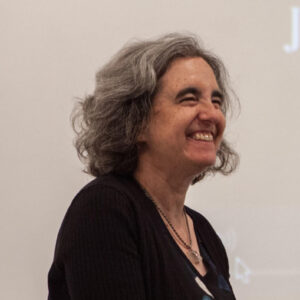
Photo courtesy the Trustees of Princeton University
Born in 1962, Isenberg received her BA from Yale University in 1984, where she worked with Ann Fabian and William Cronon, and her PhD from the University of Pennsylvania in 1995, where she studied with Michael Katz. Following these mentors, Isenberg produced a wealth of impressive scholarship over her career.
Isenberg distinguished herself as a scholar with a passion for exploring the forgotten people and places of major cities. Her undergrad thesis at Yale, the first of many prizewinning works, traced the life of a New England woman in the San Francisco gold rush. Before entering graduate school, Isenberg deepened her education in urban affairs by applying her skills in urban planning and housing development at the New York City Department of Parks and Recreation and the Community Preservation Corporation in the Bronx. As a doctoral student, she crafted another prizewinning work in her dissertation on the creation and crisis of the American downtown.
Her published works only brought more prizes. Her first book, Downtown America: A History of the Place and the People Who Made It (Univ. of Chicago Press, 2004), won the Ellis W. Hawley Prize from the Organization of American Historians and the Lewis Mumford Prize from the Society for American City and Regional Planning History (SACRPH), among others. Her second, Designing San Francisco: Art, Land, and Urban Renewal in the City by the Bay (Princeton Univ. Press, 2017), won the PROSE Award in Architecture and Urban Planning from the Association of American Publishers and the John Brinckerhoff Jackson Book Prize from the Foundation for Landscape Studies. Her third book, the soon-to-be-released Uprisings (Princeton Univ. Press), turned her talents to yet another city: Trenton and the deadly uprising there after the murder of Martin Luther King Jr.
But these books only scratch the surface of Isenberg’s considerable contributions to urban history. She served as president of SACRPH, as a board member for the Urban History Association and H-Urban, and as the founding review editor for the Journal of Planning History. She was the founding co-director of both the Princeton-Mellon Initiative in Architecture, Urbanism, and the Humanities (2011–25) and the Robert Wood Johnson “Truth and Repair” project (2023–25), which united scholarly communities at Princeton, Rutgers University, St. Peter’s University, and cultural institutions across New Jersey. She also linked her recent research in the “Trenton project” to a larger community of artists and public history advocates to restore and recover the recent past there.
Despite her larger-than-life profile as a national figure in her field, Isenberg remained primarily focused on her students. Over three decades, she taught at Florida International University (1994–97), the University of North Carolina at Chapel Hill (1997–2001), Rutgers University (2001–10), and finally Princeton (2010–25). Perhaps not surprisingly for a scholar of urban planning, Isenberg was skilled at building communities and crafting environments in which her students could thrive. She enabled her students to feel safe presenting their ideas and taking risks in their research. In 2024, she received one of Princeton’s awards for graduate student mentoring in recognition of her incredible commitment to the Department of History’s students.
Setting an example of cooperation and collaboration, Isenberg was well known for reaching down to lift up her own students and other junior scholars in the field, showering them with seemingly endless energy and encouragement. She nurtured young minds, encouraging them to pursue their own ideas and often planting seeds of a new project. For all her own considerable accomplishments, she seemed to delight in the achievements of others even more. She had a beaming smile that projected warmth and confidence—not in herself, but in you.
In a word, Alison Isenberg was brilliant. Of course, she had a brilliance that shone through in conventional ways our discipline prioritizes, in prizewinning writing and award-winning teaching. But she was brilliant in that her presence always shined brightly. She lit up a room just by being there. To her lasting credit, her students basked in that light and the communities she crafted glowed from her warmth. Our world is now darker and dimmer without her in it.
Kevin M. Kruse
Princeton University
This work is licensed under a Creative Commons Attribution-NonCommercial-NoDerivatives 4.0 International License. Attribution must provide author name, article title, Perspectives on History, date of publication, and a link to this page. This license applies only to the article, not to text or images used here by permission.