
Ted Farmer is professor emeritus at the University of Minnesota. He lives in Bowie, Maryland, and has been a member since 1969.
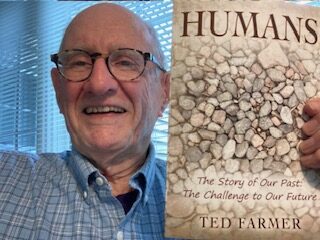
Ted Farmer
Alma maters: BA (history and philosophy), Stanford University, 1957; MA (regional studies—East Asia), Harvard University, 1962; PhD (history and Far Eastern languages), Harvard University, 1968
Fields of interest: modern Chinese philosophy, Ming China, early modern world, global studies
Describe your career path. What led you to where you are today?
One year teaching at Yale; 1968–2010 at the University of Minnesota
How have your historical interests evolved across your career?
From modern China I was drawn into the comparison of Asian civilizations. Next came a focus on the early modern world. Then a turn to global studies and, after retiring, a turn to the study of humans as a species.
What projects are you currently working on?
I have just published Humans: The Story of Our Past; The Challenge to Our Future (2024). I am working on a sequel about the shortcomings of the post-World War II system in the face of the growing environmental crisis.
What is your favorite historical site to visit?
The Confucian Temple in Beijing. This is a modest site which contains stone stelae bearing the names of successful candidates in empire-wide civil service examinations over six centuries.
What’s the most fascinating thing you’ve ever found at the archives or while doing research?
A collection of Ming Dynasty local gazetteers in an archive in Ningbo, China. These maps and accompanying text document the tensions between an imperial regime recording its territorial holdings and local elites seeking to immortalize their own accomplishments.
Who in your life served as a teacher or mentor and influenced your understanding of history?
Arthur F. Wright fostered my interest in China at Stanford and later at Yale. John K. Fairbank was a charismatic historian at Harvard, a model exemplar of our profession and a president of the AHA.
What do you value most about the history discipline and community?
The open and ongoing search for a better understanding of the past and the joy of participating in an open-ended, international profession.
Do you have a favorite experience with the AHA?
In 1968, in his presidential address to the AHA convention, John K. Fairbank, with a twinkle in his eye, spoke a few words of Chinese to the assembly, noting that it was a historical first.
AHA members are involved in all fields of history, with wide-ranging specializations, interests, and areas of employment. To recognize our talented and eclectic membership, Perspectives Daily features a regular AHA Member Spotlight series.
This work is licensed under a Creative Commons Attribution-NonCommercial-NoDerivatives 4.0 International License. Attribution must provide author name, article title, Perspectives on History, date of publication, and a link to this page. This license applies only to the article, not to text or images used here by permission.