Jared Ross Hardesty is a professor of history at Western Washington University. He lives in Bellingham, Washington, and has been a member since 2006.
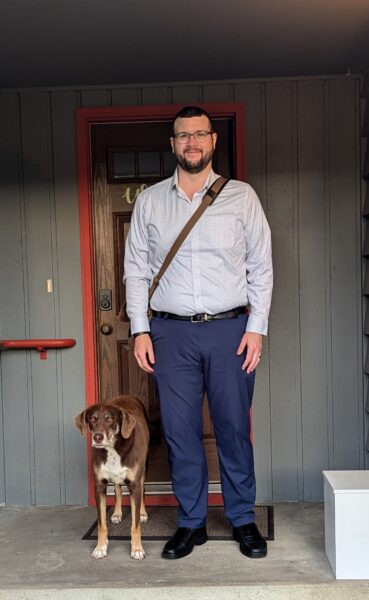
Jared Ross Hardesty
Alma maters: BA, Ohio Northern University, 2008; MA, Boston College, 2010; PhD, Boston College, 2014
Fields of interest: colonial America, Atlantic world, slavery, labor
Describe your career path. What led you to where you are today?
I grew up in a working-class family with a love of history. When I started taking college-level history courses in high school and learned that you can make a career out of being a historian, I knew that is exactly what I wanted to do and have never looked back.
What is your favorite historical site to visit?
While I love any site related to the colonial era, I would have to say my favorite historical site I’ve ever visited is San Antonio Missions National Historical Park.
What projects are you currently working on?
I am currently working on two book projects. The first, coming out of years of teaching courses on historical methodology using the Golden Age of Piracy (1716–26) as a focus, is a microhistory of notorious pirate Thomas Anstis and his final months at sea before being murdered in a mutiny. The second, connected to my larger research agenda, is a history of absentee plantation ownership in early New England. I have found dozens of wealthy New England families who owned plantations in the West Indies and American South between 1630 and the American Civil War.
How have your historical interests evolved across your career?
My early research focused on slavery in colonial New England. Since then, I have broadened the scope of my work significantly. While I have always engaged with the slavery scholarship beyond New England, I have increasingly found myself interested in the region’s place and role in the wider world of enslavement. That research has taken me far away from Boston to the slave societies of the Caribbean, including Dutch and Danish colonies. It has also revealed all sorts of fascinating connections and yielded important insights that I believe change how we understand both early New England and slavery more broadly.
What’s the most fascinating thing you’ve ever found at the archives or while doing research?
Perhaps this is recency bias, but working on the pirate project, I found that Anstis and his crew signed a petition asking for a pardon as a round-robin. To see a document signed like that is visually striking and raises all sorts of questions about why the sailors decided to sign it in that way. In a sense, the form of the petition offers tantalizing clues about relations on board the pirate ship, potential hierarchies and relationships, and negotiations between more willing pirates and those they forced aboard their ship.
Who in your life served as a teacher or mentor and influenced your understanding of history?
Honestly, so many people, although I was lucky to have an excellent undergraduate mentor, Robert Waters at Ohio Northern University. Rob really showed me the ropes of how the profession works—and may have taught me a thing or two about writing as well. Most significantly, I learned that sound historical arguments can only come from deep engagement with the sources (he loves quoting Robert Caro’s “turn every page”) even when they challenge your own (and other’s) beliefs.
What do you value most about the history discipline and community?
In terms of disciplinary values, I will quote my undergraduate professor John Phillip Lomax in saying that history teaches us to ask, “How do you (or I) know that?” It is such a simple, yet powerful question. Having an entire community committed to answering that question really does make the discipline feel special—or at least uniquely positioned to evaluate claims of truth and knowledge.
Do you have a favorite experience with the AHA?
I’ve attended almost every AHA annual meeting since 2011. There are a lot of great memories and experiences. My favorite, every year, however, is the book exhibit. To see all the new books on exhibit, have the opportunity to talk to editors and press staff, and run into old friends while perusing is just such an incredible experience. A couple years ago, I arrived at the exhibit a few minutes before it opened on the first day and there was a crowd of people waiting to enter—like Black Friday for historians! As a millennial, I have come to think of it as the Scholastic Book Fair for history nerds.
If you have served on the AHA Council, a committee, or an AHR advisory board, what has been your favorite part of that experience?
I just finished serving a three-year term on the Beveridge Family Research Grants in Western Hemisphere History committee. I really enjoyed reading the applications and learning about all the wonderful new scholarship, often by young, up-and-coming historians.
AHA members are involved in all fields of history, with wide-ranging specializations, interests, and areas of employment. To recognize our talented and eclectic membership, Perspectives Daily features a regular AHA Member Spotlight series.
This work is licensed under a Creative Commons Attribution-NonCommercial-NoDerivatives 4.0 International License. Attribution must provide author name, article title, Perspectives on History, date of publication, and a link to this page. This license applies only to the article, not to text or images used here by permission.