
That is the question raised by the latest figures for doctoral degrees awarded in history. According to the National Research Council, there were 616 history doctorate recipients in 1982-83 and 1983-84. This is the first time since 1973-74 there has not been an annual decline in doctorate production (National Research Council, Summary Reports, 1966-83: Doctorate Recipients from United States Universities; see, Perspectives, November 1984).
Is this the bottoming out of a trend, or merely a temporary interlude? The pool of new graduate students traditionally comes from the baccalaureate population in history, which, according to the National Center for Education Statistics, continues to drop. The most recent figures available (1982-83) demonstrate a continuing decrease in the number of bachelor degrees awarded in history, from 17,146 in 1981-82 to 16,465 in 1982-83. The same is true of two other humanities fields, “English and literature” (from 24,963 to 24,055) and “foreign languages” (from 9,841 to 9,685), although in both cases the relative decrease was smaller than history (a 4 percent decrease in history, compared with 3.5 percent in English and literature and 2 percent in foreign languages (National Center for Education Statistics, Digest of Education Statistics [annual]).
Is this the bottoming out of a trend or merely a temporary interlude?
Obviously no real conclusion can be drawn from the fact that the number of doctorates in history remained steady over the past two academic years. However, compared with the peak year of 1973-74 (when 1,186 doctorates were granted), that figure is still small. Because of this, it is possible that many history doctorates will find employment in academic history departments (one measure of academic opportunities in history—the AHA’s Employment Information Bulletin— advertised 334 openings for which PhDs were eligible be tween September 1984 and May-June 1985: see Perspectives, December 1985), but a substantial proportion will find either academic employment in a field other than history or nonacademic employment.
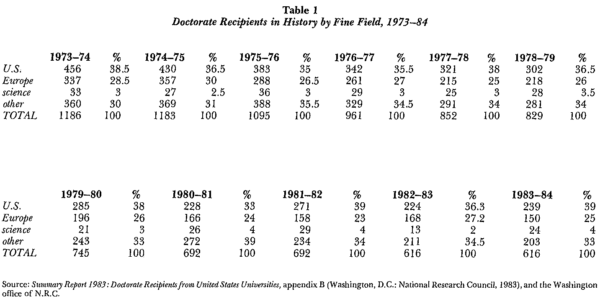
Despite a decrease of 48 percent in the number of history doctorates over the past decade, the distribution of students by field of specialization has remained constant (see Table 1). Since 1973-74, US and European topics have accounted for more than 60 percent of all dissertations completed with the exception of 1980-81 (when the figure was 57 percent). US history alone generally embraces well over a third of the total, as does the broad category of “other” (defined as all dissertations dealing with a geographical area not including or limited to the US and Europe—but including the USSR and Canada—and excluding the history of science).
The implications of these studies are riddled with paradoxes. Taken as a whole, however, they do demonstrate that the pursuit of a degree in history has become markedly less popular in the United States than it was a decade ago. In spite of this, intradepartmental special interests appear to be holding their own in relative terms despite declining enrollments; but before such a conclusion can be confirmed or refuted, a detailed breakdown of the “other” category and a study of the specializations of undergraduate history majors are needed.
For more information, contact the Doctorate Records Project, National Research Council-JH 634, 2101 Constitution Ave. NW, Washington, DC 20418 (doctorates), or the National Council for Education Statistics, Department of Education, 1200 19th St., NW, Washington, DC 20208-1402 (baccalaureates).