Sir Walter Scott, who knew a thing or two about myth and meaning, once observed that “a lawyer without history or literature is a mechanic, a mere working mason; if he possesses some knowledge of these, he may venture to call himself an architect.” You can find that line mid-novel in Guy Mannering, just one of many remarks tossed off by fictional barrister Paul Pleydell, whose office shelves lean more toward Tacitus than torts.
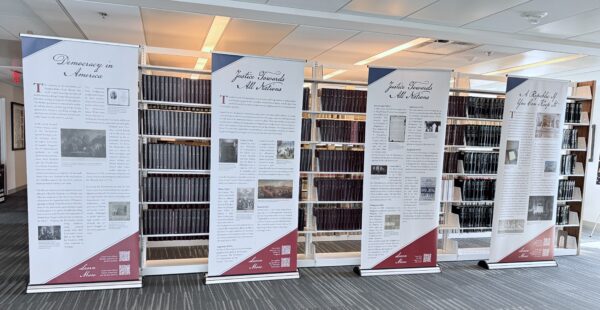
The traveling exhibit 250 Years of Independence stopped at the Pence Law Library at American University in September 2025. Anna Snyder
Now, with the United States commemorating the 250th anniversary of independence, Scott’s line echoes amid renewed debates about memory, meaning, and national identity. The lawyer as mason. The lawyer as architect. Across the country, exhibitions, events, and conversations will shape how Americans remember 1776. Yet as these efforts unfold on parallel, uneven tracks across history and related fields, one group central to the Revolution is curiously often omitted: lawyers.
It’s an odd omission. In the revolutionary era, lawyers weren’t background characters. They were among the most public actors in the revolutionary crisis, drafting manifestos and constitutions, translating protest into legal argument, and helping to frame the break with Britain in terms grounded not just in Enlightenment theory but in British common law.
Over the past 250 years, lawyers have continued to be involved with debates of historical consequence—through court decisions that reinterpret foundational principles, legal scholarship that challenges or defends prevailing doctrines, and advocacy that pushes the boundaries of constitutional meaning, among other forms of engagement. From abolition to civil rights, from women’s suffrage to debates over executive power, lawyers have been both agents of change and defenders of the status quo.
Their work has shaped the legal frameworks through which societal shifts became lasting reforms, complementing the efforts of historians in preserving, interpreting, and sometimes challenging national narratives. While lawyers often operate through statutes, cases, and institutions, historians engage the broader currents of memory and meaning, helping society understand not just what happened but why it mattered and for whom. They illuminate the context behind legal change, recover overlooked voices, and question inherited myths, ensuring that the past remains a subject of inquiry rather than reverence. Together, these two professions have helped shape the evolving story of American democracy—sometimes in tandem, sometimes in tension, but always in dialogue.
Together, these two professions have helped shape the evolving story of American democracy.
And yet, in many public commemorations, law often remains background noise. Courtrooms may be reconstructed, and facsimiles of founding documents like the Constitution or the Declaration of Independence may make cameo appearances, but these often serve as static props. Likewise, the law and legal profession tend to be treated as backdrops: a passive setting for dramatic political events or moral movements, rather than a dynamic force in shaping the very terms and possibilities of those events.
The legal ideas of the founding—about federalism, rights, representation, or sovereignty—remain ongoing, unfinished arguments that still animate American life today. Lawyers played critical roles in political and social history, helping to reshape the very structures of government and justice that characterize the founding and give it lasting significance and influencing public life as much as politicians, generals, or
Lawyers, bar associations, and courts have begun marking the 250th anniversary, but largely within professional circles and outside the national spotlight. Across the country, legal institutions are using this moment to connect founding ideals with contemporary legal practice, extending their broader commitment to public understanding and the rule of law. These efforts often include traditional continuing legal education programs as well as educational outreach, public dialogue, and professional reflection, serving as tools through which the legal community engages with the democratic project.
For example, the American Bar Association has launched a yearlong campaign and a two-year traveling exhibit to mark the signing of the Declaration of Independence. Led by a planning committee composed of distinguished lawyers from each of the original 13 colonies, the campaign will include a broad array of programming aimed at exploring how the Declaration’s core commitments continue to shape legal thinking and democratic life today. The exhibit, 250 Years of Independence: Fortifying America’s Commitment to Democracy for All, frames the anniversary as an opportunity to explore the evolving meaning of independence and the essential role of law in securing it. It brings the story of independence and the law directly into everyday legal environments, such as courthouses, large law firms, and public law libraries from Florida to California.
State and local efforts echo this approach, often blending public education with civic engagement. In Indiana, the Court of Appeals of Indiana and the Indiana Historical Society have partnered to bring Appeals on Wheels, an innovative traveling oral argument exhibit, to high schools, colleges, law schools, and other community settings across the state. Meanwhile, the New Jersey State Bar Foundation has produced an expansive set of free educational resources under the title 250th Anniversary of American Independence—Free Materials for the Semiquincentennial (or for civics anytime), a flexible tool kit that serves as a model for civics instruction and a reminder that the work of democracy begins with legal literacy.
Other organizations are using the anniversary to invite innovation and reflection within the profession. The American Inns of Court launched a contest encouraging local chapters to design events or projects that highlight the legal dimensions of the founding era. And in Virginia, a collaborative symposium hosted over the course of 2025 and 2026 by the Virginia Law Foundation and the Virginia Bar Association, The Legal Revolution, is exploring the nation’s founding documents and founding fathers as lawyers and leaders.
While these initiatives provide valuable platforms for reflection and education, they often remain contained within the legal community, operating through bar association websites, court educational programs, and professional forums. As a result, they tend to be siloed from the broader, more public-facing commemorations that engage diverse audiences across the country. This separation limits opportunities for the public to appreciate how lawyers and legal ideas have actively shaped the nation’s founding and its ongoing evolution.
This parallel development isn’t unique to lawyers, but it does reflect how the legal profession has, over time, carved out its own intellectual and institutional pathways, often adjacent to, but distinct from, the broader currents of historical scholarship and public memory. Like historians, lawyers are trained to interpret texts, weigh precedent, and construct narratives grounded in evidence and argument. Yet legal discourse has often remained inward facing, oriented toward courts, clients, and codes rather than public audiences or historical interpretation. In many ways, the legal profession’s deep investment in its own methods and language has created a kind of civic insulation.
As a result, law is too often left out of the public’s understanding of the founding—not just as a technical field, but as a language of revolution, reform, and resistance. This separation misses an opportunity: to place legal thinking alongside historical storytelling in shaping how Americans understand their past and envision their future. Reuniting these conversations could help bridge that divide and make the 250th not just an anniversary but a moment of civic renewal.
The legal profession has carved out its own intellectual and institutional pathways, often adjacent to, but distinct from, historical scholarship and public memory.
There’s an opportunity here: for lawyers and legal institutions to partner with public historians to tell a richer, more grounded story about the American founding, one that centers legal argument as a revolutionary act—as in the cases of Elizabeth Freeman and Quock Walker, cases that collectively dismantled the legal foundations for slavery in 1780s Massachusetts. What did justice mean in 1776? Who was included in the constitutional order, and who was left out? How did legal ideas about rights, sovereignty, and citizenship evolve? And what can practicing lawyers and the legal field learn from this today?
Answering these questions requires lawyers to participate in a larger civic narrative. Historians bring context and critique and connect scholarship to communities, and lawyers translate principles into practice. Together, they have an opportunity to shape a fuller, more engaged national conversation about the meaning and legacy of the founding. In recent years, collaborations between lawyers and historians have become increasingly important, as major advocacy organizations recognize the value of historical insight in legal strategy and public discourse. The AHA itself has filed amicus briefs, including for the recent Harvard University v. Department of Homeland Security case over foreign scholars and students. Partnerships like the Brennan Center’s Historians Council on the Constitution demonstrate how professional historians contribute to amicus briefs and legal debates, enriching arguments with nuanced historical perspectives. These collaborations underscore the vital role that interdisciplinary dialogue plays in deepening our understanding of law and history and in ensuring that legal interpretations remain connected to the broader narratives that shape our democracy.
Nothing about the American experiment was inevitable. The founding was not a foregone conclusion, nor were its principles universally agreed on or uniformly applied. Every milestone in American legal history has been shaped by the choices of individual people: lawyers who argued cases that pushed the boundaries of constitutional meaning, judges who rendered decisions that redirected the course of justice, and citizens who insisted, often at great cost, that the promises of the law be made real. Legal change has never been automatic; it has required interpretation, imagination, and courage. By treating history not as a sequence of settled outcomes but as a record of contested decisions and human choices, we begin to see the law as a living tool that can be used to defend power or to challenge it, to preserve exclusion or to expand democracy.
In that sense, the 250th anniversary is not just a time to look back but an invitation to recognize the responsibility we all share—in courtrooms, classrooms, and communities—to continue shaping the meaning of independence. At its best, legal history doesn’t simply explain how the past unfolded. Instead, it opens up conversation about how laws shape our lives and reflect our evolving values. Maybe that’s what Sir Walter Scott was after when he drew the line between a mechanic and an architect. The lawyer as mechanic follows rules. The lawyer as architect understands their origins and how they might be rebuilt time and time again.
In 2026, the legal community has an opportunity to join historians, educators, and cultural institutions in reexamining its legacy, placing law back at the heart of the founding story—not as a backdrop but as an active, evolving force in shaping civic life.
Anna Snyder is the staff director of the American Bar Association’s Standing Committee on the Law Library of Congress.
This work is licensed under a Creative Commons Attribution-NonCommercial-NoDerivatives 4.0 International License. Attribution must provide author name, article title, Perspectives on History, date of publication, and a link to this page. This license applies only to the article, not to text or images used here by permission.