The exigencies of printers’ deadlines demand that members read news in these columns that is at least four weeks and up to eight weeks old. A case in point—The fall brings with it important meetings of all three divisional committees of the Association: Research, Teaching, and Professional. All take place in October, but only the Research Division meets early enough in the month to squeak under the deadline for this issue. A brief report of its meeting will follow at the end of this column, but Teaching and Professional Division Committee meetings cannot be reported until the next issue.
In mid-September the editor of the Association’s projected new edition of the Guide to Historical Literature, John Higham, John Martin Vincent Professor of History at the Johns Hopkins University, spent September 17– 19 in intensive meetings to launch that endeavor. The first day’s session was devoted to discussions with representatives of Oxford University Press and Personal Bibliographic Software Inc. to ensure that the publisher, the editor, and the software supplier are all on the same wavelength regarding design, capabilities, and performance.
The two following days brought together the twelve-person Board of Editors for an intensive weighing of the considerations that will shape the content of this great undertaking. Rough agreement was reached on fifty-five different sections into which the totality of human history will be divided in order to skim off the cream of bibliographic nourishment in each area for inclusion in the planned two-volume, third edition.
Oxford University Press representatives were present and shared fully in the enthusiasm and optimism of the editorial board. Each section will be limited to 650 entries, selected by section editors, still to be chosen, and in consultation with contributors expert in each field, working under the section editor’s leadership and under the aegis of the general and associate editors and the editorial board.
It is hoped that our fund-raising will progress to the point that all will be operational by next summer. We project completion of the project in the early part of 1994.
September 1987 was also the apogee of observances of the bicentennial of the US Constitution. On September 16 on the Mall in Washington and on the steps of the West Front of the Capitol, an enormous celebration was held in the presence of the President, of ex-Chief Justice Burger, who chairs the Federal Bicentennial Commission and who has been helpful to our own Project ’87, and of over 100,000 observers. The following day in Philadelphia the 200th anniversary of the signing was celebrated, which was also Chief Justice Burger’s eightieth birthday.
A reception in Washington earlier in the week marked the opening of an eighty-seven hour watch in the the Rotunda of the National Archives, during which all four pages of the Constitution were on display around the clock. It was both moving and impressive to see how many of our fellow citizens trooped through the building at all hours of the succeeding nights; tourists, taxi-drivers, local citizens, night owls, and awed visitors gave proof through the nights that our patriotism is still there. And on the second weekend of October, after this issue has been put to bed by the printer, a major Project ’87 conference is being held in Williamsburg on “Mr. Madison’s Constitution and the Twenty-First Century.” This final Project ’87 undertaking is supported by the CSX Corporation and the Virginia Commission on the Bicentennial of the US Constitution.
September was also a good month for other ceremonies of interest and importance to historians. On September 14, James H. Billington took the oath of office as Librarian of Congress, administered by the Chief Justice and in the presence of the President and Mrs. Reagan and a distinguished group of guests. Historians have reason to be proud that an eminent historian of Russian history and culture has been chosen to succeed another distinguished historian, Librarian of Congress Emeritus Dr. Daniel Boorstin.
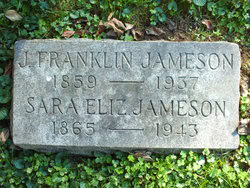
Grave site of J. Franklin Jameson in Washington, DC.
On the 28th of the month, at the National Archives and Records Administration building, a ceremony was held to mark the fiftieth anniversary of the death of one of the AHA’s early great leaders, John Franklin Jameson. Professor John Higham gave an appreciation of the work of Jameson, and Drs. Morey Rothberg and Jacqueline Goggin gave a talk and slide presentation on the Jameson papers, which they are editing under the joint auspices of the Archives, the Library of Congress, and the AHA. In the early afternoon a group visited the cemetery in Georgetown to lay a spray of flowers on the grave of Dr. Jameson, who in addition to his many other works, also held the first PhD in history granted in the United States.
A major conference of Latin American historians, archivists, and librarians was held under the auspices of the Library of Congress and the AHA. Endorsed by the Christopher Columbus Quincentenary Jubilee Commission, this conference was made possible by funding and active professional support from the National Endowment for the Humanities. Details will be reported in detail in the next issue of Perspectives, but we should note here that the meeting was very successful. Opening remarks by our former president, William H. McNeill, wearing his hat as vice chairman of the Columbus Quincentenary Commission, and by Lynne Cheney, chairman of the NEH, set the tone for a hard-working two and a half days of meetings on the “Archives and Records for Studying the Hispanic Experience in the US 1492–1850.”
Another enterprise in which the Association is active is the proposed National Commission for the Social Studies, on which our former president, Arthur S. Link, serves as one of the leaders and organizers. We are informed by the National Council for the Social Studies, one of the principal sponsors of the Commission, that funding of $20,000 has been obtained from the Rockefeller Foundation and the National Geographic Society, with strong prospects of larger funding over the next three years. The Commission is to focus, among other subjects, on the history curriculum in the schools.
The Research Division Committee met the first weekend in October to receive status reports on many activities and to consider several changes in Association policies, pending review by the Council later this year. It revised the guidelines for program committees that plan our annual meetings by clarifying the responsibilities of those committees and identifying certain prescriptive session opportunities to be organized by AHA standing committees.
The Research Division codified guidelines for periodic performance re views of the American Historical Review editors, and endorsed to the Council nominations by the current editor of the Review, Professor David Ransel, to fill vacancies on its Board of Editors. It decided to recommend to the Council that the Association withhold further support for a proposed Documentary Heritage Trust until its plans and objectives are better defined. The Division Committee also approved a proposal for a long-range planning study for the Association, which is being considered by all three divisional committees, and made certain suggestions to the Council on how a study might be conducted.
The Research Division decided how to manage the new, small research grants for projects in Asian, African, and European history, named after Bernadotte Schmitt, our former president. His generous bequest enables us to provide eastern hemisphere coverage parallel to our existing small grants program for American and Latin American history. Initially the Schmitt grants will be considered in the same cycle as the older Beveridge, Littleton-Griswold, and Kraus grants and awards made by the Committee at its spring meeting.