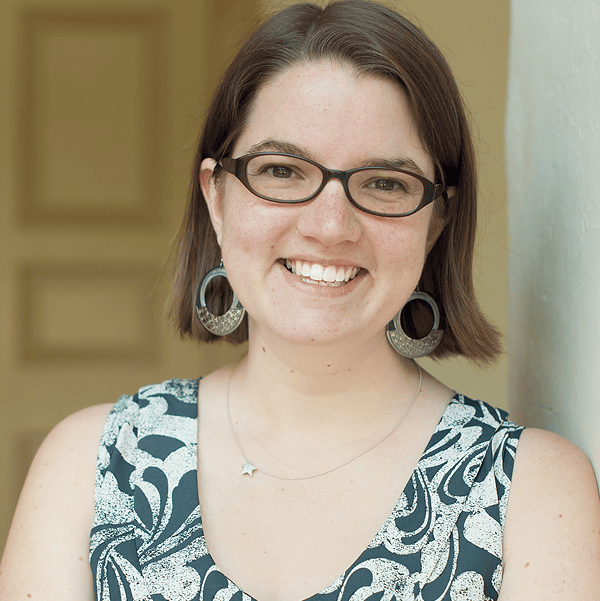
The AHA welcomes Suzanne Marchand (Louisiana State Univ.) as president of the AHA during the 139th annual meeting.
A second-generation historian, Marchand earned her BA from the University of California, Berkeley, and her MA and PhD from the University of Chicago. She specializes in intellectual history and modern central European history, but her interests range widely, from the afterlife of the classical world and the history of the humanities to business history and material culture.
Marchand is the author of three books: Down from Olympus: Archaeology and Philhellenism in Germany, 1750–1970 (Princeton Univ. Press, 1996), German Orientalism in the Age of Empire: Religion, Race, and Scholarship (Cambridge Univ. Press, 2009), and Porcelain: A History from the Heart of Europe (Princeton Univ. Press, 2020). She has just completed a manuscript about Herodotus’s influence on Western thought, covering 1500 to the present. A dedicated teacher of both undergraduate and graduate students, she has co-authored two textbooks on European and world history.
Perspectives spoke to Marchand about her wide-ranging historical interests, the classes she loves to teach, and her goals as AHA president.
How did you first become interested in history?
This is a little hard to answer, as my father was a historian, and he always wanted my sister and me to love all the things he loved (which included not only US history but also music, theater, baseball, and gardening). I remember going to Williamsburg, Salem, and Sturbridge when I was about six years old, and loving the experience of time travel. But as is the case for so many of us, it was middle and high school teachers who inspired me to deepen my studies: Mr. Winters, Ms. Kendall, and Ms. Richardson, I owe you so much! Then in college at UC Berkeley I learned that I could be an “intellectual historian,” which meant that I could be a historian, but also study and teach art, literature, philosophy, social theory, and (a little) music; how amazing was that?
You are a second-generation historian. What did your father think of you joining the discipline?
My father, Charles Roland Marchand, was a historian of 20th-century US history, and the most curious person I have ever known. I know he was proud of me for pursuing European history, but he was equally proud of my sister, who has devoted her career to classics. We have both been lucky enough to achieve what he would have said was the greatest goal: to be permitted to live the life of the mind and especially the opportunity to pass on our fascinations to the next generation. In fact, although he loved his research, my father was proudest not of his books but of his many, many students, and the most satisfying years of his career were those after he joined the California History Project and began to work with K–12 teachers. He died in 1997, but I am sure that he would have wanted me, as AHA president, most of all to emphasize our duty to the next generations, and to celebrate the profound and transformative power of teachers.
Your work spans a number of fields—modern Germany, material culture, and most recently ancient history’s connections to the modern world. Do you see a through line that connects these disparate topics across your career?
I have a long-standing interest in the afterlives of the ancient world, whether classical or Near Eastern; I am convinced that we modern historians do not pay sufficient attention to how greatly indebted we are to these legacies. This, and my training as a University of Chicago graduate student in the history of the disciplines, explains much of my interest in the histories of archaeology, philology, art, and museums. In a way, my work on the history of the central European porcelain industry also stemmed from these interests, as it occurred to me, after a visit to the Silberkammer Museum in Vienna, that I might be able to count manufactories’ design formats (classical or “oriental”?), and in that way better grasp popular affinities for the ancient past. When that turned out to be impossible, I decided that the business history of the industry was a fascinating way to tell an alternative history of modern German culture. The economic and social history I had to learn in the process, and the many provincial museums I visited, gave me a new “materialist” outlook on the past. Now I integrate into my teaching questions such as, How did the people of the past make, buy, and use the objects of daily life?
I am convinced that we modern historians do not pay sufficient attention to how greatly indebted we are to the ancient world.
My most recent manuscript, on Herodotus’s largely unmapped but massive impact on the history of modern scholarship, in a way brings together my work on classical and Near Eastern reception histories, as the “Father of History” aimed to bring together both the history of the Greeks and the history of the “barbarians.” But I hope to extend my material culture and business history interests in whatever comes next.
In your research, what have been your coolest finds?
While writing the porcelain book, I had a terrible time finding images of people actually using porcelain. Museums preserve objects of artistic value, but only exceptionally do they describe how everyday objects were used. So I was thrilled to find in a descendant’s book a photo of the Jewish German von Klemperer family in about 1911, seated before an elaborate wall display of their priceless collection of Meissen porcelain. Confiscated by the Nazis, the collection was lost from sight until part of it was discovered in 1991 and donated to the Dresden Museums.
But the object I love best is this porcelain figurine, made by the Frankenthal Porcelain Manufactory in about 1773. It depicts the barbarian queen Tomyris watching the severed head of the Persian King Cyrus being dipped in a vat of blood. The figurine was modeled after a painting by Rubens; and it showed me three things: (1) Luxury-buying audiences of the 18th century knew this Herodotean story well, (2) the medium of the porcelain figurine renders most scenes a little bit silly, and (3) occasionally my otherwise totally disparate interests actually do intersect!
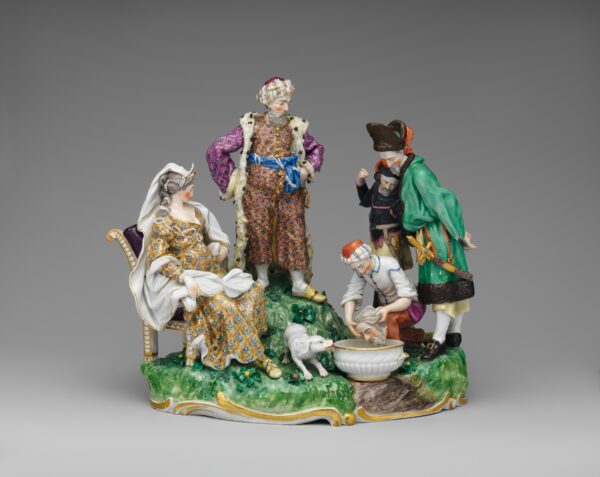
Objects such as this 18th-century figurine, Tomyris with the Head of Cyrus, provide Suzanne Marchand with evidence of the modern world’s fascination with stories drawn from the ancient Greek historian Herodotus’s Histories. Metropolitan Museum of Art, The Jack and Belle Linsky Collection, 1982/public domain
You’ve taught at two different types of institutions in Princeton University and Louisiana State University. What have you learned teaching there that you might not have experienced elsewhere?
Fortune first landed me at Princeton in 1992, where I was privileged to belong to the world’s best research faculty in European history. My colleagues were also devoted to teaching, and I had the opportunity to teach fantastic students in a broad range of courses, many of them in the seminar format I prefer. When I moved to LSU in 1999, I began teaching larger lecture courses, and I encountered a broader range of student abilities: Here, some are exceptionally talented and hardworking, but need encouragement and inspiration; others need assistance in more basic skills such as note-taking, critical reading, and writing. LSU students typically have more and different challenges: Most are working, some upwards of 40 hours a week, in addition to taking courses. Some are veterans, some single moms. Our campus has a strong African American student body (approximately 20 percent) and many first-generation students. All these students need our dedication and care, and in teaching and mentoring students of all kinds, I hope I have done my part. I have loved it all—Princeton was wonderful, formative, unforgettable. But I do feel that I make a bigger difference at LSU.
What are your favorite things to teach?
One of the things that was peculiar about my education is that I was trained as an intellectual historian rather than a German historian. So while my publications often focus on Germany and Austria, the kind of teaching I do is almost never restricted to Germany. In fact, this past fall semester I taught a course on Germany since 1871—for the first time ever!
Among the courses I teach at LSU, my favorite is a half-lecture, half-seminar course on 19th-century Russian and French literature in historical perspective. Russian authors ask big, cross-cultural questions that students love to grapple with: What is crime, and what is punishment? How do autocracy, poverty, and political fanaticism contort the human soul? French literature of this era offers unparalleled insights into class, gender, and generational relations. A lot of it is very funny or ironic, which balances the Russians’ existential intensity. The great novels from these traditions allow me to draw historical events as well as customs, local conditions, and even costumes into the conversation.
I also designed a new survey course for the sophomore or junior level on the history of the city in Europe. We visit a different city every session—Rome during the Catholic Reformation, London during the Civil War and Great Plague, Paris during the French Revolution, Ypres during World War I, Warsaw during World War II. The course is great fun to teach, because urban history is not event history. In each lecture, I provide a general history of the place, but we also talk about the built environment, walls, churches, prisons, sewage. It’s a great course to bring in nonhistory students, like engineering or city planning students.
What goals do you have for your term as AHA president?
It is not an easy time to step into this role. But I think my greatest goal as president is not to be paralyzed by outrage or cynicism, but to encourage us all to speak openly about how much we love teaching history—wherever and however we do it—and how vital honest, evidence-based history is to the maintenance of our democracy and to living rich lives.
I also want to celebrate the “big tent” that is the historical discipline, one that includes ancient, medieval, and early modern historians, historians of science, of business, of gender, of military affairs: All historians should feel welcome to present at our annual meeting, to serve on our committees, to publish their work in the pages of the American Historical Review. I would like us to work at the local, regional, and national levels on civic engagement and principled, history-focused advocacy, together with our many other partners.
All historians should feel welcome to present at our annual meeting, to serve on our committees, to publish their work in the pages of the American Historical Review.
Finally, I want to advertise the tireless, superlative, highly professional work the AHA staff performs every day. We owe them a great debt of gratitude for keeping the many-headed Hydra that is the AHA breathing fire and functioning at peak performance, day in and day out. No strong man is going to slay us.
Finally, we ask everyone, “What can’t you get enough of?” Any books, hobbies, or other pop culture that you’re turning to right now?
After years of never quite getting around to listening to podcasts, I have recently begun to listen to the BBC’s In Our Time series, Historically Thinking, and Literature and History. I especially enjoy interviews about subjects I know nothing about, and regularly find myself saying, “Wow! Why didn’t I know that!” At LSU, we have a terrific interdisciplinary reading group called Aristotle Update that is beginning to remedy my deficient knowledge of classical philosophy. Every semester, we do table readings of plays: I’m looking forward to our December meeting, when we read Tom Stoppard’s Rosencrantz and Guildenstern Are Dead. Finally, I can’t get enough of travel: The world’s wonders never cease to amaze me. My friend Molly Greene (professor of Ottoman history at Princeton) and I recently visited Sarajevo, Mostar, and Ljubljana—that was a trip of a lifetime!
This interview has been edited for length and clarity.
This work is licensed under a Creative Commons Attribution-NonCommercial-NoDerivatives 4.0 International License. Attribution must provide author name, article title, Perspectives on History, date of publication, and a link to this page. This license applies only to the article, not to text or images used here by permission.