
Some forty years ago, Wendell Willkie gave an impassioned plea for the creation of a true American “world outlook.” The university community of Texas has echoed this sentiment on numerous occasions, declaring that it wished to endow its charges with a “thorough understanding of their global neighbors” and make them “intellectually and emotionally at home in any street in this shrinking planet called Earth.” An examination of the actual situation show these high-blown aims to be little more than empty rhetoric.
In spite of the theoretical concern for internationally cognizant graduates, the Texas legislature, as early as 1954, became apprised of the “disturbing lack of knowledge and appreciation of the facts and significance” of even America’s civilization among the state’s collegians. The solution for this “imperative public necessity,” while providing an incomplete remedy for one ill, totally ignored a much more widespread one.
The knowledge of American history by Americans seems a sound idea if administered fairly across the board, and yet this has not been the case in Texas. In any institution of higher learning supported by state funds, a candidate for a baccalaureate must take six hours of American history. This requisite is reduced to three hours, however, if a student achieves a sufficiently high score on a nationally or locally administered Advanced Placement examination, substitutes a Texas history course, or is enrolled in a ROTC program. I disagree with all three of these exemptions, but I must take some satisfaction that Texas undergraduates are at least getting some idea of their national identity, if only in a sorely fragmented way.
The fate of history instruction in the state’s many private universities, though often different from the situation in state schools, also demands an earnest sense of reform. A fairly large number of these institutions follow the curriculum path of their state counterparts, but many have opted for a more general approach, which allows the student to choose courses from a broad spectrum of offerings in liberal arts and humanities.
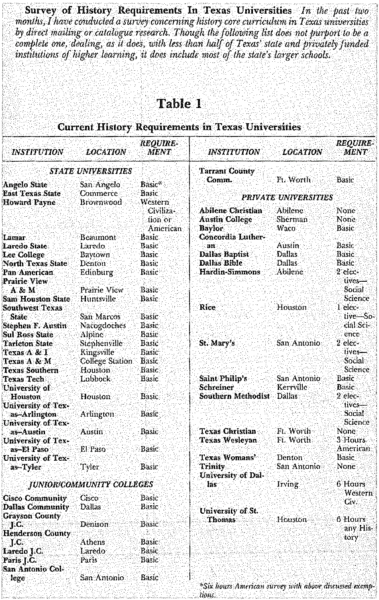
Western civilization is required at only a very few church-run universities. It seems safe to say that students in Texas’ private schools have a somewhat better chance of exposure to European history and culture than their counterparts in the state schools. I must take exception to the totally elective nature of the social science programs in these institutions on two counts.
My first objection is that the broad humanities agenda, often administered on an interdisciplinary basis, too easily devolves into an intellectually uncoordinated morass, in which even the most advanced student can get bogged down. My second grievance lies with the educational training of the incoming undergraduates, for whom these courses are generally designed. The majority of these students are the product of Texas’ huge secondary-school complex, which has recently been taken to task on seval counts, including academic preparation. I submit that such students are simply not ready for the “open” social science approach adopted by the larger private schools. Perhaps after a freshman year in which the historical basics have been dealt with in a totally traditional way, such an interdisciplinary mode could be a useful one, and the students themselves would have some qualifications to make intelligent decisions regarding electives.
Despite the shortcomings mentioned above, the principal problem with Texas university history instruction is that Bachelors’ degrees are routinely handed out without giving their recipients the slightest hint that a wide world with a varied set of cultures exists outside America. The problem is not a local one, as the findings of recent educational commissions show. By and large, the American undergraduate has become “more parochial at the very time the human agenda becomes more global”; the undergraduate “lacks historical perspective,” and possess few of the “shared values and knowledge that binds us together as a society.” It seems unthinkable that an apologia for the study of international civilization must be made in the midst of a period when technology is transcending borders and closing intellectual gaps between the various branches of homo sapiens.
In Texas, however, the need for such an appeal is critical. To the arguments of other Europeanists crying out in an indifferent American wilderness, namely, that the study of western civilization places the American student in a rational mainstream from which his or her thought world largely originates, and that such mental exercises can form a cornerstone in the building of international friendships, I must add my own reasons.
The need for internationally minded, American citizens has been reiterated time and again since the end of World War II. But this summons has been largely neglected on the American university scene. The Select Committee on Public Education, an investigative body appointed by Texas Governor Mark White in June of 1983, bears out this basic conclusion, and demonstrates that academic unpreparedness begins in the secondary schools of the Lone Star State. This phenomenon, too, is prevalent on a national scale. Evelyn Edson, a western civilization instructor in Virginia, in the February 1984 issue of Perspectives, page 17, paints a clear and all-too-typical picture of the almost complete ignorance of world history among the current crop of college freshmen.
When I have pointed out these facts to potentates in history departments throughout Texas, I received verbose replies of various tints that boil down to a simple “So what?” or “You see, it just wouldn’t sell.” To this illogical and manifestly shortsighted policy, I reply the following: Western civilization should always be an integral part of the college core curricula since it allows the undergraduate to enter society as a person with some idea of place in a cultural tradition unbroken for over six thousand years; it frees a person from total reliance on the media for the formation of a world view; it puts a person on equal footing with young people of other countries whose educators think the study of American culture is a very important part of a general intellectual training; it enhances career success possibilities, especially in the realm of international commerce; it broadens the experience of American travelers, who are now venturing overseas in record numbers and, more importantly, it teaches a person to activate the complex thinking apparatus between the ears by gathering relevant facts and abstracting logical syntheses from them. Western civilization is crucial for all college students. It applies as aptly to liberal arts majors and the growing number of students matriculated in international programs as it does to the droves pursuing a data processing or electronics degree.
Within the past few weeks, a massive academic commission has announced its findings to the nation. Among these recommendations was the readjustment of the college curriculum to put it in line with the “clear expectations” for a wide scale improvement of education standards. My suggestions for changes in the history requirements of Texas universities are in complete agreement with these national aims.
In regard to American history instruction as it is currently practiced in Texas, modifications are very definitely needed. The present system, like our internal revenue network, is merely too riddled with exemptions to be fairly carried out. To remedy this situation, I suggest each college student in Texas be required to take the basic American survey in its classic six-hour form.
A mix-and-match approach, involving three hours of American history and three of Texas history, is not a satisfactory answer. It can do nothing but disrupt the unity of the former by breaking up a course designed to be taken in two parts and duplicate the latter by offering material already required in almost every secondary school system in the state.
Indeed, the ROTC program may afford its participants some tangential knowledge of America’s past, albeit from a military point of view, but I fail to see how this training can be substituted for half of the American history requirement, and recommend that this loophole be closed.
The only exemption that I approve of is the Advanced Placement examination, but I would even like alterations made in this instrument. Rather than following a piecemeal method of Advanced Placement, I would like to see the test refer to the subject matter of the entire American survey. If a student exceeds a certain grade, let the American history requirement be fulfilled; if not, let the student be liable to take all six hours of the course. With the implementation of these changes, American history would be elevated from its present role as a disorganized, minor core requisite to its former place of importance within the college curriculum.
The reconstruction of a strong American history requirement demands one at least as powerful in western civilization. I propose for this subject an instructional schema identical to that of American history—a two-part course constituting six hours of credit that all candidates for the baccalaureate would have to take, unless the responsibility was discharged by the passing of an Advanced Placement examination.
By removing the history of the “third world” from this system, I could clearly be accused of ethnocentrism, but such is not my intention. As Edson has shown, a history course that tries to squeeze the study of all world civilization into twenty-eight weeks can seldom be more than a sterile exercise in name, date, and event listing. On the other hand, the western civilization approach leads the American collegian back to his or her intellectual and political roots.
Any attempt to place a world history course in the Texas university core curriculum would simply exceed the edtional infrastructure of most of the state’s schools. On the other hand, western civilization is taught at almost every college and university in the state. The slighting of a large portion of the world’s cultures in our higher educational system, however, can hardly be tolerated, but I call for a solution from one more qualified than I to give it. Until such a proposal is forthcoming, I submit that the increasingly popular humanities courses could be utilized to insert an awareness of the various phases of “third world” culture into the minds of Texas students.
The plan I have just outlined is essential for the improvement of Texas higher education, and falls in line with recent demands among the national academic community for the restoration of the liberal arts to their past place of eminence on the university scene. Moreover, these changes could be effected with a moderate amount of reshuffling and expense. Critics of the program will undoubtedly point to the added administrative costs and those incurred by the hiring of new instructors. Students will complain that their work load will be increased. To all of this, I reply, “which is more expensive, the immediate dollars and effort involved or the long-term costs of a college population blatantly uninformed of its own national traditions and those of the world in which it has been granted citizenship?”
Donald Joseph Kagay, of Dallas, Texas, received his PhD in 1981 from Fordham University, pursuing the study of early parliaments in the Crown of Aragon as his dissertation subject. Though currently self-employed outside of the academic world, he still serves as a consulting historian in Dallas, Texas with very strong archival connections to the various documental depositories of eastern and central Spain.