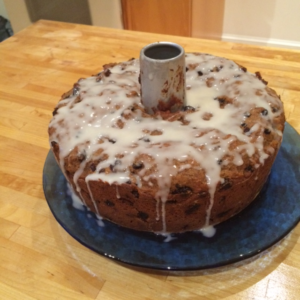
Election Cake prepared by Amanda Moniz
Dedicated historians that we are, we at the American Historical Association decided to sample an election cake as part of the #MakeAmericaCakeAgain campaign. I volunteered to make the cake using the OWL Bakery’s recipe and decided to use this project as an opportunity to explore the history of voting with my kindergarten-age daughter.
After making a few changes to the recipe, my daughter and I prepared the dough and left it to proof (rise). While the dough proofed, we took a family outing to the National Park Service’s National Colonial Farm at Piscataway Park in Accokeek, Maryland. The tobacco farm depicts the lives of a middling white family, the Boltons, in 1770. As we had mixed ingredients at home, I had talked with my daughter about the history of baking and the history of voting. The farm buildings and the very fine interpreters added to our exploration of both topics.
Poking around the buildings, we paid special attention to the kitchen. The dark space and the hearth were, of course, very different from our kitchen. Most notably, we learned that the family owned one slave, a woman named Kate, and that she had slept on a platform in the kitchen. Showing my daughter Kate’s sleeping space offered, I thought, a more effective way to convey the cruelty of slavery to a young child than my words could.
We talked with the interpreter playing Mr. Bolton about the family’s livelihood and about politics. He explained that he owned his land and therefore he had the vote. But he also explained that his crop hadn’t been good that year, which led to a more general discussion of the economy. We heard that because tobacco depletes soil so rapidly, rich landowners were buying up more land in the area. As a result, fewer men were becoming landowners and, in turn, the franchise was becoming more restricted.
Back at home, we baked the cake and, once it cooled, glazed it. Finally, time to taste! The aroma evoked bread, but the texture was cakey, which was what I expected, and the spicing was terrific. It was less sweet, though, than I thought it would be, even with the glaze. To my taste, it would go well with a morning cup of coffee.
So what about the history lesson? I asked my daughter what she thought people should know about the history of voting around the time of the American Revolution and about the cake. Her answers: You could only vote if you owned property. And definitely glaze the cake.
Election Cake
Adapted by Amanda Moniz from the OWL Bakery’s recipe based on Amelia Simmons’s recipe in American Cookery (1796)
Day 1 (Prepare Preferment)
Using Instant Yeast:
275 ml milk ~70º F (warm very slightly in a pot)
1/4 tsp instant yeast
2 1/4 cups plus 2 Tbsp All Purpose or whole wheat pastry flour
Combine milk and yeast and mix thoroughly until starter or yeast is well dispersed in the milk mixture. (I used my fingers to break up clumps of yeast.) Add flour and mix vigorously until the starter is consistent and smooth. Scrape the sides of your bowl and cover with a damp towel or plastic wrap. Allow your starter to ferment for 8-12 hours at room temperature. When ready to use, your preferment will have bubbles covering the surface.
Soak Dried Fruits
2 cups currants and raisins
3 TBS rum
Warm over low heat for a few minutes, remove from the heat, and allow to soak, covered, overnight or for several hours.
Day 2 (Prepare Final Dough, Proof, and Bake)
1 cup unsalted butter
3/4 cup sugar
2 eggs
1/3 cup whole-milk yogurt
1/4 cup molasses
Preferment
2 1/4 cups All Purpose or whole wheat pastry flour
2 Tbsp spice blend (I used 1 TBS cinnamon, 1 tsp nutmeg, 1 tsp mace, 1 tsp cloves)
1/4 tsp ground coriander
1/4 tsp ground black pepper
2 tsp salt
2 Tbsp rum or another 2 cups rehydrated fruit
With a paddle attachment in a stand mixer, cream the butter very well, then add sugar, mixing until very light and fluffy. Add the eggs one at a time on medium speed. Mix in the molasses and yogurt. Scrape down the paddle and bowl between additions.
Exchange the paddle with a dough hook. Add the preferment and mix until just incorporated. Combine all of the dry ingredients before adding them to liquid ingredients and mix until just incorporated, being careful not to over-mix. Gently fold in the rum and rehydrated fruit.
Put dough into a tube pan or cake rounds that have been buttered and lightly floured. Proof for a few hours, until the cake has risen by about ⅓ of its volume.
Preheat the oven to 375° F. Bake at 375° F for 10 minutes. Reduce oven temperature to 350° F and continue baking for about 25-30 minutes, until a tester comes out clean. Cool completely before cutting and eating.
Make a glaze by mixing about 1 cup of sifted powdered sugar with about 1 TBS milk and a couple drops of vanilla extract. Drizzle on the cake.
Enjoy!
This post first appeared on AHA Today.
This work is licensed under a Creative Commons Attribution-NonCommercial-NoDerivatives 4.0 International License. Attribution must provide author name, article title, Perspectives on History, date of publication, and a link to this page. This license applies only to the article, not to text or images used here by permission.