Stephen W. Haycox, Distinguished Professor Emeritus of History at the University of Alaska Anchorage (UAA), died on August 8, 2025, near Seattle while on a berry-picking excursion. He had recently celebrated his 85th birthday. He is survived by his wife, Dagmar Phillips; two children, Mary and Paul; one stepson, Robin Phillips; and several grandchildren. His son Peter and stepdaughter Alexandra Phillips predeceased him.
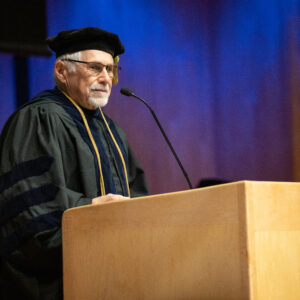
James Evans/University of Alaska Anchorage
Born in 1940 in Fort Wayne, Indiana, Steve grew up there and in New Jersey. After high school, he joined the US Navy as a bandsman playing trombone and served on the heavy cruiser USS St. Paul in Southeast Asian waters. He could play horn and guitar; scarcely a week went by after his leaving the navy that he did not play and sing one of Woody Guthrie’s Dust Bowl classics: “California is a garden of Eden . . . / But believe it or not, you won’t find it so hot / If you ain’t got the do re mi.” Upon leaving the navy, he enrolled at Seattle University, completing his BA in spring 1966. He began graduate study in early American history that fall at the University of Oregon under the guidance of Thomas Payne Govan. Govan was a brilliant and personable scholar much beloved by graduate students and junior faculty alike, and throughout his own long academic career, Steve continued to look to Govan as his model for teaching and scholarship.
After earning his doctorate in 1970, he joined the faculty of Anchorage Community College (ACC). After a short period, he was appointed to the small group of start-up faculty for the Anchorage Senior College. With ACC, the Senior College formed the first version of the University of Alaska Anchorage. From that beginning, for more than 40 years he led the development of UAA teaching, scholarship, and community service in historical study with an emphasis on American history, the history of the American West, and, above all, Alaska. He never tired of telling friend and foe that Alaska, with 375 million acres (586,000 square miles), is more than twice the size of Texas and nearly four times the size of California. Among much recognition, his teaching, scholarship, and community service culminated in the award of the University of Alaska Foundation’s Edith Bullock Prize and an appointment to the rank of Distinguished Professor.
Steve authored or edited eight books and served Alaska as a public intellectual. His other scholarship includes a bevy of columns in the Anchorage Daily News and commentary on public radio. In many ways, he was a one-person clearinghouse for scholars, reporters, and bloggers from across the Lower 48 and Europe seeking plain facts or interpretations of disputed facts about Alaska history. Above all, he brought Alaska history scholarship into the New Western History scholarship pioneered by the historians he most admired (William Cronon, Patricia Limerick, Richard White, and Donald Worster). His intellectual capstones were “‘Fetched Up’: Unlearned Lessons from the Exxon Valdez” (Journal of American History, 2012); Battleground Alaska: Fighting Federal Power in America’s Last Wilderness (Univ. Press of Kansas, 2016); and Alaska: An American Colony (Univ. of Washington Press, 2002; 2nd ed., 2020). Neither book neglected the mythic aspects of the state’s precarious balance on its last-frontier pedestal. But his scholarship overall and especially those two books demonstrated that even in an extraction colony, the impacts of race, class, gender, and environment on the local level are as pivotal to people’s lives as the immense powers of the federal government centered 4,250 driving miles away in the District of Columbia.
Steve leaves behind family, friends, scholars, and a legion of students who will remember him for many things. His mind a fountain of detail, Steve was a model DIY man, a builder and repairer of houses and machines; he was a good listener, a witty conversationalist, and just plain good company. He was a serious man, generous with his time, a helper of new faculty and a supporter of old colleagues. Outside the university, many remember his friendly encouragement and his carefully considered public commentary. Above all, he was a measured optimist, much like Tom Govan, his mentor of long ago. In his mid-80s, he continued to contemplate plans and projects. As a friend and former colleague has put it, “He could only be stopped by death.”
Kenneth O’Reilly
University of Alaska Anchorage (emeritus)
W. A. Jacobs
University of Alaska Anchorage (emeritus)
This work is licensed under a Creative Commons Attribution-NonCommercial-NoDerivatives 4.0 International License. Attribution must provide author name, article title, Perspectives on History, date of publication, and a link to this page. This license applies only to the article, not to text or images used here by permission.