Mabry Mill, located at milepost 176 on Virginia’s Blue Ridge Parkway in the community of Meadows of Dan, is one of the most photographed sites along the 469-mile route. Annually, hundreds of thousands of visitors to the Mabry Mill Visitor Center are told the site is an authentic representation of “the sights and sounds of Rural Appalachia.” This carefully crafted image has cemented its status as a cultural touchstone representing the nation’s pioneer spirit.
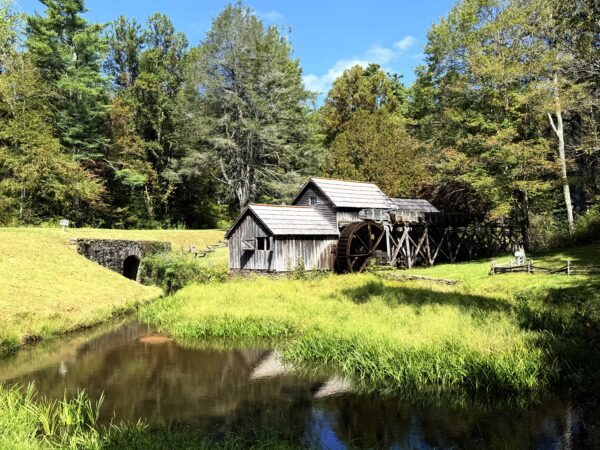
Recent repairs at Mabry Mill in Floyd County, Virginia, required collaboration from the National Park Service, the Blue Ridge Parkway Foundation, and the local community. Cody Dalton
However, this idyllic facade hides a troubling reality: The landmark is in a state of alarming decline. Its roof suffered severe leaks, the iconic waterwheel was rotting, and the reflecting pond became a swampy marsh. The closure of the on-site restaurant, an economic anchor for the site, further compounded the sense of decay. The story of Mabry Mill is a study in contrasts: a celebrated icon suffering from systemic neglect, a site of authentic history that has been deliberately altered, and a community landmark caught between federal bureaucracy and local dependency. Its struggle reveals the complex relationships among and immense challenges of historical authenticity, public memory, and historic preservation. Mabry Mill serves as a compelling example of a larger, national struggle over how we value, fund, and interpret our past, making it a powerful case study for the challenges facing public history and historic preservation today.
Before it became a National Park Service (NPS) site, Mabry Mill belonged to Edwin “Ed” and Mintoria Elizabeth “Lizzie” Mabry. Around 1903, Ed Mabry began constructing the complex. He first built a blacksmith and wheelwright shop, followed by the gristmill, a sawmill, and a woodworking shop. The Mabrys also built their home there. Using a complex system of flumes that he engineered to channel water across the level ground, Ed powered a multifaceted business. For three decades, the mill ground corn, sawed lumber, and provided essential repair services, functioning as a hub of local, self-sufficient commerce. It was this functioning, evolving industrial site that the NPS acquired in 1938 following Ed’s death.
The Mabry Mill that visitors see today is a carefully constructed historical exhibit whose interpretation has changed significantly over time. Upon acquiring the property, the NPS recognized its potential as a tourist destination. The agency’s goal, typical of the mid-20th century, was to present a generalized, romanticized vision of “pioneer culture” rather than the specific history of this early 20th-century industrial site.
The recent physical decline of Mabry Mill was the culmination of decades of systemic neglect.
This interpretive strategy involved physically altering the landscape to fit a preferred narrative. To create a more comprehensive “pioneer” tableau, the NPS added historic structures including a cane mill, a sorghum press, and a log cabin. The Matthews Cabin, built in 1869, was moved to the site in 1956 and erected where the Mabry family home once stood. In a telling decision, the NPS during a 1942 restoration had razed the actual house Ed and Lizzie Mabry built and lived in, deeming it and other buildings inconsistent with the curated story.
This act reveals a fundamental shift in the site’s meaning. In preserving a generalized pioneer myth, the specific, authentic history of the site’s namesakes was partially dismantled. Prioritizing a clean, thematic story for visitor consumption was a common approach in heritage tourism during this era. Today, these choices are viewed more critically. The site is now understood as a layered landscape where original structures (the gristmill) co-exist with additions (the Matthews Cabin). This evolution in understanding reflects a broader shift in public history toward acknowledging the complexities and erasures involved in creating historical narratives, with sites like Mabry Mill an example of how interpretations of the past are not static but are themselves historical artifacts.
Yet those artifacts have not always received the care and funding needed to maintain them. The recent physical decline of Mabry Mill was the culmination of decades of systemic neglect, reflecting the chronic underfunding and massive deferred maintenance backlog plaguing the entire NPS. The Blue Ridge Parkway alone faces over $449 million in deferred maintenance. With an annual budget largely consumed by routine operational costs, scant funds remain for the specialized repairs needed by historic wooden structures like the mill.
This long-term underfunding manifested in critical failures at Mabry Mill. The wooden shake roof decayed, the waterwheel rotted, the reflecting pond filled with silt, and the popular Mabry Mill Restaurant closed in 2023 when the concessionaire ceased operations. Meadows of Dan was hit hard, as local businesses depend on the mill to drive tourism. The visible disrepair became a source of disappointment for tourists and economic pain for residents.
Just as the mill seemed on the brink of irreversible decline, a concerted effort to save it demonstrated a collaborative model of historic preservation. Increasingly, sites like Mabry Mill have relied on public-private partnerships to fill the funding gaps. The financial lifeline came not from new federal appropriations but from the Blue Ridge Parkway Foundation (BRPF), the park’s nonprofit fundraising partner. The BRPF raised over $100,000 in private donations to replace the failing roof. The restoration work itself, begun in summer 2025, reflects a modern interpretive focus on material authenticity. The project used 6,000 hand-riven white oak shakes and was undertaken by the NPS’s elite Historic Preservation Training Center, which employed period-appropriate methods to ensure historical accuracy. The first step in a larger restoration plan, future work will include repairing the waterwheel, dredging the pond, and seeking a new concessionaire for the restaurant.
This effort exemplifies how philanthropic support is now essential for the NPS to fulfill its core preservation responsibilities. The revival of Mabry Mill demonstrates a 21st-century reality for saving public landmarks: It requires a hybrid model where a federal agency, a dedicated nonprofit partner, and a passionate public of donors and advocates work in tandem. The 20th-century paradigm of primarily federal stewardship is not viable in an era of systemic budget shortfalls. Instead, preservation now rests on a “three-legged stool” of collaboration.
The first partner is the agency—in this case, the National Park Service. The NPS acts as the official steward, providing the legal framework, historical oversight, and specialized labor. However, constrained by bureaucracy and limited appropriations, it often lacks the agility and capital to address major needs quickly.
This is where a second organization, the dedicated nonprofit partner, becomes essential. Organizations like the Blue Ridge Parkway Foundation serve as nimble engines for progress, soliciting donations, managing targeted fundraising campaigns, and engaging the community in ways a government agency cannot. BRPF fundraising bridged the gap between the recognized need for repairs and the agency’s available resources. This dynamic is replicated by other “friends” organizations nationwide, from the Central Park Conservancy in New York City to the Golden Gate National Parks Conservancy in San Francisco.
The third and final partner is the public. This model is powered by passionate donors, volunteers, and advocates. The funding for Mabry Mill’s roof came not from a single grant but from individuals. This approach fosters a sense of shared ownership and ensures that the preservation of these sites reflects a genuine public commitment, an approach now necessary to safeguard America’s shared heritage.
The tension between historical authenticity and a marketable, postcard-perfect narrative is a dilemma that played out at historic sites across the nation.
The story of Mabry Mill, from its industrious beginnings to its curated transformation, alarming decay, and recent revival, exemplifies the core conflicts in American historic preservation. It is simultaneously a monument to the ingenuity of the Mabry family and a carefully curated NPS exhibit that reflects a mid-20th-century desire for a romanticized past. This tension between historical authenticity and a marketable, postcard-perfect narrative is a dilemma that played out at historic sites across the nation.
Furthermore, the mill’s recent decay has made it a stark case study of the systemic crisis of deferred maintenance that jeopardizes America’s heritage. Its rotting timbers are a tangible symptom of the National Park Service’s multibillion-dollar maintenance backlog. Its revival through a public-private partnership with the Blue Ridge Parkway Foundation is not a unique solution but a blueprint for the collaborative, community-funded model that is now essential for saving historic sites where federal stewardship alone has fallen short.
Finally, the very interpretation of the site has evolved, mirroring a broader shift in historical preservation. The initial, authoritative narrative of a generic pioneer life has given way to a more nuanced understanding of the site as a constructed landscape where authentic elements co-exist with curated additions. This shift from a simplified myth to a more complex, layered story reflects a nationwide movement toward telling more honest, challenging, and inclusive histories. Mabry Mill’s journey through these phases makes it a case study in contested public memory and the practical realities of preservation. It forces us to confront critical questions: Should we prioritize an authentic, complex history or a simplified, accessible narrative? Who decides which story is told and which is erased? And in an era of strained public funding, how do we build sustainable models to protect our shared heritage? The ongoing story of Mabry Mill provides no easy answers, but still it stands, offering visitors a peek into one family’s experiences in early 20th-century Virginia.
Cody Dalton is a PhD student in curriculum and instruction at Virginia Tech. Before pursuing his doctorate, he taught history at George Washington High School.
This work is licensed under a Creative Commons Attribution-NonCommercial-NoDerivatives 4.0 International License. Attribution must provide author name, article title, Perspectives on History, date of publication, and a link to this page. This license applies only to the article, not to text or images used here by permission.