In my sixth year of teaching K–12 social studies, I am grateful to be supported by some of the most dedicated teachers I have ever encountered. Their professionalism and drive to improve their craft to support student learning have inspired me in the classroom and beyond. My colleagues’ example—combined with my students’ enthusiasm and the freedom to participate in scholarly conferences and continue my own research—has been the catalyst to a meaningful career, marked in ways I could not have predicted by both intellectual and professional growth.
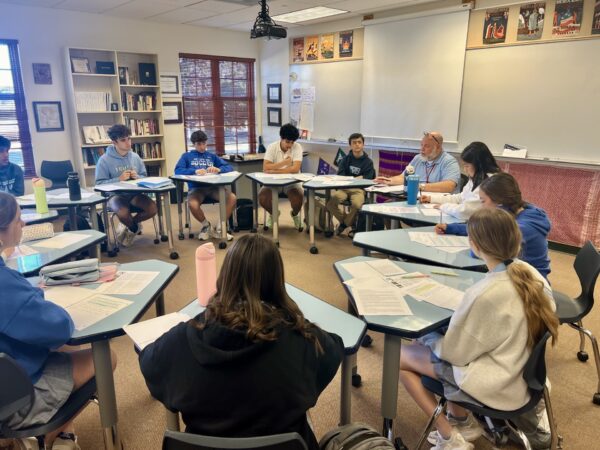
In his high school classes, William Cohoon uses Harkness discussions to help his students develop the critical, empathetic, and argumentative skills of a historian. Dave Ostroff
When I started graduate school, I devoted my attention to finding a career at a university, drawn to becoming a historian by my travels in Guatemala and conversations about the country’s history. Teaching high school students had not crossed my mind; I misunderstood K–12 education as a step away from the kind of academic work I was training for. My graduate program offered a “history as a profession” course that highlighted the shrinking academic job market and discussed alternative careers, but I dismissed these warnings, focusing all my energy on finding a university position.
During the 2019–20 academic year, I applied to nearly 30 academic jobs without receiving an interview. The minor alterations required to fit my application to each job description were time-consuming. With each application came hope and stress about cities my growing family might live in. My wife, also a PhD, and I were expecting our second child, and many of our conversations centered on finding an environment where we could build a family and community. After defending my dissertation in March, I began considering and applying for positions to teach high school history. I received only two requests for interviews, one at an East Coast prep school and another to teach History of the Americas at a charter school with an International Baccalaureate (IB) curriculum in Dallas, Texas. The latter offered me a position. Although I felt some relief securing a stable job, I also experienced a sense of anxiety and discouragement about accepting a position for which I felt both overqualified and underqualified.
My first year of teaching high school was extraordinarily difficult, in large part because I lacked formal secondary teacher training. Luckily, I worked with two outstanding colleagues who guided me. My grade-level lead taught me how to scaffold assignments to help build reading comprehension. Another colleague shared history curriculum resources that support student learning. With their mentorship, I found ways to make an impact, particularly with a small group of students who (to my surprise) asked whether they could attend an online conference at which I was presenting my work on statecraft in late colonial Peru. Their enthusiasm showed me that my scholarship could resonate with students in ways I never expected and that my research could inspire students at this level.
My students’ enthusiasm showed me that my scholarship could resonate with students in ways I never expected.
After a year of teaching history, I transferred to the flagship school in our charter district. Some of my graduate training focused on historical cartography in colonial Latin America, so the chance to teach only AP Human Geography was especially appealing. Studying new material reinvigorated my taste for learning and enriched my understanding of spatial analysis in relation to colonialism. At the same time, my unfamiliarity with the curriculum forced me to leave my comfort zone and seek collaboration with other teachers, whose wide-ranging interests opened space for discussions on capitalism, xenophobia, and gender identity. Over the next two years, my students pursued opportunities to learn for the sake of learning, going home to research topics I could not elaborate on during class and returning the next day eager to share their findings. Watching them work reminded me that teaching, like scholarship, demands curiosity and disciplined inquiry.
After three years of honing my teaching skills, I accepted a position to teach world history at Trinity Valley School (TVS). Collaboration, not competition, defines the culture at TVS. In my department, faculty seek one another out to discuss new lesson ideas and effective ways to integrate them into our classrooms. Recently, I partnered with a chemistry teacher, who guided my students in making iron gall ink from scratch, while I taught them how to whittle quills for a project on knowledge and power in my colonial Latin American class. These cross-disciplinary experiences, paired with small class sizes, allow for close connections with students and their families. In just three years, I have already taught multiple siblings from the same family, deepening my sense of community.
With strong encouragement from my department chair, I have also participated in professional development programs such as the AHA’s Teacher Institute in World History and, most recently, the Exeter Humanities Institute West, which showed me that learning in high school could mirror an advanced scholarly seminar. During our Harkness discussions—a method of pedagogy named for the early 20th-century philanthropist Edward Harkness, who championed classes in which students lead the conversation—I recognize the same intellectual give-and-take of a university seminar. Guiding students to question assumptions, assess evidence, and refine their interpretations requires the habits of a historian, including critical reading and clear argumentation. Much like a research project, creating a lesson begins with a historical question. Then, I gather primary and secondary sources and guide students through interpreting evidence to construct their own arguments. This process mirrors the analytical rigor I use in my own archival work. I design my courses as an act of synthesis by tracing global patterns of exchange, power, and resistance to reveal how seemingly isolated events intersect. This interpretive approach models for students the process historians use to create narratives from disparate sources. Professional development has shown me that teaching itself is an intellectual pursuit, requiring the same curiosity, adaptability, and reflection that I once reserved for archival research.
While my experience is not the norm in Texas, teaching here has sharpened my sense of purpose. Although the Texas State Board of Education has reshaped the Texas Essential Knowledge and Skills (TEKS) for social studies in the state’s public schools, I have still found freedom in what and how I teach at an independent school. The TVS administration encourages teacher autonomy in the belief that discussing difficult topics helps students become critical thinkers and empathetic people. While teaching AP Human Geography, I guided students in analyzing population density maps of LGBTQ+ residents, revealing how geography shaped social confinement. In World History, students read firsthand accounts of King Leopold II’s brutality in the Belgian Congo, or research and write minibiographies on revolutionary women such as Anne Lister. To deepen their theoretical understanding, we engage with thinkers like Edmund Burke, Karl Marx, and Michel Foucault, whose ideas help students interrogate systems of power and social change. In my Latin American history courses, students can learn about how women used witchcraft to subvert colonial authority or the sterilization campaigns of Indigenous women in the Andes in the 20th century.
I once thought the pursuit of scholarship could occur only in a tenure-track position at a top-tier university. Since I started teaching high school, I have shared my research at the Conference on Latin American History (CLAH), the Southeastern Council of Latin American Studies (SECOLAS), and the Rocky Mountain Council for Latin American Studies (RMCLAS), where I also serve on the executive council committee. Attending conferences allows me to stay connected with current historical scholarship in my field while exchanging ideas with colleagues across institutions. At RMCLAS, I served on the panel “They All Become Latin Americanists (And Won’t Even Know): A Roundtable on Teaching Strategies for Latin American Studies,” where I shared my experiential learning projects with other faculty members. Currently, I am researching experiential learning through a project I developed on the Columbian Exchange, and I hope to publish my findings in The History Teacher. I have received recognition and financial support from CLAH and the American Philosophical Society to further my scholarly interests.
Teaching and scholarship are interrelated—not mutually exclusive but mutually reinforcing.
These experiences suggest that teaching and scholarship are interrelated—not mutually exclusive but mutually reinforcing. Just as my scholarship enriches my classroom, so too have my students shaped the way I think as a historian. Their questions about capitalism, colonialism, empire, race, and gender have made me reconsider how I frame certain topics in my book project on Bourbon Peru. Explaining complex ideas in a K–12 setting forces me to clarify arguments in ways that make my research sharper and more accessible to a broad audience. Teaching has not pulled me away from scholarship; it has transformed the way I approach it.
Graduate students navigating today’s academic job market need to adopt a broad definition of what it means to be a historian. The skills cultivated in graduate school—conducting archival research, framing complex arguments, communicating ideas clearly, and managing long-term projects—are useful not only in the university. I rely on those same skills when scaffolding research assignments, guiding Harkness discussions, and teaching students how to frame questions about our readings. Graduate training has value outside the professoriate; it provides tools for engaging the next generation. Students need these skills more than ever to judiciously evaluate the flood of information they encounter daily.
My academic journey has taught me to redefine what success looks like. I once believed that a career outside the academy was a mark of failure. I carried the weight of that belief for many years after signing my first contract as a secondary school teacher. In reality, the decision opened opportunities that I might not have found in a tenure-track role. I now experiment with pedagogy to integrate my scholarship into teaching in creative ways, while making an immediate difference in young people’s lives. I have come to see success in new terms: as a balance of excellent teaching, active research, and meaningful scholarship. Teaching world history has expanded my research interests and strengthened my scholarship. Most of all, I have discovered that intellectual fulfillment and professional purpose can flourish outside a university setting. That path is one that graduate students should see not as a last resort but as a rewarding possibility.
William Cohoon teaches upper school history at Trinity Valley School in Fort Worth, Texas. He earned his history PhD at Texas Christian University in 2020.
This work is licensed under a Creative Commons Attribution-NonCommercial-NoDerivatives 4.0 International License. Attribution must provide author name, article title, Perspectives on History, date of publication, and a link to this page. This license applies only to the article, not to text or images used here by permission.