Coinciding with America’s 250th anniversary, as conversations about history, legacy, and identity have taken center stage in the national discourse, Netflix has given new life to one of America’s most durable pieces of frontier mythology. Little House on the Prairie, which premiered on July 9, draws on Laura Ingalls Wilder’s beloved children’s book series—which has sold some 73 million copies over almost a century in print—and promised to be “part family drama, part epic survival tale, and part origin story of the American West.”
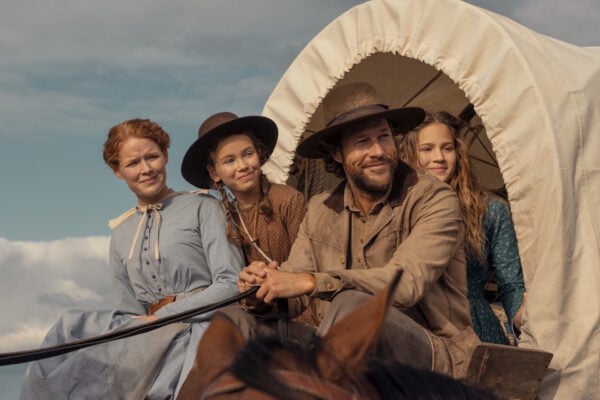
The new Netflix adaptation of Little House on the Prairie began streaming on July 7. Courtesy Netflix
This adaptation has arrived at a time when many Americans seem increasingly drawn to frontier entertainment: reality shows like HBO’s Back to the Frontier invite families to live as 1880s homesteaders, Paramount’s Yellowstone and its sprawling spinoffs have built an ever-expanding “Dutton-verse,” and social media influencers turn 19th-century domestic labor into aspirational content. Yet in all these cases what is being revived is not simply a longing for frontier days, but a historical myth with a long history of defining American belonging in part through exclusion and erasure, a trend experiencing a profound and troubling renewal in the present.
The power of popular media in shaping collective memory and molding Americans’ ideas about history requires us to examine the messages these works transmit and what they communicate about both America’s past and present. This is especially true for media aimed at children. As historians of American education and former K–12 teachers, we have observed how students’ sense of history is shaped not only by textbooks and school curricula but also by popular media. Children, like adults, build their sense of historical consciousness not through instruction alone but through emotional experience. In this context, Little House and other historical fiction aimed at younger audiences act as pieces of pedagogy. Wilder herself acknowledged as much, writing that her books were meant in part to teach children living in the present “what it is that made America as they know it.”
As numerous scholars have argued, Wilder’s books promoted a vision of American history that cast the hardships and violence of the 19th-century West in a shroud of comfort and opportunity. This mythology, of course, did not start with Wilder. Long before the first in her eight-book series was published in 1932, this view of the West had already cemented itself in the American imagination through scholarly works like Frederick Jackson Turner’s The Frontier in American History and artistic interpretations like John Gast’s American Progress (which sparked renewed controversy when it was used in a Department of Homeland Security tweet last year). These works told similar stories: white settlers, empty land, and unbounded freedom. Ignored were the violence and displacement that made this freedom possible—the genocide and dispossession of Indigenous peoples, the labor of enslaved and immigrant workers, the federal government’s role in enabling these abuses through land grants and subsidies that underwrote the process of white settlement, and the military actions that secured it. What remained was a tale of Manifest Destiny, white racial supremacy, and triumphant individualism—a myth that has proven incredibly durable, in no small part because of works like Wilder’s Little House.
What is being revived is not simply a longing for frontier days, but a historical myth.
This frontier myth was being constructed throughout Wilder’s childhood. Born Laura Ingalls in 1867 in Wisconsin, her family was drawn westward by the promise of open land and opportunity. When the Ingallses first arrived “on the prairie” in 1869, they illegally squatted on Osage territory, leaving only when federal troops threatened to remove them. Subsequent moves to Minnesota, Iowa, and South Dakota were made possible only through the Homestead Act, which drew settlers with the promise of subsidized land. Wilder’s childhood years were marked by dire poverty, malnutrition, and repeated crop failures; in adulthood, she lived through the Dust Bowl, an ecological catastrophe caused in part by the aggressive homesteading practices in which her family had participated.
As Caroline Fraser’s Pulitzer Prize–winning Prairie Fires: The American Dreams of Laura Ingalls Wilder argues, the Little House books were “a profound act of American myth-making and self-transformation.” The difficulties of prairie life were smoothed into a story of adventure and opportunity, and the settler colonial worldview was rationalized. In the second book of the series, for example, Wilder writes of the Ingallses’ settlement on Osage land that “there were no people; only Indians lived there.” Fraser also documented the decisive editorial influence of Wilder’s daughter Rose Wilder Lane, a founding figure of American libertarianism. This ideology—shaped in part by both mother and daughter’s opposition to the New Deal—inflects the books in their lack of acknowledgment of the government assistance the Ingalls family received and the didactic emphasis on individual freedom. Rose urged her mother to convey “the truth,” not as facts but the core meaning underlying them. “You tell the truth by selecting the facts which illustrate it,” she wrote. Wilder herself acknowledged the editorial license she took: “All I have told is true,” she wrote, “but is not the whole truth.” Now published in 45 languages, that “truth” has become a default version of the American past.
The books’ popularity was bolstered by television adaptation. NBC’s wildly popular television series spanned nine seasons from 1974–83 and 204 episodes. But its producers disagreed sharply over prioritizing historical accuracy or audience appeal, and ultimately the Ingalls family’s financial precarity was replaced with comfortable stability. Producer Ed Friendly eventually left the show, complaining that it more aptly be called “How Affluent Is My Prairie?” The series also failed to improve on the books’ treatment of Indigenous peoples, continuing to deploy harmful stereotypes. The show scrubbed the most offensive material present in the book series, adding storylines that preached acceptance of those with different racial, ethnic, and religious identities. Yet the result was a sanitization, making the show feel progressive even as it left the structural erasures of the original largely intact.
Unresolved tensions about historical accuracy and cultural representation returned when Netflix announced its reboot in early 2025. Within hours, conservative commentator Megyn Kelly posted on X: “Netflix, if you wokeify Little House on the Prairie I will make it my singular mission to absolutely ruin your project.” Melissa Gilbert, who starred as Laura in the NBC series, pushed back immediately, writing on Instagram: “Watch the original again. TV doesn’t get too much more ‘woke’ than we did. We tackled: racism, addiction, nativism, antisemitism, misogyny, rape, spousal abuse, and every other ‘woke’ topic you can think of.” The exchange marked not just a cultural war over so-called “wokeness” in television, but over what stories are permissible in the national historical consciousness.
The Netflix adaptation arrives in an era marked by intensified nostalgia for an imagined American past, one deeply entangled with the politics of white conservatism and rural nostalgia. At a time when book bans threaten to limit young readers’ access to diverse and inclusive stories, where lawmakers have worked to strip histories of oppression and resistance from K–12 curricula, and where the federal government has actively removed references to women and minoritized populations from museums and historic sites, popular media is one more critical site in the struggle for American history and identity. The Netflix team is clearly aware of the historical and political tensions at play. The first 15 minutes of the series makes clear this is not just a white prairie: Dr. George Tann, a Black doctor who helps the Ingalls family (Tann was a real person, though his romance plot in later episodes is fictional) and an Osage family, including daughter Good Eagle who befriends Laura, are introduced early as central cast members. In particular, Julie O’Keefe and her team deserve praise for their work in bringing the Osage characters to the screen. The presence of these characters provides windows, albeit limited, into nonwhite experiences that were absent in the original series.
The first 15 minutes of the series makes clear this is not just a white prairie.
Yet these stories are never allowed to disturb or detract from what is clearly Netflix’s larger goal: adding to its slate of “feel-good, heartland-rooted comfort programming.” As one critic put it, the series is “aggressively wholesome.” It includes characters of color, but it does nothing to complicate the mythologized West that Wilder’s books promoted almost a century ago.
Nothing illustrates the show’s narrative stance better than Netflix’s own press, which touted the effort to build Wilder’s world faithfully down to constructing the little house itself from wood pegs, “built the way Charles would have done it.” The press material also highlights the on-screen recreation of the rocking chair Pa makes Ma in the books. As executive producer Joy Gormal Wettels explained, they found artisans who built “a historically accurate chair that matched the Garth Williams illustration” featured in the series. But the standard invoked here is not whether the chair matches the historical record, but whether it matches the illustration in the beloved novel. Netflix’s Little House is historically accurate, then, in a specific sense: it is historically accurate to the myth that Wilder wrote.
The tensions between historical integrity, entertainment, and narrative comfort are not unique to Little House or Netflix. Popular media is saturated with stories that toe this line. But however lightly these productions don their historical credentials, they are doing something more than entertaining viewers—they are teaching them. They signal who counts as the protagonists of American history and who can be written out of the frame. Helping young people recognize the frontier myth and what it erases means approaching this media with a critical lens. It requires us to put works like Little House in conversation with both scholarship and children’s literature on the American West that center a multitude of backgrounds and perspectives. The Little House series does not offer just a story about the past but an argument about it, the latest iteration of a story that has been told for more than 150 years. The frontier myth has survived not because it is true but because it fits an uncritical story of American history—one that deserves to be challenged by audiences both young and old.
Abigail Jean Kahn is a PhD candidate in history of education at Stanford University. Michael Hines is a historian of American education and assistant professor at Stanford University.
This work is licensed under a Creative Commons Attribution-NonCommercial-NoDerivatives 4.0 International License. Attribution must provide author name, article title, Perspectives on History, date of publication, and a link to this page. This license applies only to the article, not to text or images used here by permission.