
Acknowledging that I entered graduate school as long ago as 1985 might alert readers to the fact that I was educated as an intellectual historian during the high and heady years of deconstructionist and Foucauldian criticism. Famously, deconstructionist criticism made us all suspicious that so-called “scientific” knowledge was made to exert power over someone or something, and the upshot of our own inquiries was to make clear just how unobjective scholarship has always been.
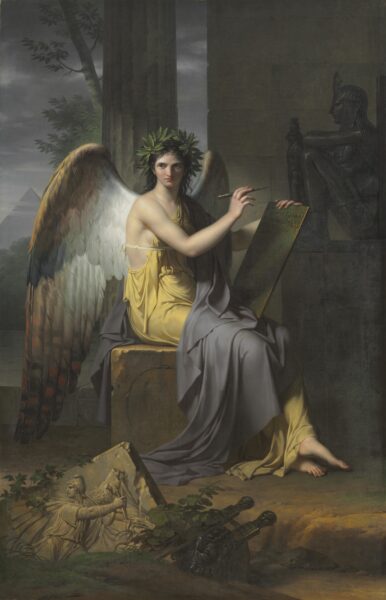
Surrounded by fragments of evidence, Clio gives her audience a skeptical look, as if to say, “Hmm, I’m not sure I’m ready to write yet . . . Perhaps I need to learn more first.” Charles Meynier, Clio, Muse of History, Cleveland Museum of Art, Severance and Greta Millikin Purchase Fund 2003.6.5, public domain.
The first red flag that this line of thinking had its own rather terrifying social effects came in 2004 when Bruno Latour, a leading deconstructor of scientific certainty, faced by climate change denial that took this thinking too far, decided that excessive confidence in scholarly expertise was no longer the battle that needed fighting. For me, the full force of this notion came in the course of the 2016 election, as the question of how to fight fake news became paramount. So worried did I become about the public’s loss of trust in historical (or any other) expertise that I began to say—at first only to close friends—“I want my objectivity back.”
For a time, it seemed to me that some idea of objectivity was the only way to restore the credibility of historical expertise. But how to reach it? I knew that objectivity was an empty pretense, one that had, moreover, obscured imperious and later discredited claims. As early as 1988, Peter Novick’s That Noble Dream had unveiled the bankruptcy of objectivity claims in American historical writing. In 2007, Lorraine Daston and Peter Galison’s Objectivity showed how across the sciences, born of particular forms of mental and bodily practice, the idea was made an epistemological virtue. I could not pretend that these critiques were not still compelling. But, with the prompting of my early modernist guru Anthony Grafton, I increasingly began to recognize the limitations of my modernist training. (My Eurocentric focus is another problem, which I recognize but need more help to fix!) Historical scholarship isn’t all about the writing of histories—its core values and virtues lie in our research practices. As the study of ancient history shows us more clearly than does modern scholarship, these practices evolve without us needing to claim they result in perfect objectivity. And when I began to think about the history of Herodotus’s reception, it occurred to me that ancient and early modern authors had much to teach us about the practice of historical inquiry, which has been treated (I believe unfairly) with so much cynicism by the deconstructionists.
Historical scholarship’s core values and virtues lie in research practices.
So what if we focus today on the work of the historian not as a writer, as did, famously, Hayden White, but as an inquirer? Herodotus himself called his work (in Greek) The Inquiries, not The History of the Persian Wars, as my translation titled it. Indeed, the person we hail as “the father of history” had known that he was doing something different from the poets, even as he wittingly or unwillingly incorporated literary tropes and flourishes into his narrative. Unlike many writers of his era who claimed the inspiration of the muses, Herodotus possessed the specific “voiceprint,” as Robert Fowler called it, of a man who drew explicit attention to his hard work investigating the causes of the Graeco-Persian Wars. Like his contemporary medical thinkers and pre-Socratic philosophers, Herodotus was interested in demonstrating his empirical bona fides, by the twin processes of autopsy (witnessing for oneself) and information gathering, mostly collecting oral traditions. Particularly in the first half of his narrative, which surveys the non-Greek world long before his birth, Herodotus made sure readers recognized that he had labored to measure the circumference of the Black Sea; to record numerous, contradictory, Scythian origin stories; to go to Egypt to ask the local priests more questions than the Elephant’s Child asked the many-colored python in Rudyard Kipling’s famous short story. Herodotus presents himself as the sort of man you can trust because he asked questions, he went places, he checked (at least some) stories.
In one important passage, Herodotus fact-checks Homer’s account to suss out the real origins of the Trojan War. On the basis of the testimony of Menelaus, preserved in Egyptian oral tradition, the historian concluded that Helen of Troy had never gone to Troy but had been waylaid in Egypt by King Proteus. Homer, Herodotus claimed, had known this story, “but since it was not so suitable to the composition of his poem as the other which he followed, he dismissed it” (2.116). As his version of the tale was both more logical (Why would the Trojans go to war for one woman?) and attested by a Greek eyewitness, Herodotus presented his story as different in kind. While Homer’s was poetic, his was historical. It was more plausible, in terms of human nature, and it was grounded in evidence; it had been obtained by inquiry. Herodotus said nothing (frustratingly) about how, where, and when he wrote his inquiries. But he would not have been bothered by accusations that he had intruded judgments, tragic emplotments, or full speeches into the text. He had earned the right to do these things by the investigative work he had put in beforehand.
But inquiry would be nothing without criticism, and historians have generally been a critical bunch. As John Marincola noted, Herodotus’s predecessor Hecataeus opened his big historical work (now known only in fragments) by dissing his fellow Greeks. Hecataeus said, “I write what follows as it seems to me to be true; for the stories of the Greeks are varied, and, as is manifest to me, ludicrous.” And Herodotus’s successors never ceased to find fault; “everyone refutes Herodotus,” wrote one of his most ardent ancient critics (Against Apion 1.16). Everyone felt they had to one-up him: The historians and geographers who followed had to show that their information-gathering processes were better and more probable. One might look at the history of this process as zero-sum squabbling. Yet how best to know the history of Egypt or to understand the character of Alexander was a productive controversy, and criticism ended not in despair but in more inquiry.
Inquiry into the deep past was (and remains) difficult, and few Romans were willing to follow Herodotus into lands of barbarian tongues and iffy tales. Many political men took the Thucydidean path and simply wrote the history of the present, in which they had played a role. History’s purpose was increasingly presented as pedagogical, rather than, as in Herodotus’s inquiries, antiquarian and memorial. But to instruct elite citizens meant, more than ever, to provide materials that were not invented or incredible. Through research or personal experience, writers were expected to investigate, ask questions, sift out absurdities, and make reasonable judgments of character. Compositional additions were expected—after all, history remained a branch of rhetoric. But it was a branch whose competence was underwritten by being there and knowing a lot, not only by speaking well.
From the Roman period forward, European historians chiefly compiled and compared traditional accounts, and Christian writers muddled the inspiration/inquiry divide by invoking God’s voice, and protesting that they needed no other security on which to judge. But even so, medieval writers in the West, as in the Islamic world, collected, selected, and sieved many texts to compose both holy and secular histories. The bibliophile Peter the Eater (Petrus Comestor), for example, worked hard to incorporate profane texts such as Josephus’s Jewish Antiquities into his Historia scholastica (ca. 1173). Monks traveled from place to place to view manuscripts and documents. Autopsy, as practiced by pilgrims and itinerant scholars, played a role in the verification of relics and the legitimation of religious experiences, both of which fed the writing of histories. Recent scholarship has shown us just how much expert investigation went into the writing of early modern ecclesiastical histories. Competition between them drove writers to encompass more material, learn more languages, explain events—even miraculous ones—with greater and greater degrees of natural probability. Compositional and ideological connective tissue—or its absence—was judged and criticized. But as source materials became more readily accessible, and as readers grew more ecumenical, it became more and more clear that they who inquired more, inquired best.
The 17th century saw a full crisis not unlike the deconstructionist threats of the 1970s and 1980s, in which hyperskeptical “Pyrrhonist” philosophers threatened to sweep away the very foundations of knowledge. The crisis also affected historical writers of princely and universal histories. Much less affected were those who we typically call antiquarians, who were deeply engaged in accumulating fragments of knowledge about specific things, and travelers such as Jacob Spon and George Wheler, eager to see for themselves the monuments of ancient and modern Greece. What they saw and recorded could now be processed by others, such as the great stay-at-home Dutch scholar Johannes Meursius, or improved by the next batches of travelers. Although it took some time for antiquarians’ inquiries to be incorporated into narrative histories, antiquarianism, as Arnaldo Momigliano suggested long ago, saved historians from that credibility crisis—chiefly by reminding us of the power of autopsy and of collecting information, processes that made possible the writing of better histories.
In the 19th century, historians named and elaborated an exercise with earlier roots: source criticism. In some ways, this was a new form of Pyrrhonism, one that unveiled the difficulties not of accessing sources but of their very construction and built-in biases. Source critics were not the first to discover vast lacunae in the past, but they created new ones by labeling past histories and/or source materials untrustworthy. Could Plutarch be trusted on Alcibiades, who had lived 500 years before Plutarch wrote Parallel Lives? Could one trust a friendly—or unfriendly!—Catholic cardinal on a pope’s upstanding behavior? Such critical questions again required deeper inquiry, and those who did not match contemporary standards of scholarly practice—including the aged Leopold von Ranke himself, in his dilettantish Universalgeschichte—were excoriated by their colleagues. This was another part of historiographical practice not discussed by 20th-century deconstructionists, who presumed contemporaries are always speaking the same language. In this crowded 19th-century scholarly world, competition engendered more extensive forms of autopsy—such as actually going to Egypt or Scythia—and forms of new information gathering, some of which we now recognize as imperialist tomb and archive raiding. But this process, too, was one in which criticism, competition, and the need for more certainty spun off new inquiries. As the circle of writers and critics has increased and diversified in recent decades, more inquiries have created more questions, as well as some better answers.
We need to renew respect for historians’ long traditions of inquiry and criticism.
If you ask working historians today to describe their research methods, I believe most would say something like: I (using first person, as did Herodotus) learn the specialized techniques I need to ask good questions; I investigate things as directly as possible; I sieve out absurdities and biases in the sources; I read the work of my predecessors and analyze the quality of their evidence. Then I tell my story. Criticism, including self-criticism, should then make us pause and ask whether we have unfairly stacked the data to generate our stories. If we have done so, it is up to us to rewrite, as do dissertators after the defense and authors in response to readers’ reports. We do not have to feel badly if our students and successors improve our techniques and add new insights derived from their own expertise and experiences. Our stories will change. But what we do, and what we teach, are most of all sound practices of inquiry and criticism—different for each specialized field—and it is this that we can be proud of handing on to the next generation.
In the end, I don’t want objectivity back—we never had it in the first place. We don’t need omniscience, especially in an age in which AI falsely claims it. What we do need is to renew respect for historians’ long traditions of inquiry and criticism. We need to confront the current public crisis of expertise by committing ourselves to being the sorts of people who can be trusted—because we ask questions, go places, check our stories, anticipate our critics, and, like Herodotus, show our work. The father of history didn’t need to believe in objectivity, but he did need to believe that the combination of inquiry and criticism makes for better scholarship. Perhaps the same can be said for us.
This work is licensed under a Creative Commons Attribution-NonCommercial-NoDerivatives 4.0 International License. Attribution must provide author name, article title, Perspectives on History, date of publication, and a link to this page. This license applies only to the article, not to text or images used here by permission.