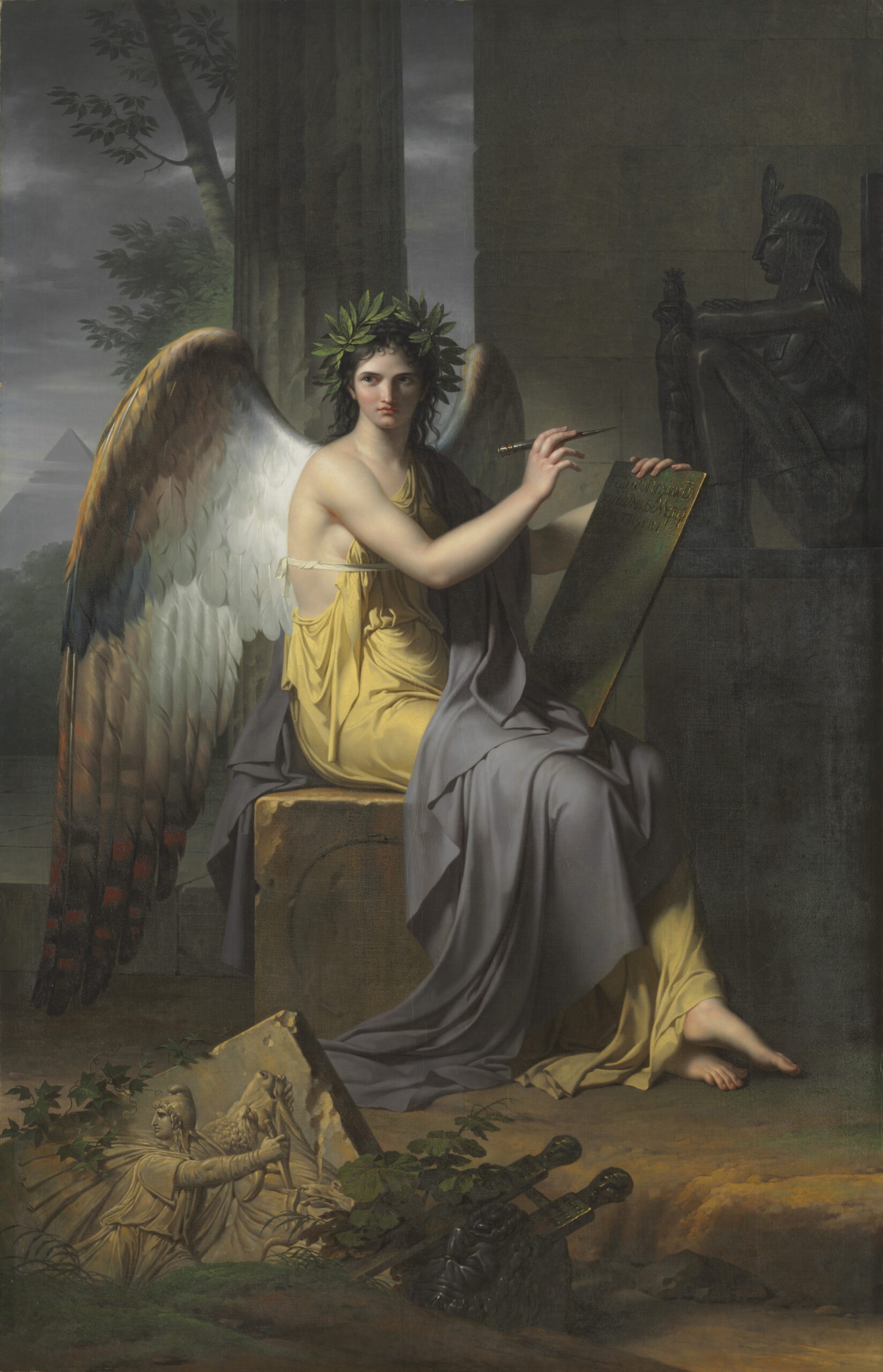
For the past decade and more, I have been pondering the modern afterlife of the writer Cicero dubbed “the Father of History,” Herodotus. Tracking the long legacy left for us by Herodotus, who was equally reputed to be “the Father of Lies,” has turned out to be a fascinating (and often hilarious) way to understand how we have made, and transformed, historical methods and ideals. Much more than that of his “just the facts” critic Thucydides, Herodotus’s kaleidoscopic reputation exemplifies our struggles to define what “good” history looks like, especially when it includes, as Herodotus does, women, non-Europeans, rivers, and flying snakes.
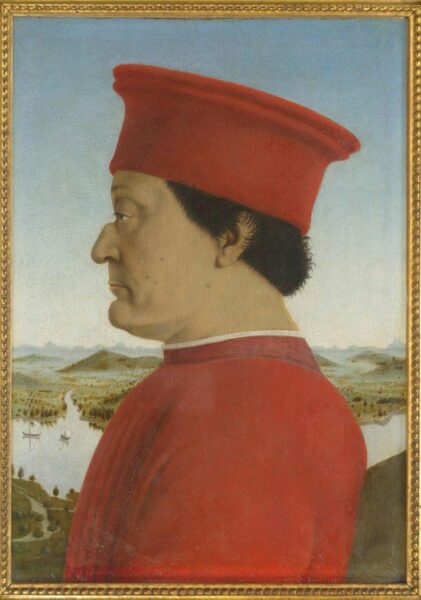
Piero della Francesca’s portrait of the Duke of Urbino obscures his missing right eye. The Uffizi
In the course of my researches, I have been astounded by the ways that ancient and early modern thinking about history—its ethics, its rhetoric, its truth claims, its proper practices—have shaped our own, sometimes by our reiteration of those ideas, and sometimes by our rejection of them. In this essay, I take up one strand of this tangled thread: the very long discussion of history’s relationship to flattery. This is a delicate subject, for patronage, partiality, or simple lack of self-consciousness has so often tempted us to use the past in this way, although we have repeatedly warned ourselves that this is perhaps the worst of sins. Reviewing some of these compulsions and counterarguments seems timely in this semiquincentennial year, one in which we face not unprecedented but renewed threats to historical expertise and integrity. Maybe the ancients—and our early modern forebearers—can offer some useful guidance.
Let’s begin with Herodotus, who famously set out to tell the great deeds of both the Greeks and the Persians. But the Father of History was no flatterer: He managed to have something offensive to say about pretty much everybody, which may just be his greatest claim to impartiality. Even in his famous lines praising Athens for saving Greece from Persian conquest, Herodotus admitted that his opinion “will be displeasing to most”—but he has to deliver this truth anyway. His younger contemporary Thucydides argued that a proper history should neither flatter nor, like that of Herodotus, entertain, but be a “possession for all time.” Let us pause to note the time dimension Thucydides has explicitly added: To be a good historian means seeking an appreciative audience beyond one’s own times—because one’s contemporaries are not likely to thank you for truth telling.
For Thucydides, to be a good historian means seeking an appreciative audience beyond one’s own times.
The second-century Syrian Greek rhetorician Lucian of Samosata is worth quoting at greater length, from his treatise “How to Write History.” Lucian was responding, critically, to a torrent of heroic narratives that glorified recent Roman victories against the Parthians. Lucian argued that the worst fault of historians was to “neglect the events and spend their time lauding rulers and generals, extolling their own to the skies and slandering the enemy’s beyond all reserve.” It was okay for poets to praise heroes, but history’s task was different: to write in the public interest, but not to please public opinion. The best readers to write for were educated “faultfinders” who would catch the historian in errors or exaggerations, even if the majority applauded. And like Thucydides, Lucian thought the historian’s true judges would be not contemporaries but later, wiser readers. Here we have our time dimension again: Orienting one’s history to please the present was a grave vice. Lucian’s next metaphor reminds one of the instructions to courtly portrait painters to paint only the ruler’s good side: “He must not be concerned that Philip has had his eye put out by . . . the archer at Olynthus—he must show him exactly as he was.” And then, invoking his hero Thucydides, Lucian summarizes: “The historian’s sole task is to tell the tale as it happened. . . . If he has a friend he will nevertheless not spare him if he errs. . . . Whoever serves the present will rightly be counted a flatterer—a person on whom history long ago right from the beginning has turned its back, as much as has physical culture on the art of make-up.” The historian, in short, should not apply lipstick to Mother Nature and should put the public interest and posterity ahead of friendship, patronage, and national partiality. Not bad rules, in my humble opinion!
When Greek historiography was revived in the era of the Renaissance, Europe’s political conditions were much changed. Now most polities had a prince, queen, or king, most of whom delighted in seeing their acts ratified or amplified by history-writing courtiers. Some obliged, even placing their sovereigns in the company of great figures such as Scipio Africanus and the Persian King Cyrus. Courtly artists had the same dispositions. As if in direct defiance of Lucian, in about 1473, Piero della Francesca painted the Duke of Urbino’s left profile, concealing the fact that he had lost his right eye in a jousting accident.
But few ever confused pageantry or art with good history, and if sycophantic tributes threatened to conceal rulers’ flaws, historical accounts at the time also frequently served as a discrete means for counselors to teach princes difficult lessons, such as the virtues of temperance and the wisdom of staying within the laws. Already in antiquity, historical examples were functioning in this way in the genre of educational manuals that came to be known as “mirrors of princes.” This genre flourished in the Renaissance, as modern states began to form. The most famous—and most unconventional—of these, Machiavelli’s The Prince (1513), devoted a full chapter to “how flatterers are to be avoided,” denouncing those who out of self-love or fear will not speak the truth. But one could praise the dead, as Machiavelli said in his treatise The Art of War, because then all cause for flattery disappeared; one could also use negative examples of tyrants or usurpers to warn rulers against those abuses. History was positioned here as a zone of neutrality where honest, frank speaking could prevail—after the events it recounted!
“Mirrors of princes” flourished in the Renaissance.
There were certainly writers of history who worked in this direction, especially in Latin and antiquarian works princes generally did not read. As Anthony Grafton has demonstrated, some clerics and mavericks did their best to assess evidence critically, despite the consequences. But historical writers employed by courtly patrons or religious institutions were highly incentivized to paint their patrons in flattering light. Thus was 17th-century history writing embedded ever more firmly in the world of courtly patronage—or religious polemic. In despair, the deep-dyed skeptic François de La Mothe Le Vayer penned several treatises on historical truth, hoping the ancients would offer guidance. He praised Polybius for recognizing that historians “are obliged to forget all kinds of friendship and all other considerations than that of the exact truth.” And he begged contemporary historians to go back to Lucian, who taught that the best histories were the least beautified and the least pleasing; they were “rather like medicines, which can only be employed a long time after they are prepared.”
In the 18th century, new and wider readerships and less censorious princes encouraged history writers to shift attention to wider cultural histories, which sometimes entailed flattering nations—or factions within those nations—rather than princes and kings. Seeing this train of toadyism gathering steam, the English critic Lord Bolingbroke deplored that “history very often [becomes] a lying panegyric, or a lying satire; for different nations, or different parties in the same nation, belie one another without any respect for truth, as they murder one another without any regard to right or sense of humanity.” He, too, retold Lucian’s story of the painting of the prince in profile, to disguise his imperfect eye. Voltaire worried more about the corrupting forces of tradition and superstition than flattery, and wrote histories meant to ridicule, or scathe. His histories did not earn the respect of the more meticulous scholars of the state-supported Parisian Académie des Inscriptions or the German historians of the Göttingen school, who denounced Voltairian dilettantism. An admirer of the Académie’s scholarship and Voltaire’s narrative flair, Edward Gibbon provided a model of what history without flattery might be—enabled by Gibbon’s private means. But he, too, had axes to grind, and in any case was rewarded with few plaudits in his day.
The 19th century, particularly in the German states, witnessed two major changes in the structure and patronage of historical work: rising investment in state-funded universities, increasingly divorced from clerical influence, and the foregrounding of the so-called “research imperative”—the idea that scholars must seek out new knowledge, whether or not it is useful or flattering to contemporaries. These changes in structure and patronage created the conditions of financial and intellectual independence necessary for more historians to choose controversial subjects, though the temptation to flatter the nation—as did, for example, German historian Heinrich von Treitschke, British historian Thomas Macaulay, and Czech historian František Palacký—endured.
Changes in structure and patronage created the conditions of financial and intellectual independence necessary for more historians to choose controversial subjects.
These 19th-century historians cared a great deal about the ancient world and fought many of their historiographical battles by way of ancient proxies. In fact, the so-called father of scientific history, Leopold von Ranke, wrote his now lost dissertation on Thucydides before becoming a modern historian. His most famous injunction to historians, that they should tell the story of the past “wie es eigentlich gewesen” (as it actually happened), is a gloss on Thucydides, or perhaps Lucian. Having Thucydides as a model meant that all too many of these historians focused on power politics and wars, and often writers forgot to be critical of “great men.” After Ranke, it took more than a century of effort and advocacy by historians of non-Europeans, everyday life, women, the environment, and material culture to restore something like a Herodotean worldview to history writing. But expanding our compass did not, and should not, necessitate giving up that Thucydidean commitment to telling uncomfortable truths about nonprincely subjects as well.
Thanks partly to further structural changes and to the expansion and diversification of the discipline in the last half century, we have been able to fully take on board Lucian’s final words: “That, then, is the sort of man the historian should be: fearless, incorruptible, free, a friend of free expression and the truth . . . giving nothing to hatred or to friendship, sparing no one, showing neither pity nor shame nor obsequiousness, an impartial judge, well disposed to all men . . . in his books a stranger and a man without a country, independent, subject to no sovereign.”
These are helpful words to remember in 2026, reminding us that deep in our professional DNA are injunctions to be fearless and self-reflexive friends of free expression and evidence-based painting of the past—even when we disagree with our friends, and even when, like Herodotus, we dole out praise our audiences don’t want to hear. As before, we also have to fight for circumstances in which we can speak candidly; as Cicero told us, governments under which historians are fearful of speaking truthfully are not good governments. Modern scholars too often dismiss or disparage the legacies of the ancient world; in this case, I submit that we still have a great deal to learn from its lessons on history.
This work is licensed under a Creative Commons Attribution-NonCommercial-NoDerivatives 4.0 International License. Attribution must provide author name, article title, Perspectives on History, date of publication, and a link to this page. This license applies only to the article, not to text or images used here by permission.