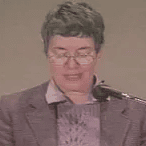
President Nominates Don W. Wilson to be Archivist of the US
On September 10 the White House forwarded papers to the Senate nominating Don W. Wilson as Archivist of the United States. Many NCC organizations have officially expressed support for the se lection of Wilson, a nonpartisan, professional archivist and historian. Last spring when the NCC sent to the President a list of representative individuals who could serve ably as US Archivist, Don Wilson was among those suggested.
Wilson received his PhD in history from the University of Cincinnati. He has held positions as Archivist of the Kansas State Historical Society, Historian and later Deputy Director of the Eisenhower Presidential Library, and Associate Director of the State Historical Society of Wisconsin. Currently, he is the Director of the Gerald R. Ford Presidential Library and Museum.
The staff for the Senate Governmental Affairs Committee indicate that the process for the confirmation of Don Wilson should move very quickly. The Subcommittee on Government Efficiency, Federalism, and the District of Columbia of the Senate Govern mental Affairs Committee plans to hold a confirmation hearing—probably a brief one—on Wilson’s nomination in mid-October.
Senator Jim Sasser (D-TN), the chair of this subcommittee, has encouraged written statements by constituent groups for the hearing record. Because of time constraints, no outside witnesses are slated to testify. While the archival and historical community eagerly await the confirmation of Don Wilson as the first Archivist of the independent National Archives and Records Administration, many keepers and users of federal records have expressed appreciation for the interim leadership of Frank Burke, who has served as Acting Archivist for the past two and-a-half years.
FY’88 Appropriations
As we go to press the Senate and the House have not yet reconciled the differences between their FY’88 appropriations figures, but the budgets passed thus far for the National Archives, the National Historical Publications and Records Commissions’ grants program, the National Endowment for the Humanities, and historic preservation are encouraging.
The Senate has passed a budget of $117 million for the National Archives, which includes $4 million for the NHPRC grants program and $6 million for architectural plans for a new archival facility. The current funding level is $100.3 million. The Senate has given a major boost to historic preservation recommending $25 million for state programs and $5.3 million for the National Trust for Historic Preservation. The budget passed by the House calls for level funding, that is $20 million for the states and $4.25 million for the Trust. The NEH budget appears to be holding close to current level funding in both the House and Senate.
Rep. Glenn English Charges the State Department With Not Complying with FOIA
Representative Glenn English (D-OK), who chairs the House Subcommittee with oversight responsibility for the Freedom of Information Act, recently charged that the US State Department’s administration of the FOIA is “so riddled with wrong information that it is worthless as a management tool.” Last year at English’s request the General Accounting Office (GAO) began a comprehensive study of the State department’s handling of FOIA requests. English stated that he initiated the review because “the State Department has the worst reputation among all Cabinet departments for the quality and timeliness of its FOIA operations.”
Although the final GAO report has not been completed, GAO in a preliminary briefing to the House Subcommittee on Government Information has documented an unacceptably high number of errors in the Department’s basic FOIA case tracking system. Calling the preliminary findings of the GAO “astounding,” English has urged Secretary Shultz “to take immediate action to correct the problems with the FOIA automated case tracking system.” English anticipated that his subcommittee will conduct hearings on the State Department FOIA operation when the final GAO report is completed in early 1988.
1986 Tax Law Implications for Authors
The Authors Guild is mounting a strong campaign against a footnote added to the 1986 tax law that requires authors to comply with uniform capitalization provisions. Efforts are under way to clarify the issue by exempting authors from this provision.
The group most directly affected by this tax rule are professional free-lance writers whose livelihood is dependent on their writings and who use the so-called Hobby Loss Rule. This rule requires that an author make a profit from writings in three of the previous five years in order to qualify for the deduction of expenses on a project prior to receiving income.
The Treasury Department contends that those who use the Hobby Loss Rule to deduct expenses prior to making a profit use the uniform capitalization provisions. This involves complex and burdensome financial bookkeeping and the unrealistic requirement that authors guess at how much income may ultimately come from a book and prorate expenses over the anticipated income-producing life of the work.
The new provision, however, only affects those who use the Hobby Loss Rule. Many historians currently deduct some expenses, such as a word processor, against the income received from royalties on a book; but in this case, the income is greater than the loss, and the Hobby Loss Rule is not used.
The House and Senate are currently working on different versions of the Technical Corrections Amendment Bill. There are currently some encouraging signs that the final bill may specify that free-lance authors’ expenses in researching and writing a book are not subject to capitalization rules.
Three Federal Agencies Establish Historical Programs
Two federal agencies within the Defense Department—the Defense Mapping Agency and the Strategic Defense Initiative organization—have recently initiated historical programs. And a third agency, the General Accounting Office, which has had a comprehensive historical program under consideration for some time, recently selected Roger R. Trask to head the new program. Since 1980 Trask has served as Deputy Historian of the Office of the Secretary of Defense.