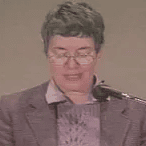
Cheney Promotes NEH Programs
In public statements during the recent National Council for the Humanities meeting and a congressional hearing before the House Subcommittee on Postsecondary Education, Lynne Cheney, who assumed the duties of Chairman of NEH almost a year ago, has taken the opportunity to highlight several NEH programs. She is particularly supportive of the Bicentennial Bookshelf, a program initiated this past September to encourage reading and discussion of the US Constitution. The program provides $500 matching grants to public libraries for the purchase of primary source material and reference books on the the US Constitution. Thus far, 848 public libraries have participated in this program.
Cheney is also devoting special attention to a study on the state of humanities education in elementary and secondary schools. In the 1985 reauthorization legislation for the NEH, Congress required NEH to conduct this study, which is to include an examination of “the current and future availability of qualified instructional personnel.” Congress also mandated that the report, which is to be completed this fall and sent to the President, the Congress, and the states, should make recommendations for encouraging humanities education in elementary and secondary schools.
A third NEH program that Cheney is emphasizing is the US Newspaper Program. This project is establishing a central bibliographic record of the 250,000 American newspaper titles published since 1690 and is microfilming those which are most historically important and which are endangered. To date, twenty-seven states are involved in this long-range project. NEH is currently encouraging the remaining twenty-three states to join this effort. If you wish more information on this project, either contact NEH directly or the NCC.
White House Forwards Names of Nominees for NEH Council to the Senate
On March 3 the White House Personnel Office forwarded to the Senate Committee on Labor and Human Resources the names of five people to serve on the National Council on the Humanities for an approval process that is usually pro forma. The nominees, for six-year terms on the twenty-six member Council which advises the Chair of NEH on policies, programs, and grant applications, are: Paul J. Olscamp, the President of Bowling Green State University and a former professor of philosophy; Anne Paolucci, a recognized playwright, poet, and scholar, and a professor of literature at St. John’s University in New York; Jean Smith, wife of William French Smith, former member of museum boards and the White House Fellows Board; John Shelton Reed, professor of sociology at the University of North Carolina; and Charles Moser, professor of Slavic languages at George Washington University.
Although Moser was nominated for the Council during the last Congress, his nomination met strong opposition, and the Senate Labor and Human Resources Committee decided not to act on his name because there was not sufficient time at the end of the session to delve into controversial nominations. The objections to Moser that surfaced last fall are being voiced once more. The major concern is that Moser would be intolerant toward diverse kinds of scholarship. Currently a director of Accuracy in the Media, a conservative group that monitors the news media, Moser has also publically supported Accuracy in Academia, a group that monitors college courses for liberal bias. In 1974, Moser participated in a bitter textbook censorship battle in West Virginia where he joined a parents’ group in attempting to ban textbooks that they called “anti-Christian, anti-American, depressing, and negative.” Last fall when questioned about his positions and activities Moser responded, “I think my positions are reasonable ones, and I’m prepared to defend them.”
During the last several years, many members of Congress have expressed concern that some of the nominees to the National Council on the Humanities had either inappropriate or insufficient qualifications for membership on this prestigious Council. Thus, in 1985 when Congress passed reauthorization legislation for the National Endowment for the Humanities, stronger language was included regarding the selection of council members. The Law states that members of the Council should be “individuals who 1) are selected from among private citizens of the United States who are recog nized for their broad knowledge of, expertise in, or commitment to the humanities, and 2) have established records of distinguished service and scholarship or creativity.”Additionally, the law requires that the members of the Council “provide a comprehensive repre sentation of the views of scholars and professional practitioners in the humanities.”
While several of those recently nominated have established records of distinguished scholarship and service to the humanities, others may only marginally meet the high qualifications established by the 1985 law. Since history is one of the major disciplines within the humanities and since substantial portions of NEH funds go to history related projects, there is a sense of great disappointment within the historical profession that this most recent slate of nominees did not include someone with expertise in history.
House Intelligence Committee Critical of Overclassification
In February the House Permanent Select Committee on Intelligence issued a report, “United States Counterintelligence and Security Concerns—1986.” One section of the report focused on overclassification: the classification of information whose disclosure could not reasonably be expected to damage the national security. The report concluded that the executive branch has not taken the necessary steps to reduce the amount of classified materials being produced. To illustrate the size of the problem, the report notes that the Pentagon alone classifies 11 million new items a year and some estimate that the total number of classified documents now numbers into the trillions.
Because controlling access to that enormous volume of material has become an unmanageable problem and has resulted in serious leaks of damaging information, the House Select Committee on Intelligence warns the administration that unless it undertakes an initiative to force those who classify to resist overclassification, there will be a “congressional restructuring of the classification system.” For historians one of the most significant aspects of the report deals with the findings of a recent Congressional Research Service study on overclassification. This study emphasizes the costly nature of overclassification and stresses that such an approach is counterproductive and does not strengthen the nation’s security system. In fact, the study concluded that overclassification “damages the credibility of appropriately classified information and the integrity of the classification system.”
NCC member organizations have identified classification policy as a priority issue for 1987. The House Permanent Select Commit tee on Intelligence report indicates that the climate may finally be conducive for exploring some alternatives to our present untenable classification system.
Vento Releases GAO Report Critical of the National Park Service
Congressman Bruce Vento, the chair of the House Subcommittee on National Parks and Public Lands, released in February a General Accounting Office report that has found that many park units lack completed or updated resource management plans and that little headway has been made in solving many of the parks’ resource protection problems. This report is of particular interest to historians because over half of the National Parks are historic or cultural sites and many of the threatened resources are historical artifacts and structures. Representative Ven- to expressed concern that the professional resource managers’ hands were tied, noting that the GAO found that although parks have proposed projects to address known resource problems, many projects have not been funded. To receive a copy of this re port, titled “Parks and Recreation: Limited Progress Made in Documenting and Mitigating Threats to the Parks,” and numbered GAO/RCED-87-36, write: US General Accounting Office, P.O. Box 6015, Gaithersburg, MD 20877. The first five copies of eaclh report are free. Additional copies are $2 each.