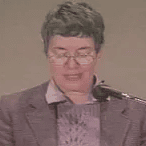
Announcement Expected on Nominee for NEH. There has been no definite word, as of press time, from the White House concerning a nomination for the Chair of the National Endowment for the Humanities. There is, however, increasing talk in Washington of the pending nomination of Lynne Anne Vincent Cheney.
Born in Casper, Wyoming in 1941, Cheney is now a Senior Editor of the Washingtonian Magazine. She holds a PhD in Comparative Literature from the University of Wisconsin and has written two novels—Executive Privilege and Sisters. In 1983 she coauthored with her husband, a member of the House of Representatives, a book about former leaders of the House, Kings of the Hill. She now serves as a member of the President’s Commission on the Bicentennial of the US Constitution.
Library of Congress. On March 3, Samuel Gammon, the Executive Director of the American Historical Association, testified on behalf of the thirty-eight NCC organizations before the House Subcommittee on Legislation to express the grave concern of the scholarly community about the disastrous consequences for the Library of Congress of the current budget cuts. Gammon addressed specifically the harmful results of reduction in hours, the reduction in acquisitions, and the reduction in cataloging. First, he noted that scholars will be handicapped by the reduction of hours, from 77 1/2 hours to 54 1/2 hours a week, in the general reading rooms. “When scholars,” he stated “come to Washington for a few days or a week to do research at the Library of Congress, they need to maximize their time.” On the issue of reduced acquisitions, he pointed out that once the decision has been made to reduce journal orders, the quality of the collection is very much in jeopardy.
Finally, he expressed distress over the staff reductions in the Library’s cataloging division. Scholars can only use material when they have access to it. The current cuts will result in the failure to catalog approximately 25,000 books. This is a serious matter for the entire scholarly community because the cataloging division of the Library of Congress, as our national library, provides cataloging data to libraries throughout the world.
The members of Congress need to hear from the academic community on the research implications of these cuts. The four most important people to contact, in addition to your individual Senators and Representative, are the chairmen of the appropriations subcommittees and full committees. Their names and addresses are: Chairman, Senate Appropriations Committee, Senator Mark Hatfield (R-OR); Senate Subcommittee on Legislation, Senator Alfonse D’Amato (R-NY); US Senate, Washington, DC 20510. Chairman, House Appropriations Committee, Representative Jamie L. Whitten (D-MS); Chairman, House Subcommittee on Legislation, Representative Vic Fazio (D-CA); US House of Representatives, Washington, DC 20515.
National Park Service. On March 4, the House Subcommittee on National Parks and Recreation held a hearing to consider H.R. 3921, a bill to establish the Richard M. Nixon National Historic Site at Nixon’s birthplace in Yorba Linda, California. Joan Hoff-Wilson, the Executive Secretary of the Organization of American Historians and a scholar of the Nixon presidency, urged that the site not be opened until after Nixon’s death. “Too much haste during the lifetime of a president can lead,” she noted, “to serious interpretation and structural problems.” Although Nixon is now most remembered for Watergate, Wilson stated that her research to date has convinced her that “as memories of Watergate dim, not only will certain of his foreign policy initiatives—particularly rapprochement with China and detente with the Soviet Union—place him among the most important presidents of the last fifty years, if not the entire century, but that he will also be remembered as a domestic reformer.”
Wilson also urged that the site reflect not only the history of one person such as the former president, but that the property in Yorba Linda “should be preserved as a generic example of small town, southern California culture in the first quarter of this century.”
I also testified at this hearing on behalf of the NCC and commended the use of historical sites for both historical research and for public education. Concerning specific provisions of the bill, the NCC recommended that in the interest of achieving some distance and objectivity, that the opening of the site be postponed until after President Nixon’s death. The NCC also recommended that the presentation include material on southern California culture in the early twentieth century and give some attention to Nixon’s entire life, not just the first nine years in which he lived in the Yorba Linda house. Finally, the NCC recommended that an Advisory Council, including historians, be established to insure that a balanced history is presented.
Some Additional Nixon Records May Be Available This Fall. On February 27, the Office of Management and Budget approved new regulations under which the Nixon records-including 40 million pages of documents and 4,000 hours of tapes would be opened. The proposed regulations have been sent to Congress for 60 days for review. The sticking point in the process seems to be a Justice Department memorandum, attached to the OMB regulations, which states that Nixon could still invoke executive privilege to keep some of the documents from becoming public. The Justice Department memorandum also raises questions about the authority of the Archivist in these decisions. Some concern about the Justice Department memorandum has been expressed and there is a possibility that hearings to clarify the issue may be held in April. Legislation passed by both houses of Congress would be needed to block or to change the OMB regulations.