In 2020, while running for New York State Assembly, Zohran Mamdani coined the slogan “Roti and Roses,” a play on the political refrain “Bread and Roses.” For the former rapper and MC once known as Mr. Cardamom, roti is key to his identity as a Ugandan of Indian origin as well as an immigrant to the United States.
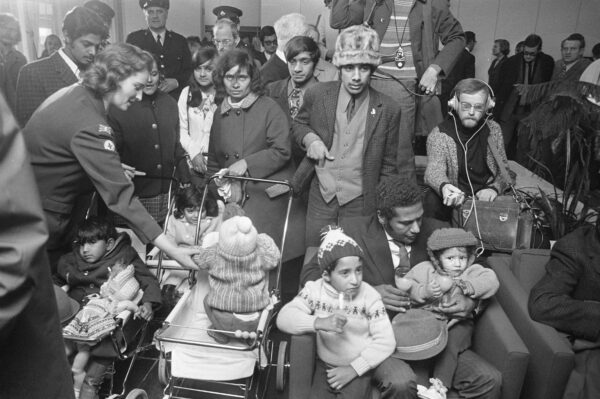
South Asians arriving in the Netherlands after being expelled from Uganda. Bert Verhoeff/National Archives of the Netherlands/public domain
Also known as chapati, the round whole wheat flatbread is a staple food in East Africa, carried from the subcontinent by migrants in the 19th and 20th centuries. Roti’s popularity in Africa reflects centuries of engagement between South Asia and Africa through Indian Ocean trade networks. That history is a key element of Mamdani’s cosmopolitan identity. “There’s no question in my mind that I’m Ugandan. There’s no question in my mind that I’m Indian. And there’s no question in my mind that I’m a New Yorker,” he said in a 2020 interview with Jacobin. “And I’m all of these things, yet in each of these places I’ve been made to feel that it’s not actually my home to call.”
Now the newly elected mayor of New York City, democratic socialist Mamdani soared in popularity through a campaign platform that centered the concerns of working-class New Yorkers. While he has been criticized for many of his political positions, his status as an immigrant and naturalized citizen has been targeted as well. Revelations that he had self-identified as both “Asian” and “Black or African American” on his 2009 application to Columbia University came under the spotlight in a New York Times article in July 2025, based on information from a digital hack of university records obtained by a conservative eugenicist. The “scandal” called to mind other cases of politicians falsely claiming minoritized identities, including Elizabeth Warren’s claims to Indigenous ancestry. Mamdani’s claims to an African identity were, however, based on his birth in Uganda as the descendant of migrants from South Asia, a broader historical context that critics ignored. Rather than seeing these multiple forms of identity as being mutually exclusive, Mamdani has been open about, and celebrates, the transnational roots of both his private and political lives.
Mamdani’s formative years were spent in Uganda and South Africa. His middle name, Kwame, is a tribute to the Ghanaian president and Pan-Africanist Kwame Nkrumah, and his African identity is part of how he locates himself in the world. His family history in Africa dates back over a century, as does mine. Like Mamdani, I am a third-generation African, with no legal claims to Indian citizenship. My great-grandparents migrated from Gujarat in the early 20th century. My maternal grandfather was born in Rhodesia (today’s Zimbabwe), as were both my parents. I was born and raised in the capital, Harare. While I took part in South Asian traditions and culture, I grew up in a specifically African context.
Africa became a “New World” for both Hindu and Muslim migrants seeking new opportunities.
Sustained South Asian migration to Africa began with the British colonial indentured labor system created after the formal abolition of slavery in 1833 and the expansion of British imperialism in Africa. Unable to induce Black Africans to work for them in their new colonies, the British contracted laborers from the subcontinent to work on railways in East Africa and plantations in South Africa. Many died in these labors; of the survivors, some chose to stay rather than return to the British Raj. When indenture ended in the 1920s, Africa became a “New World” for both Hindu and Muslim migrants seeking new opportunities. They often worked in trade or as civil servants in East Africa. In imperial racial hierarchies, Indians were placed between white Europeans and Black Africans, discriminated against as colonized populations but accorded relatively more rights than the majority population.
An African Indian identity has thus always been a contested one. After independence, many African nations developed indigenization policies that would redress colonial inequalities by transferring economic control to Black Africans. In Uganda, president Idi Amin expelled nearly all 55,000 to 80,000 Asians who held British passports in 1972, and Asians’ assets were seized and redistributed. While the policy targeted those who had not taken up Ugandan citizenship upon independence, even Indians with Ugandan passports were caught up in the expulsions, including Mamdani’s father. India refused to take the refugees, leading many to seek asylum in the United Kingdom. Indians’ wealth and privilege, along with their “foreign” origins, rendered them targets in the postcolonial period.
Mamdani’s family is a product of this history. Descendants of Gujarati Muslim migrants, his paternal grandparents were born in present-day Tanzania. His father, Mahmood, was born in Bombay but grew up in Uganda. Mahmood studied in the United States, participated in the US civil rights movement, and taught in South Africa and Uganda before joining the political science faculty at Columbia University.
Mamdani’s mother, Indian American filmmaker Mira Nair, met Mahmood in the 1980s in Kampala while conducting research for Mississippi Masala. The film tells the story of an Indian Ugandan woman, Mina, whose family flees Africa and settles in Mississippi. Mina falls in love with an African American man, their relationship transgressing the racial boundaries inflicted on them by society and their families. Mina’s complicated relationship with her heritage as both African and Indian in the United States reflects the sense of confusion felt by many members of double diasporas. She describes herself as “mixed masala,” a blend of multiple spices and origins.
Many of us, like Mamdani, know only Africa as a physical homeland. Indian communities across east and southern Africa have transitioned from being diasporic populations during the colonial era to becoming African. In Kenya, Indians are legally identified as the country’s 44th tribe. In Zimbabwe, postcolonial legislation constituted Indian businesses as Indigenous economic institutions. Our families’ lives and experiences call for a redefinition of an African identity beyond the colonial racial and ethnic categorizations that divided Black Africans into “tribes” and declared Indian migrants “alien” and “foreign.” By deracializing an African identity, Mamdani’s claims to being Ugandan make sense. Indians in Africa migrated as part of the imperial experience but lived as colonized subjects. They grounded their family’s lives in African spaces and made historical and geographical claims to belonging, rather than racialized ones. In this framing, Indians are reconstituted as African peoples, not foreigners.
Yet an African American identity carries its own complicated history and legacy. In response to Mamdani’s Columbia application, outgoing mayor and political opponent Eric Adams stated, “The African American identity is not a check-box of convenience. It’s a history, a struggle, and a lived experience. For someone to exploit that for personal gain is deeply offensive.” The term came into popular usage in the 1980s, advocated by civil rights activist Jesse Jackson as a way to give Black Americans back their history and acknowledge their African ancestry. As a racial and cultural identity in the United States, it carries the weight of enslavement, oppression, and segregation, and who can claim that identity has been widely contested. Barack Obama, the child of a Black Kenyan father and a white American mother, had his heritage and identity debated during his 2008 campaign and his presidency. As the daughter of immigrants from Jamaica and India, Kamala Harris faced similar critiques for identifying as African American. However, both Obama and Harris were born in the United States, and their personal histories are part of the broader lived experiences of African Americans today.
While Mamdani has argued he was not claiming a Black identity in his college applications, Black Africans who have migrated after the end of slavery have also struggled to fit in with an African American identity. Nigerian writer Chimamanda Ngozi Adichie has grappled with this, calling herself “a Black person without America’s blighted history.” African migrants to the United States often feel disconnected from an African American identity, treated as a separate diaspora. South African comedian Trevor Noah has talked about being a “cultural chameleon” and the difficulties of seeking inclusion in the United States as a “Coloured” person—a term used specifically in southern Africa to describe those of mixed-race origins. A shared Black identity, however, has allowed African Americans and Africans to find common ground through the history of Pan-Africanism. But Africans who are not Black are often left out of traditional narratives of transregional connections and solidarity between civil rights in the United States and decolonization in Africa.
This leaves many of us unclear about how to define ourselves. When I graduated from Georgetown University with my PhD in African history in 2021, I had to choose between wearing a stole for the Asian and Asian Pacific Islander Desi American community and a Kente stole for African American and African diaspora students. I ultimately chose the former, not wanting to claim a designation that has typically been associated with a Black identity. But in retrospect, I wish that I had chosen to highlight my African roots instead. Like Mamdani, I believe that an either-or option did not reflect the complexity of our backgrounds and history of our communities.
There is space for migrants to locate themselves—ourselves—in these connecting histories.
There is space for migrants to locate themselves—ourselves—in these connecting histories. Rigid definitions of race in the United States cannot always encompass Global South epistemologies and the experiences of Americans born abroad. Mamdani’s self-proclamation as African was not meant to dismiss the African American experience. An Afropolitan identity of cultural hybridity includes the African diaspora as well. Going beyond nativist Western and colonial definitions of the term “African” allows Africans in and beyond the continent to celebrate their global inheritances and legacies. It also allows migrant and diasporic communities to claim multiple forms of belonging.
Mamdani’s and my family history recalls the words and legacy of Steve Biko, a leader of the Black Consciousness Movement in South Africa. Biko defined a Black identity as a commitment “to fight against all forces that seek to use your blackness as a stamp that marks you out as a subservient being,” allowing Indian and Coloured South Africans who had experienced disenfranchisement under apartheid to find membership in a collective Black, and therefore African, political identity. Indians across Africa participated in nationalist movements, particularly in South Africa and Kenya, and connected with decolonization movements across the Indian Ocean as part of Global South forms of resistance.
While Africans of Indian origin in the United States like Mamdani are not part of the past encompassed by an African American identity, they can be part of the future of being African in America. Gambian journalist Sheriff Bojang Jr. argued in June 2025 that “Zohran would not only be New York’s first Muslim and first Indian-American mayor. He would be the first to carry the intellectual legacy of postcolonial Africa into the political heart of the West.” Mamdani’s intersectionality, he stated, was a form of “power, not confusion.”
Mayor Zohran Mamdani is a first in many ways, and I see myself represented by him. We can be African and South Asian and American, all at the same time. Mamdani celebrates his hybrid roots and legacies, an identification that checking a box on a form can never quite encompass.
Trishula Patel is assistant professor of history at the University of Denver.
This work is licensed under a Creative Commons Attribution-NonCommercial-NoDerivatives 4.0 International License. Attribution must provide author name, article title, Perspectives on History, date of publication, and a link to this page. This license applies only to the article, not to text or images used here by permission.