
John E. O’Connor, professor emeritus in the Federated Department of History of New Jersey Institute of Technology and Rutgers University, Newark, died on December 9, 2025, at age 82.
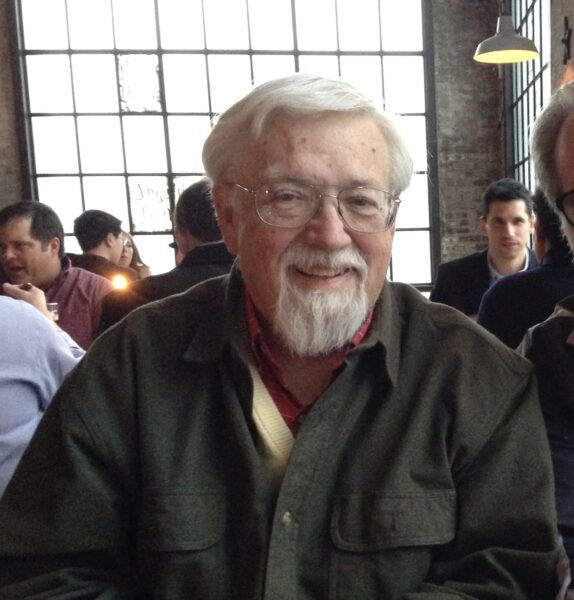
John E. O’Connor
John was born in Manhattan and raised in Westbury, New York. He earned his BA at St. John’s University (1965), his MA at Queens College (1968), and his PhD in American history at the City University of New York (1974), under E. James Ferguson. John began teaching history in 1969 at what is now New Jersey Institute of Technology (NJIT) in Newark, where he would spend his entire career, moving up the ranks to professor. In the 1980s, John founded, ran, and offered courses in NJIT’s first liberal arts major, Science, Technology and Society (originally called Man and Technology).
John began his career as a historian of New Jersey. His first book, based on his PhD dissertation, was William Paterson: Lawyer and Statesman, 1745–1806 (Rutgers Univ. Press, 1979). Considering that Paterson had been New Jersey’s second governor, a US senator, a Supreme Court justice, and a key contributor to the Constitution’s formation, he had received surprisingly little scholarly attention before John’s book. He also published on the history of Newark, in collaboration with Charles F. Cummings. In 1976, the two served on the Newark Bicentennial Commission and soon after published Newark: An American City (Newark Bicentennial Commission, 1979). Another collaboration, a 1984 article in New Jersey History on Bamberger’s department store and the culture of consumption in the decade leading up to the Great Depression, received the William Adee Whitehead Award from the New Jersey Historical Society.
In December 1970, John’s career took a fortuitous turn when he and Marty Jackson founded the Historians Film Committee. Its first newsletter, dated March 1971, explained its primary purpose: “to further the use of film sources in teaching and research” by historians. This was the origin of Film and History: An Interdisciplinary Journal of Film and Television Studies, which has remained in print continuously since that time, in affiliation with the AHA since 1975. This was also the start of John’s work in the field that would define his career.
In 1974, John and Marty produced Teaching History with Film, a pamphlet in the AHA’s Discussions on Teaching series, which John expanded in 1987 to include television. John and Marty’s 1979 edited volume, American History, American Film: Interpreting the Hollywood Image (F. Ungar; expanded ed., Continuum, 1988), followed a similar pattern, with John editing the companion volume, American History, American Television (F. Ungar, 1983). Throughout the 1980s, while editing Film and History, John continued to produce valuable publications in this field, including The Hollywood Indian in 1980; an American Historical Review article in the December 1988 issue on the importance of film and television study for understanding the past; and a major edited volume, Image as Artifact: The Historical Analysis of Film and Television (R. E. Krieger for the AHA Institutional Services Program, 1990), which begins with three foundational chapters by John on his methodologies. Many historians who came of age after 1990 credit these chapters with shaping their approach to film analysis.
Then, in 1991, tragedy struck. On the day he was scheduled to fly to Russia for a conference, John suffered a massive brain hemorrhage. After surgery and a long period of rehabilitation, he was able to return to teaching and scholarly editing but his abilities were greatly impaired. As John was recovering, the AHA (of which he was a life member) established the John E. O’Connor Film Award “in recognition of his exceptional role as a pioneer in both teaching and research regarding film and history.” First awarded in 1993, it recognizes “outstanding interpretations of history through the medium of film or video” in dramatic features and documentaries.
Beginning in the late 1990s, with support from his wife Mary and his son Will, John collaborated with Peter C. Rollins on a series of influential edited volumes on film and television history, mostly published by the University Press of Kentucky: Hollywood’s World War I (1997), Hollywood’s Indian (1998), Hollywood’s White House (2003), The West Wing (2003), Hollywood’s West (2005), and Why We Fought (2008).
Besides his scholarship, John will be remembered for his affability and punning wit. He was a fine colleague and a loving husband and father.
Richard B. Sher
NJIT and Rutgers University, Newark (emeritus)
This work is licensed under a Creative Commons Attribution-NonCommercial-NoDerivatives 4.0 International License. Attribution must provide author name, article title, Perspectives on History, date of publication, and a link to this page. This license applies only to the article, not to text or images used here by permission.