Janet M. Theiss, an associate professor at the University of Utah, made foundational contributions to the study of Chinese women, gender, law, and politics in the Qing era. She died on November 2, 2025, after an unexpected aortic rupture.
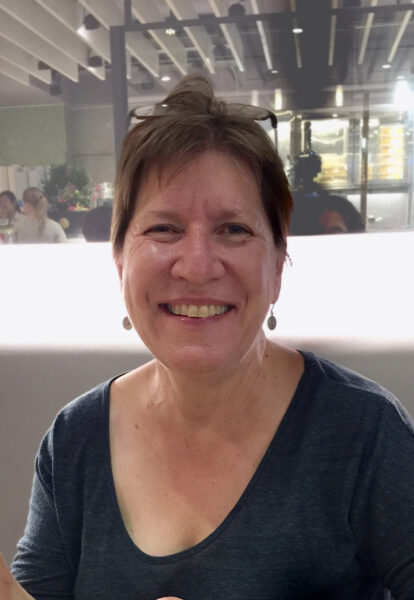
Photo courtesy Tobie Meyer-Fong
Janet grew up in a household characterized by sociability, service, and learning. Her father, Norman Theiss, was a Lutheran pastor, and her mother, Judith Eheim Theiss, was a music educator and elementary school principal. Janet grew up in Chicago before the family moved to Silver Spring, Maryland.
Janet loved ideas. At Swarthmore College, she majored in history and minored in English. An honors seminar on modern China taught by Lillian Li inspired Janet to shift her focus from Europe to China. Upon earning her BA in 1986, Janet undertook intensive Chinese language study at the University of Michigan. She then studied at Sichuan University, where she witnessed tumultuous student-led democracy demonstrations in 1989. After returning to the United States, she earned her PhD in history in 1998 from the University of California, Berkeley.
Janet joined a critical mass of scholars working to dismantle historiographical stereotypes of female oppression in pre-20th-century China. Janet’s first monograph, Disgraceful Matters: The Politics of Chastity in Eighteenth-Century China (Univ. of California Press, 2005), dissected the popularity of the female chastity cult. “Chastity” meant lifelong sexual fidelity to a husband or fiancé, and chastity martyrs could be canonized and commemorated. To uncover the experiences of nonliterate women, Janet analyzed criminal cases involving sexual assaults or the adjudication of female virtue. Her findings combined meticulous historical analysis with exquisite sensitivity to the voices of people in the past. She showed that Qing emperors promoted the chastity cult as the pillar of a civilizing agenda meant to reform both men and women. But women also deployed chastity norms in ways that subverted patriarchal interests. At the extreme, some women committed suicide when family heads insisted on hushing up “disgraceful matters,” for they knew their deaths would trigger criminal charges against their assailants.
Janet’s monograph project in progress, titled Scandal and the Limits of Self-Invention in Eighteenth-Century China, was centered on a scandal that ended the career of Zhejiang governor Lu Zhou and destroyed two elite lineages linked by marriage, the Feis and the Wangs. Madame Fei bribed Governor Lu to conceal her adultery, and both facts were exposed after he was impeached for corruption. The case became an empire-wide cause célèbre. Having pieced together this complex story, Janet was using it to illuminate the tensions between public virtue and private passions in Qing political and social life. In four published articles, Janet analyzed the elite-official networks that made bribery irresistible, the struggle between loneliness and loyalty in marriage, the narrative conventions of love letters, and how women used poetry to imagine their gendered selves.
Janet was deeply committed to teaching, service, and outreach. During her 28 years at the University of Utah, she offered diverse courses on Chinese and East Asian history and advised numerous graduate students. She was an institution builder, serving as the founding director of the university’s Asia Center and transforming it into a Title VI National Resource Center. Nationally, she led the revival of the Society for Qing Studies and oversaw its journal, Late Imperial China, as co-editor and associate editor. She served on numerous professional boards and committees, including the AHA’s Committee on the John K. Fairbank Prize and most recently as chair of the East and Inner Asia Council of the Association for Asian Studies. She also collaborated with Barbara Molony and Hyaeweol Choi to produce two works for a wider academic audience: Gender in Modern East Asia: An Integrated History (Routledge, 2016) and The Oxford Handbook of Modern East Asian Gender History (Oxford Univ. Press, 2026).
Janet was at home in the world, whether poring over documents in Chinese archives or accompanying her husband, archaeologist Bradley J. Parker, to sites in Turkey and Peru. Bradley predeceased her in 2018. Janet is mourned by an international community of colleagues, former students, and friends who remember her as a remarkable historian and person: adventurous, resilient, generous, affectionate, and humorous. She is survived by her daughter Tabitha Parker-Theiss, her father Norman and her stepmother Mary, and her sisters Jennifer and Tamara. The Center for Chinese Studies at the University of California, Berkeley, has established a memorial fund in her name.
Yi-Li Wu
University of Michigan
This work is licensed under a Creative Commons Attribution-NonCommercial-NoDerivatives 4.0 International License. Attribution must provide author name, article title, Perspectives on History, date of publication, and a link to this page. This license applies only to the article, not to text or images used here by permission.