
James Crooks, professor emeritus at the University of North Florida, died on August 17, 2025. He was 91 years old.
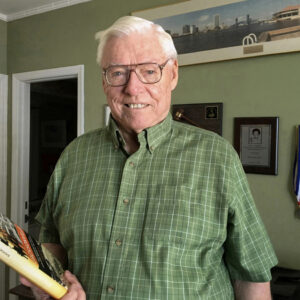
Photo courtesy Crooks family
Jim, as everyone called him, took an unusual path to the professoriate. Born on September 27, 1933, in Glen Rock, New Jersey, he graduated from high school in 1950 and attended Yale University, lettering in football. He interrupted his studies to serve as an army paratrooper before returning to Yale to earn his BA in American studies in 1957. In 1958, he married Laura Naomi Ward, who became a lifelong partner in education and activism.
Following a stint at Connecticut General Life Insurance, a line of work he did not relish, Jim began graduate studies in history at Johns Hopkins University, completing his PhD in 1964. While at Hopkins, he took part in the 1963 March on Washington, where he heard Martin Luther King speak. His wife Laura remembers this as having “a profound influence on Jim’s community involvement for the rest of his life.” The rising tide of the civil rights movement made a deep impression on his scholarship, teaching, and politics. Though those politics were unmistakably liberal, Jim had a knack for making his points in reasoned nonpartisan fashion. He preferred doing so over a satisfying meal and a glass of red wine.
If the start of Jim’s career was belated, his rise was steady. In 1964–66, he was a visiting lecturer at University College Dublin before he returned to the United States as an assistant professor at Hollins College. In 1968, he published his dissertation as Politics and Progress: The Rise of Urban Progressivism in Baltimore, 1895 to 1911 (Louisiana State Univ. Press).
In 1972, Jim became a founding faculty member at the University of North Florida (UNF), the state’s newly opened campus in Jacksonville. During a 29-year UNF career, he served as department chair, assistant dean, and interim dean of the College of Arts and Sciences and was awarded a Fulbright fellowship to Hyderabad, India. UNF recognized Jim with its highest honor, naming him a Distinguished Professor in 1992. Jim’s commitment to social justice shaped his teaching in fundamental ways. He developed courses on American cities and suburbs, urban children, and an honors seminar on American poverty. In all these courses, he encouraged students to engage with community agencies focused on issues of poverty and homelessness.
Jim also became a prolific historian of his adopted hometown, writing Jacksonville: The Consolidation Story, from Civil Rights to the Jaguars (Univ. Press of Florida, 2004) and Jacksonville After the Fire, 1901–1919: A New South City (Univ. Press of Florida, 1991). Race figured prominently in both narratives, Jim’s thesis being that modernization and political reform worked to the advantage of the white elites who managed and implemented these reforms rather than racial and other minorities whose progress was, at best, uneven.
That unevenness bothered Jim. After his retirement in 2001, he served on the Jacksonville Community Council, the United Community Outreach Ministry, the Jacksonville Human Rights Commission, and JASMYN, an organization advocating for LGBTQIA+ youth in the region. In 2010, he completed Creating a University: University of North Florida Faculty and Staff Remember 35 Years, a history of the university he had done so much to shape. Into his 90s, Jim continued to research and write on the history of Jacksonville and mentor the graduate and undergraduate students he employed as research assistants.
Jim worked tirelessly to leave behind a better world than he inherited. In his later years, he fired off frequent editorials for the Florida Times-Union, weighing in on the impact of campaign rhetoric on K–12 students, warning against xenophobia, and highlighting JASMYN’s work to provide LGBTQIA+ youth safe places to congregate and talk. Despite his enormous impact on his communities, he still keenly felt the unevenness of the progress he sought to effect. At his funeral, his daughter Sarah Crooks said, “My dad was a big guy,” whose life and career were animated by a desire to contribute to a more just and equitable world. “In some ways, he died unsatisfied.”
In addition to Sarah, Jim is survived by his wife, Laura; sister Betty Wilkin and brother-in-law David Wilkin; sister Marian Downie and brother-in-law Stephen Downie; son Peter Crooks and daughter-in-law Tina Crooks, and numerous grandchildren and great-grandchildren.
David Sheffler
University of North Florida
This work is licensed under a Creative Commons Attribution-NonCommercial-NoDerivatives 4.0 International License. Attribution must provide author name, article title, Perspectives on History, date of publication, and a link to this page. This license applies only to the article, not to text or images used here by permission.