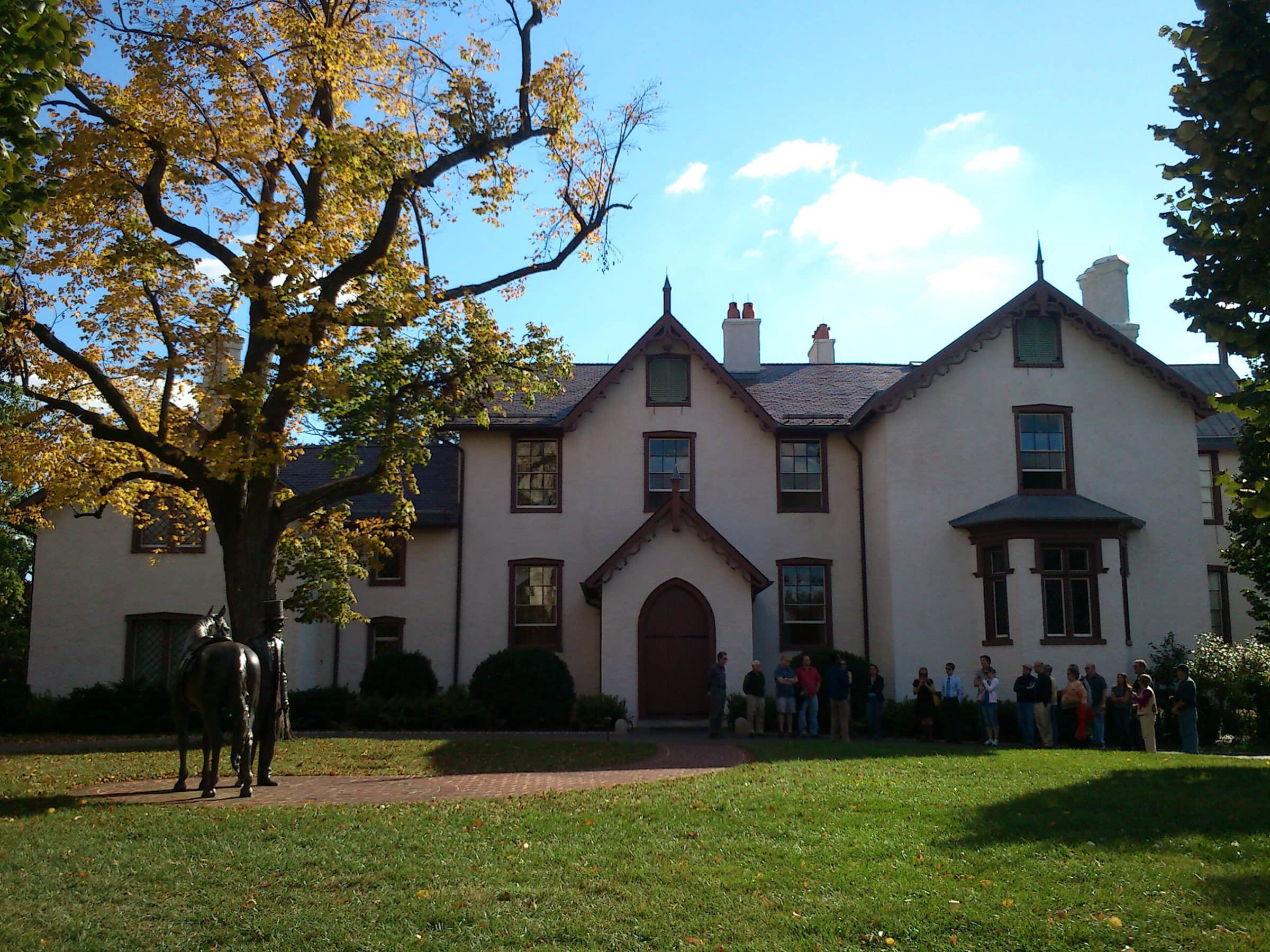
I was asked to serve as a sworn history expert and “fact witness” by the Borough of Allentown, New Jersey, as part of neighboring Upper Freehold’s planning board application to build nearly 500,000 square feet of warehouses within 1,000 feet of a state and nationally designated historic district in Allentown. During the hearing process, which lasted for 10 months, I testified twice for just under three hours: first on the site’s history, and later as a fact witness regarding issues of bias. We opponents to this development called our fight the Battle of Monmouth 2.0, because the site in question is tied to the 1778 Battle of Monmouth, in which General George Washington rallied his troops and held off a British assault in a crucial moment in the American War for Independence.
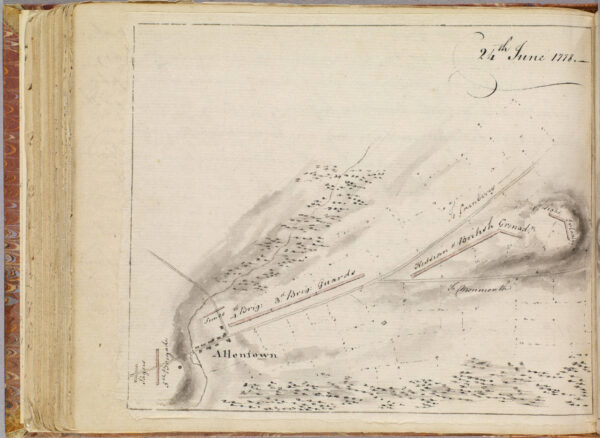
British Major John André’s map of the British encampment at Allentown was a key piece of evidence in proving the area’s historical significance. Journal of John André, 1777, June 11–1778, Nov. 15., fol. 75av, HM 626, The Huntington Library, San Marino, California.
There are many ways for historians to assist their communities when controversies emerge over land-use proposals, from zoning and planning board applications to the development of historic preservation ordinances. Those asked to serve as sworn expert history witnesses present and explain key facts that underscore the historical significance of land slated for development, usually aiming to stop or modify an application. Historians looking for other ways to contribute might submit comments on government agency reviews of development applications and help interpret evidence to determine if land development projects will undermine or support historic preservation. The role of a sworn expert history witness sometimes transforms into a media-relations role, with research and scholarship quoted in news stories for print and electronic sources. Additionally, one can craft op-eds for publication; I published five about this case in New Jersey newspapers. Typically, a sworn history expert is hired by a developer, a township, or citizens opposing or supporting a particular project when a dispute over the historical record must be resolved. In this case, I volunteered my services, because I live in the town where mega-warehouses were poised to erase a historic site.
Historians asked to serve as sworn expert history witnesses present and explain key facts that underscore the historical significance of land slated for development.
Starting in May 2023, I began research intended to help establish that approximately 10,000 British soldiers camped from June 24 to 25, 1778, in the village of Allentown, then part of Upper Freehold Township. I relied on primary sources from the Huntington Library, Founders Online, the George Washington Papers, the Library of Congress, and other institutions. With the upcoming America 250 commemorations in view, I advocated for the preservation of the encampment site.
The developer hired a team of archaeologists to investigate the site, who argued that there was no proof placing the encampment on the land proposed for development. But their findings included contradictory numbers of soldiers present at the Allentown encampment. In response, on August 4, 2025, the New Jersey Department of Environmental Protection (NJDEP), through its Historic Preservation Office (HPO), ordered the developer’s team to redo their archaeological study of the site using “systematic metal detection protocols” and to plow the land consistent with agricultural sites like this one, which has been farmed for centuries. Secondary metal detection after plowing might identify items not found in other ways. HPO challenged the conclusion of the developer’s archaeological team, which had dismissed primary source evidence. The NJDEP denied various permits, and a five-page memo to the developer’s archaeological team submitted on August 4 concluded: “Taking the aforementioned information into consideration, the HPO cannot recommend approval of the Freshwater Wetlands permit at this time.” Without a permit, the massive warehouse development plan in Upper Freehold could not proceed, but the developer continued to appeal these permit denials.
My tasks in this case included reading each of the rejected archaeological reports and HPO notes, commenting on inconsistencies in the first report, and putting key historical facts on the record before the Upper Freehold Planning Board hearings in June 2024. Subsequently, my testimony and report were placed in writing with the NJDEP. I shared public comments made on the archaeological report and on the New Jersey Open Public Records Act via Facebook and with the media. On June 26, 2025, I testified before the New Jersey Senate Budget and Appropriations Committee in Trenton when the developer’s representative presented the findings of his archaeological team. My chief role was to showcase significant primary documents, including maps, and secondary sources. In my testimony, I corrected misrepresentations of historical facts and inaccurate assertions made by members of the Upper Freehold Planning Board and the developer’s lawyer and team.
This is not a role for those uncomfortable with confrontation: Even as the developer’s attorney challenged my credentials, I could not get flustered. My job was to put on the record key facts regarding Washington’s role in directing troops to the site, to introduce and walk through British Major John André’s map of the British encampment, and to identify possible skirmishes among the British, Allentown residents, and Continental forces as documented by primary and secondary sources.
In one exchange, officials who supported building the warehouses suggested that our primary document was forged. The Upper Freehold Township mayor, who served on the town’s planning board, questioned the authenticity of André’s map, held in the Huntington Library collection, noting that the spelling of Allentown was inconsistent with historical usage of the name. To refute the mayor’s assertions, I found four variations of the spelling of Allentown in primary documents among the George Washington Papers and Founders Online. I also had the opportunity to educate the board members, explaining that Allentown was part of Upper Freehold Township until 1889, when the village was divided into separate townships. This matter of a name, which may seem foolish to argue about, was an attempt to undermine our credibility and that of the documents. In cases like this, the historical evidence can itself be the guide for discussion and argument. We prevailed on this issue: The developer’s archaeologist ultimately agreed that the André map was an original.
Some community members suggested on social media that those of us advocating for the preservation of a British encampment were “traitors” to the United States—“transplants” who came from outside the community and were unable to understand Upper Freehold’s historical roots. Part of the public testimony was designed to debunk these assertions and demonstrate that the British encampment posed an important military target. Following a comprehensive review of the primary documents, my 14-page report focused on five key exhibits of letters and orders to or from General Washington about the British encampment in Upper Freehold, which joined the division led by Lieutenant General Wilhelm von Knyphausen, encamped in Imlaystown, before marching toward the site that would become the Battle of Monmouth on June 28, 1778.
This is not a role for those uncomfortable with confrontation.
One document made the clear case that Continental Army leaders were fixated on the British encampment. On June 24, 1778, General Washington ordered a detachment of 1,500 men to intercept the British. Washington and other military leaders focused on the British encampment in Allentown and British movement through the state (see Founders Online, “Council of War, 24 June 1778”). The intelligence briefing during the American Council of War described two moving columns, one headed for Allentown. The orders contained this directive: “A detachment of fifteen hundred men to be immediately sent to act as occasion may serve, on the enemy’s left flank and rear, in conjunction with the other Continental troops and militia, which are already hanging about them.” The Council of War document also noted that “in addition to this force, from the amount given by Genl Dickinson there appear to be about 1200 Militia, collected in the Neighbourhood of the Enemy, who in conjunction with General Maxwell are hovering on their flanks & rear and obstructing their march.”
I was the only sworn witness for Allentown on any subject to submit a written report with initial testimony. And though the planning board did not cite my report in its final application approval resolution, my research helped bolster support from national and local historical advocacy groups. The findings were shared with members of the media, the Monmouth County Commissioners, and the New Jersey Governor’s Office and staff to assist with their efforts to justify preservation funding. Prior to my 2024 testimony, I prepared fact sheets for distribution to the media; Upper Freehold Township officials (who refused to accept them based on an attorney ruling); local, county, state, and national political officials; and historical advocates. Local and national media covered the hearing, the community protests, and its aftermath in subsequent interviews. The historical facts themselves received strong press coverage. But history did not influence the overwhelming majority of planning board members, who voted 8–1 to approve the warehouse application in December 2024. The matter headed for the courts, with Allentown Borough suing Upper Freehold to stop the warehouses, due in part to the site’s historical significance.
On November 6, 2025, I learned that the Monmouth County Commissioners have agreed to preserve the Revolutionary War land in Upper Freehold Township. Commissioner Ross Licitra did not provide details, because as of this writing they are not yet publicly available, but I was given permission to share this good news and thank the national, regional, state, and local history groups and historians that helped fuel the successful preservation. This decision underscores that such advocacy can work. A coalition of community activists and citizens protesting, writing letters, signing petitions, and testifying at public hearings—along with historians and national, state, and local history groups; local leaders in Allentown; and the critical funding support of the Monmouth County Commissioners—won the Battle of Monmouth 2.0 and changed the fate of this historic place.
Sue Kozel is an independent scholar; co-editor of Quakers and Their Allies in the Abolitionist Cause, 1754–1808 (Routledge, 2016); and a former fellow with the International Center for Jefferson Studies.
This work is licensed under a Creative Commons Attribution-NonCommercial-NoDerivatives 4.0 International License. Attribution must provide author name, article title, Perspectives on History, date of publication, and a link to this page. This license applies only to the article, not to text or images used here by permission.