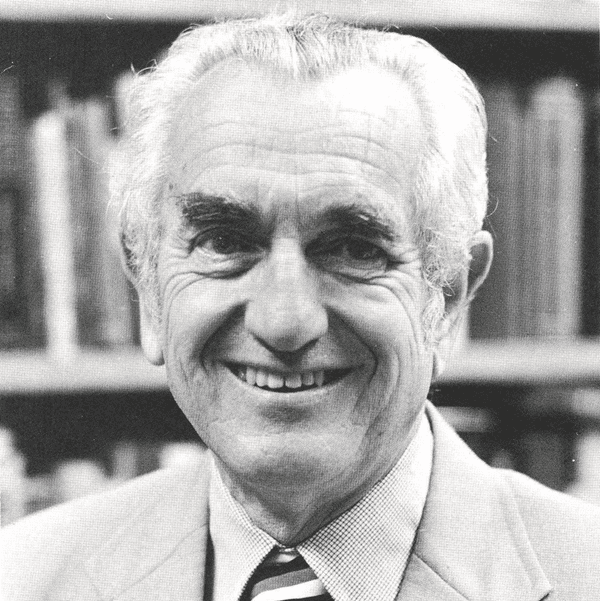
In the spring of 1985, the Council of the AHA asked me, as the incoming president, if I would be willing to visit some history departments around the country. The tour’s purpose was to obtain a sense of the state of our discipline and, in the process, “to show the flag” of the Association.
The idea appealed to me on several grounds. I like to travel, I enjoy visiting college campuses, I relish talking history, and I wanted to do something of possible value for the Association. Besides, it was conceivable that departments might like to have a visitor from the rather distant AHA.
These interests were satisfied, thanks to the generosity of my department and Stanford University, which relieved me of teaching for a quarter (April to June) while continuing to pay my salary. I was also substantially aided in the endeavor by the warm welcome the idea received from the chairs of those departments to which I invited myself. Although my visit usually meant a serious interruption in their routines, I was cordially received by the departments, the members of which graciously gave generously of their time in meetings with me often at considerable length. The cordiality and involvement can also be measured in the weight I added thanks to the good meals and to the equally good discussions.
In planning the trip, I wanted to visit various parts of the country and different kinds of institutions. In the end, I stopped at two departments in Texas, two in southern California, three in Oregon, two in Iowa, one in Wisconsin, three in Pennsylvania, three in Georgia, and three in Washington, DC. While at some of these institutions, I also talked with two groups of high school teachers, and spoke before a high school class in Milwaukee. Financial costs of the trips, including transportation, were generously and forthrightly borne by the academic institutions.
By another system of counting, the places I visited included several state universities, a number of private small liberal arts colleges, two single-sex institutions, three history departments in government agencies, one Ivy League institution, one black college, one high school, and two urban universities.
Yet, despite the effort to cover as wide a selection of institutions and parts of the country as the limited time permitted, the sample cannot be described as representative; the study is hardly scientific. A different mix of institutions might well have resulted in quite different conclusions. Nevertheless, I think the places where I did stop told me a good deal about what is happening in the profession, even if the impressions fall short of being drawn from a strictly representative array of institutions and locales.
Since my primary purpose was to learn about what a given department was doing, or contemplating doing, I deliberately stayed away from giving lectures or formal talks, though in a few cases, for special reasons, I broke that rule. That rule, however, did not mean I was silent. In fact, I fear I may have talked more than I should have.
By talking some about the Association and its American Historical Review, however, I was able to elicit a number of observations and suggestions from members and non-members alike. I was especially concerned to pass on to them Editor David Ransel’s wish to increase the number of publishable articles sent to the Review. Chances of publication for good, appropriate articles, he had assured me, were better than many members apparently think.
On the whole, faculty members and graduate students seemed pleased with the Review, finding its goal of covering the whole field of history impossible to achieve, but necessary to pursue. Only an occasional faculty member thought that the Review ought to abandon the publishing of articles on the grounds that the large number of specialized journals made the AHA vehicle unnecessary.
The consensus that emerged in regard to the Review was that the emphasis should be on articles that elucidate developments in a particular field and are intended for those readers who are not in the field. Historiographical pieces, articles that critically evaluate the research on “the cutting edge” were preferred, rather than detailed, near monographic studies. Consequently, as one senior professor at a prestigious state university remarked, couldn’t the Review publish more pieces that required less heavy documentation? Most of the articles the AHR now publishes, she contended, would require only an other six months of work to become full-fledged books.
Virtually everyone approved of the so-called Forum articles, which Editor Otto Pflanze instituted some years ago.
Although the reviews in the AHR were generally praised, almost everyone thought that the editor must be strong-minded enough to discriminate between books worth reviewing at greater length than others. Some faculty members and graduate students asked for more incisively critical reviews. One or two faculty members urged the AHR to review text books, arguing that since such books reached the largest audience of all, the profession had an obligation to evaluate them.
What does not sit well is the all too common implication that professors are always the instructors and high school teachers always the students.
High school teachers, and some professors at undergraduate institutions where teaching is emphasized and specialized articles are less pertinent to the professor’s teaching, wondered if it would be possible to create a class of membership that would entail a lower fee. The new membership would not include the Review but only Perspectives.
The purpose of such a class of membership would be to enable the Association to attract a broader range of members. Another suggestion for achieving the same end was to create joint memberships with other journals, a suggestion that to many seemed only to introduce other problems.
Another recommendation for the Review was that issues devoted to a single subject might be offered for separate sale since members in the past have found such issues useful. An additional idea was that an article reviewing and relating community studies, local history, and public history would bring those fields before the Association as they ought to be, yet rarely are.
At my insistence, a number of faculty members made suggestions for the Association in general. Several people, including one Dean, emphasized the need for the Association to implore or prod foundations and other funding agencies to recognize the need for new PhDs in history and the humanities that would come upon us in the early 1990s, when college enrollments were expected to rise. The hope was to initiate programs comparable to the Woodrow Wilson Fellowships of the 1960s and early 1970s as a means of attracting promising young people to graduate study in anticipation of the coming need and opportunities.
Faculty members at smaller institutions complained that they often felt passed over for appointment to AHA committees. One answer to that problem, it seemed to me, was for members to recommend themselves to the Committee on Committees of the Association. There is surely nothing inappropriate about self-recommendations and much that is desirable since the Committee, like the Association, seeks to bring as many members into its activities as can be properly done.
Several persons at different departments asked if the AHA might consider developing guidelines for graduate programs in history. Most faculty members were aware that this was not a new suggestion, but at the same time they also recognized that some departments were not well enough endowed in faculty, library, fellowships, and so forth to offer advanced graduate work, yet were expected to. On the face of it, the AHA did not seem to be in a good position to deal with such a large and difficult issue, but at the same time, it was dearly not a peripheral issue for departments and administrations.
Most of the issues raised about the Review and the Association’s activities, important as they are, did not come as surprises. In contrast, however, two aspects of the work of history departments were distinct surprises to me. The first was that a number of departments have forged special relations with their surrounding communities, particularly with local secondary schools.
Sometimes, as in the case of Rice University, for example, the community/history department relationship is an annual history contest among local high schools students to encourage history in the schools, and in the process arousing the interest of good students in applying for admission to Rice. In other institutions it takes the form of deep and continuing involvement in large scale activities like History Day or History Fair.
In the latter activity, San Diego State University undoubtedly stands out. For several years the department has been operating a History Fair that is international, bringing together the high school students of San Diego with those in Tijuana, across the border in Mexico. Between two and three thousand students enter these fairs each year, producing a large variety of exhibits, historical papers, and performances, largely in connection with local history. At Iowa State, also an active department in History Fair, I witnessed a video tape of a winning exhibit, which was a near professional dramatic presentation by young teenagers of the public life of Richard Nixon, which they wrote—as well as acted out—from their research in original documents on the high points of Nixon’s life.
Temple University and the University of Pennsylvania also have broad programs for reaching high school teachers, either in the form of participation in History Day (Temple) or in the Penn Institute in Social History (Pennsylvania), which introduces high school teachers to community research and writing. One professor at Temple also conducts a course in Philadelphia history for journalists at the Philadelphia Inquirer, a course that has gradually become an inquiry into the nature and writing of history.
Several departments reported that they have developed lecture series or workshops for high school teachers, their value to the teachers is reflected in their willingness to give up free time to attend them. My conversations with secondary school teachers made clear that they appreciate opportunities to work with or to learn from college and university colleagues. What does not sit well is the all too common implication that professors are always the instructors and high school teachers always the students.
I was especially gratified to find so many departments reaching out to high schools and welcoming greater contacts among professionals in history. This interaction is especially important to secondary school teachers, since as one observed rather ruefully, some high schools still assign athletic coaches with out historical credentials to teach history or social studies.
My second surprise was to learn how widespread and generally successful public history is. Several departments have programs for training graduate students in museum work, conservation, preservation, or archival work. In most cases these programs were developed out of the existing faculty; occasionally they were brought into being with new personnel.
Several institutions, Temple University and San Diego State University in particular, have built their training programs around established and important archives of local history. Since the impetus to the founding of such programs had been the dearth of traditional academic jobs, it was rather ironic to learn that in all cases demand for graduates of the programs is high.
Apparently, the public history movement has serendipitously uncovered a new and broad social need for historians. The University of Houston has found, for example, that graduate students in its public history program in Middle Eastern history have a natural source of jobs in the oil businesses of their metropolis. It is a striking example of how public history can move beyond the United States field.
. . . the historians of the Senate are a good example of how historical work has moved into the public realm in recent years.
The University of Wisconsin at Milwaukee was especially proud of its program in public history, which entails the completion of all the work for the regular MA degree in history. The department at Portland State regretted having to abandon its program because of the state’s financial squeeze, but there, too, public history had been a placement as well as a professional success. A few departments expressed little or no interest in public history, yet the chairs of some other departments are dearly looking toward developing such programs. It is worth noting, however, that the faculties at these same institutions frequently do not share the same enthusiasm. But faculty members too often forget, one chairman observed, that public history programs, by bringing in students who also enroll in courses unrelated to public history, thereby help a department to sustain a broader range of offerings than otherwise could be supported or justified.
Some of the graduate students in public history I talked to were deeply—almost reverentially—committed to the importance of local or community history, though it was also clear that the jobs available in the field are unlikely to be of such a character. Indeed, as some of the public historians working for the federal government emphasized, there is a real danger that public historians may well be compelled to tailor their findings to their employers’ wants. As one such historian observed, the public and the employers of historians do not always know what history is, what it can do, or how it can be used. Too often it is taken to be merely the unearthing of facts, without appreciating how laden its substance is with values and how much those “facts” require informed interpretation to be properly understood.
The practicing public historians I visited in Washington provided me with an excellent description of what they do. Among other things, they do a good bit of teaching, largely through their response to questions from historians and others. The historians in the Army, of course, have a long institutional history, but the historians of the Senate are a good example of how historical work. has moved into the public realm in recent years. The present Senate leadership is so committed to uncovering and preserving the history of the Senate that the historical office instructs each Sena tor upon assuming office on the importance of preserving and disposing of his or her papers. Needless, to say, oral history plays a large role in this historical enterprise. Not surprisingly, therefore, an expert in that field is already on duty in the office. Soon the House of Representatives will also establish a Historian’s Office, growing out of the office for the bicentennial of the House, which is staffed by able historians.
Although the public historians of the government find themselves dealing with the rather limited subject matter of their particular post, such as US military history or the diplomatic history of the United States, the individual historians themselves, who usually have been trained in a variety of fields, continue to maintain an interest in those fields. Many continue to work, on their own, in their special interests, though such activity if it results in publication, has little impact on their professional status. They do not receive the sabbaticals of academic historians, but they do have opportunities to attend national historical conventions and to organize their own seminars in historical subjects.
Unlike some academic historians with whom I talked, public historians—at least those I visited with—have a strong interest in the practical or policy uses of history. Before I embarked upon my travels I had read with appreciation Richard Neustadt and Ernest May, Thinking in Time, which seeks to show how history might be used in formulating public policy. When I raised that issue with the historians at the State Department, I found it was a subject they had discussed at some length, and not only because Ernest May is a member of their advisory committee. In fact, the historians at the Department are presently devising ways of testing the validity of Neustadt’s and May’s recommendations on the use of history in the formulation of public policy.
The uses of history was a subject that I raised repeatedly in my conversations with students as well as with faculty just because I thought it was a way in which history was not usually discussed. Students, interestingly enough, varied a good deal in their willingness to discuss how useful history is. Most students, at least at the outset of our talks, seemed to have concluded that history is so mutable, so interpretative, and so imprecise that it is not really pertinent to the making of public policy decisions.
Yet after some prodding and discussion, it became clear that everywhere students find history not only interesting or fascinating—as they were a little too prone to say—but also that it gives them a special way of looking at the world. Several students told of their having left some social science department in favor of majoring in history because history is more open, more interpretative, even more subjective, if you will. History as a subject, they re marked, offers opportunities for great er divergence of points of view.
When we came to talk about how one might use history, the students some times came up with analogies or “lessons” from the past, but there were always some students present who dissented, dismissing analogies as subjective and self-serving. Some were even sufficiently aware to point out that analogies in history were usually drawn on to clinch an argument about policy rather than to view the past as a way of understanding the present.
Not all undergraduates were as articulate and incisive as a young woman I lunched with at Emory University who lucidly set forth the importance of process and context in history when applied to policy formulation. Yet a strikingly large number of students I talked with expressed the same idea, if somewhat less succinctly or elegantly.
On the whole, the undergraduate students were highly committed to history, saddened a little, but not distressed, by its often being seen as impractical or lacking prestige at their college or university. In the private conversations I had with undergraduates they showed themselves to be eager to discuss quite specifically history’s virtues and limits, both abstractly and concretely, which sometimes meant particular courses and teachers. Again and again, I received the impression from these conversations that their history classes place a heavy emphasis upon good teaching, that is, instruction that engages the individual student, demands textual analyses, and calls for interaction between student and teacher and among students.
If there was one thing undergraduates wanted more of, it was greater attention to the ways through which interpretations of the past are shaped by the social and intellectual environment within which the historian writes. This was even true of students at small institutions, where one might expect the emphasis upon small classes and probing teaching to emphasize such an approach,
I came away with the impression that history faculty are reluctant to be as self-conscious about their craft as, for example, social scientists often are. Openly reflecting on their subject as a way of thinking is apparently not something historians do very much. Nevertheless, students still seem to leave their classes with a recognition that the study of the past provides a distinctive way of thinking in the present.
Visitations in the order in which they were made:
University of Houston; Rice University; University of California, San Diego; San Diego State University; Iowa State University; Grinnell College; University of Wisconsin, Milwaukee; Riverside University High School, Milwaukee; University of Pennsylvania; Temple University; Bryn Mawr College; Emory University; Spelman College; University of Georgia; University of Oregon, Reed College, Portland State University, Oregon; Historians of Department of State; Historians of the Senate; and Historians of the Department of the Army.