
The 131st volume of the American Historical Review opens with broad, global interventions of historical research, with articles in the March issue on Indigenous resistance, child removal, the intertwining of history writing and politics, and the genealogy of the word nakba. The History Lab includes a forum on the global history of abortion and a new #AHRSyllabus project, Authoritarianism 101: A Global History.
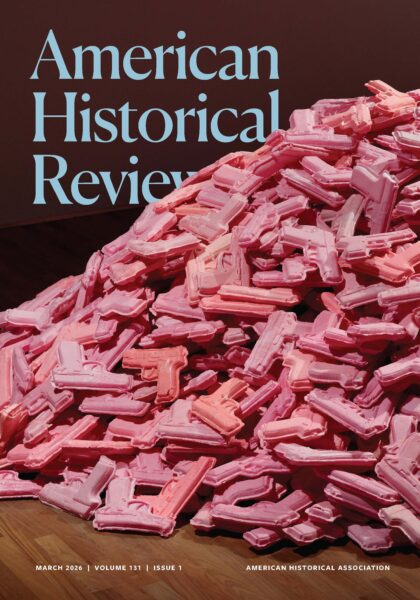
The cover of the March 2026 issue features a 1977 art installation by 25-year-old art student FX Harsono. Harsono was among the leaders of the Black December movement against the authoritarian state in 1974 Indonesia and an organizer of the New Art Movement’s foundational exhibitions, the subject of Mark Philip Bradley’s #AHRSyllabus module in Authoritarianism 101: A Global History. What Would You Do If These Crackers Were Real Pistols? shows a massive pile of hot-pink crackers shaped like pistols on the exhibition floor. Harsono intentionally used everyday objects to push back on what he saw as outdated notions of artistic creation and originality. Harsono also wanted to draw viewers closer into the work itself and create a space where they could critically reflect on contemporary society at a time when the military’s control severely limited free speech, prompting viewer responses to the question he used to title the work: What would you do if the pistols were real?
First is AHA president Ben Vinson III’s address, delivered at the AHA annual meeting in Chicago on January 9, 2026. In “Reflections on Our Times: Higher Education in Focus,” Vinson discusses what he calls the “massification of higher education” and argues that members of the academy, and historians in particular, have a unique opportunity to shape education. Amid the “polycrisis” of higher education, he proposes a nine-point agenda as a starting point, concluding that “change is ours for the making in these times, and that as colleagues, and as historians, we are poised to make a greater difference for a better future ahead.”
In “Indigenous Women and the Politics of Maternalism in Nineteenth-Century Buenos Aires, Argentina,” Hannah Greenwald (Gettysburg Coll.) examines the lived experience of women whom the charity organization Sociedad de Beneficencia displaced and forced to work as unfree domestic laborers for wealthy families. Greenwald shows how some women’s calls to bring attention to their mistreatment forced Argentine political elites to question the nature of citizenship. She argues that this Indigenous resistance under settler colonialism provides insight into the complex relationships among gender, race, and social class in the construction of settler colonial nation-states, shedding light on Argentina’s incomplete project to eradicate Indigeneity from its national borders.
“Domesticity in Precarity: Child Removal in Colonial India” by Jessica Hinchy (Nanyang Technological Univ. Singapore) focuses on the Sansi people and the separation of their children in British India, an area in the history of child removal that has not been robustly studied. She argues the story of child removal among Sansi—a socially marginalized, low-caste, and itinerant group deemed a “criminal tribe”—suggests that precarity can be both disruptive and productive of domesticity. The article proposes a framework of “domesticity in precarity” and suggests that interrogating the relationship between domesticity and precarity widens our view of the relationships and spaces that historically constituted the “domestic.”
Stefania Tutino (Univ. of California, Los Angeles), in “Ideological Biases and Professional Standards: History Writing and Politics in Seventeenth-Century Catholic Europe,” focuses on the Dominican friar Abraham Bzowski, or Bzovius (1567–1637). Tasked with continuing Cesare Baronio’s Annales Ecclesiastici, a historiographical project of post-Reformation Catholicism, Bzovius produced 12 additional volumes in his life, which were all controversial. Tutino discusses the conflicts that Bzovius’s work provoked and demonstrates that though his name might be unknown even to most early modern historians, his case elucidates crucial aspects and insightful considerations on the ways in which history writing and politics are intertwined today.
In “Nakba: Catastrophic Ideation and the Meanings of Disaster (1895–1948),” Adrien Zakar (Univ. of Toronto) delves into the formation of nakba in Arabic as a concept of disaster and a social practice of catastrophic ideation. Stretching into the Ottoman past, Zakar charts the layered genealogy of nakba prior to its use for the events of 1948 in Palestine. His research reveals how catastrophic ideation foregrounded persistent idioms in Arabic, Turkish, Armenian, and English beginning in the 19th century to mark varying degrees of political urgency and exceptionality. With this analysis, Zakar examines how the Nakba of 1948 Palestine prompted a generation of Arab intellectuals to redefine standards of selfhood, sovereignty, and objectivity.
The March History Lab opens with a forum on the global history of abortion. In “Traveling Abortions,” Lynn M. Thomas (Univ. of Washington), Mytheli Sreenivas (Ohio State Univ.), Natalie L. Kimball (Coll. of Staten Island, CUNY), Lina-Maria Murillo (Univ. of Texas at Austin), and Sarah Mellors Rodriguez (Emory Univ.) challenge the narrow view of abortion as a national saga of the recent past and foreground traveling histories of abortion over fractured domestic landscapes and across international borders. The collection of essays highlights three forms of travel: the movement of abortion seekers and providers; of beliefs, ideas, and social movements that sculpted the landscapes that abortion seekers and providers traversed; and of technologies, including the international development and circulation of vacuum aspiration and birth control foam. Their focus on movement foregrounds that abortion debates in different communities and countries need to be understood in relation to one another, because practices and politics routinely crossed boundaries and borders.
Two History Unclassified pieces are featured in this issue. In “Exchanging the Pen for the Camera,” Matthew Pehl recounts his experience making a documentary short, Cowboy Strike, on a labor conflict in late 19th-century Texas and his collaboration with a contemporary songwriter. The filmmaking process raised a series of dilemmas and opportunities for historical interpretation distinct from written scholarship, and Pehl argues that the production of nonfiction film offers scholars a powerful exercise through which they might rethink their subjects, and even the nature of the past itself.
Bethany Johnson (Univ. of North Carolina at Charlotte) also turns to creativity in her essay “The Poetry of Failure.” Using poetic inquiry as a method to get “unstuck” in the face of waning inspiration, Johnson extracted and artfully rearranged words and phrases from institutional records and reports, letters, and logbook entries of influenza orphans at Girard College. Her short, haiku-style poems allow the reader to reflect on how poetry and historical analysis connect us to the depth of human experience.
The issue rounds out with a new #AHRSyllabus project. Authoritarianism 101: A Global History offers teachers and students a broad perspective on the history of authoritarianism. The AHR commissioned teaching modules that explore a singular instance of an authoritarian past from 30 historians of Africa, Asia, Europe, Latin America, the Middle East, and North America. Temporally, the resulting modules range from the 17th to the early 21st century, with the majority concentrating on the long 20th century. Six appear in this issue, and all modules will be available free to read on the project website, along with supplemental materials like project-wide reading lists.
These six cover a wide range of places and circumstances. Three offer lessons on the 1970s: Barbara Weinstein (New York Univ.) looks through the lens of a striking 1970 photograph of then student activist and later Brazilian President Dilma Rousseff facing a military tribunal; Samuel Fury Childs Daly (Univ. of Chicago) examines testimony at the state trial of Fela Kuti, an Afrobeat musician and opponent of the 1970s military government in Nigeria; and AHR editor Mark Philip Bradley’s module features a provocative installation by a dissident artist in 1970s Indonesia (the issue’s cover features a detail of this work). Turning to the 1930s, Lauren Stokes (Northwestern Univ.) focuses on Adolf Hitler’s 1933 “Law to Remedy the Distress of the People and the Reich” speech and Louise M. Young (Univ. of Wisconsin–Madison) draws on an oral history with a Japanese woman living in Manchuria to explore why she came to support Japan’s military authoritarian government. And finally, Adrian Chastain Weimer (Providence Coll.) considers how representative governments defended themselves against royal authoritarian practices through a 1665 New England town’s petition to Charles II.
This work is licensed under a Creative Commons Attribution-NonCommercial-NoDerivatives 4.0 International License. Attribution must provide author name, article title, Perspectives on History, date of publication, and a link to this page. This license applies only to the article, not to text or images used here by permission.