At a 2024 Commonwealth meeting, King Charles III guardedly acknowledged “painful aspects” of British slavery amid calls from Caribbean member states for reparations. At the same event, British Prime Minister Keir Starmer made a lawyerly distinction between his readiness to condemn slavery as “abhorrent” and his government’s unreadiness to make reparations for it. Such gnomic remarks are not new. Visiting Jamaica in 2015, David Cameron advised that Britain and its former colony “move on from this painful legacy and continue to build for the future.”
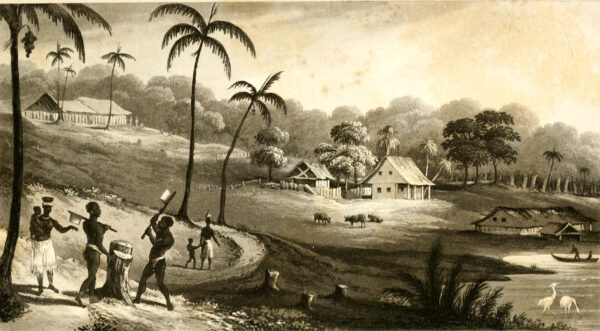
Belying the idyllic representation of this Guyanese plantation, Demerara experienced a rebellion by enslaved people in 1823 and large-scale labor actions by freedpeople and migrant indentured laborers in the decades after emancipation. Illustration in Thomas Staunton St. Clair, A Residence in the West Indies and America (1834).
This diffidence would puzzle the king and counselors’ Victorian ancestors. Having spent the 17th and 18th centuries building a colonial empire underpinned by slavery, Britain abolished the slave trade in 1808, deployed the Royal Navy against slave ships, and emancipated some 800,000 people in the Caribbean in 1833 and 1838. Prime Minister William Gladstone pronounced abolition “one of the great issues of the previous half century,” a case where “popular judgement” proved “more just than that of the higher orders.” The gulf between current discomfort and Victorian self-satisfaction stems, in part, from renewed confrontations with the financial legacy of slavery. Gladstone’s own father received over £100,000 in reparations for the 2,500 people he’d once enslaved. Another well-compensated slaveholder was Sir James Duff, ancestor of David Cameron, champion of the strategy to simply “move on.”
The gap between Victorian moral confidence (or complacency) regarding slavery and contemporary moral criticism (or defensiveness) originates in both the financial legacy of slavery and the troubled nature of freedom after 1833. During Queen Victoria’s reign (1837–1901), the emancipated and emancipating empire was shaped by unfree labor. After abolition, legally free but strictly disciplined indentured labor revived Britain’s colonial plantation sector at freedpeople’s expense.
Colonial slavery helped transform Britain into a world power under George III (r. 1760–1820). Britain conducted some 12,000 slave voyages and trafficked over three million African captives, four-fifths of them destined for sugar plantation colonies. Mass oppression garnered great wealth. By 1788, Jamaica annually received 500 ships, exported £2.1 million in value, and imported another £1.5 million from Britain. Over the course of the long 18th century, shipping to Africa increased tenfold, and shipping to London quadrupled.
Britain was an antislavery empire in a proslavery world.
Triumphant in the Napoleonic Wars, Britain was poised to enter another century of prosperity underwritten by slavery. Then, between 1833 and 1838, a popular abolitionist movement at home and enslaved unrest in the Caribbean pressured Parliament to end slavery. Still, Britain was an antislavery empire in a proslavery world, a context that constrained the possibilities available to freedpeople and indentured laborers.
Eighty years ago, Eric Williams’s Capitalism and Slavery opened a debate about whether “profits or prophets”—the material or the spiritual—animated British abolitionism. Less debatable was the centrality of profits for politicians, investors, and former slaveholders after abolition. Plantation profits depended on manipulable and expendable labor—made so by terror and dehumanization. Abolition threatened to make labor autonomous and scarce. Freedpeople could negotiate hours and wages, and they gained leverage from the labor scarcity that resulted from their readiness to relocate: whether from plantations to small farms in colonies like Jamaica or to higher-wage colonies like Guiana. Between 1838 and 1840, 66,000 emancipated Jamaicans left plantations to acquire farms. Even in high-wage colonies like Guiana and Trinidad, the number of freedpeople working on plantations was halved in the 1840s.
London policymakers and Caribbean proprietors saw the problem in terms of labor scarcity and autonomy. After shepherding abolition into law, Colonial Secretary Lord Stanley was showered with complaints from planters like Trinidad’s William Burnley, who grumbled that “want of labor, enables the laborer to do as he pleases,” causing “neglect and waste.” Writers like Thomas Carlyle amplified this grievance: “The sugar-crops rot round them uncut, because labour cannot be hired.” John Stuart Mill worried that freedpeople “can exist in comfort on the wages of a comparatively small quantity of work.” Mill’s solution to such indolence was immigration.
Failed attempts to substitute African plantation workers with Madeiran, Irish, and Chinese people were made before and after abolition. Gladstone’s father feared that the “influence of the climate was generally producing reluctance to labor” among Europeans. In the 1840s, labor’s misery in the Old World helped rebalance labor’s scarcity and autonomy in the New. British industrialization and discriminatory tariffs fueled economic contraction in India. “Since the introduction of European thread so superior in quality and cheap in price, scarcely a charka is to be seen in the country,” complained an 1835 column in the Bengal Hurkaru, an English-language newspaper in Calcutta. Indian labor was employed on Mascarene sugar plantations and supported Ceylon’s coffee sector. By equalizing sugar duties in the 1840s and increasing West Indian competition from Cuban sugar, the British government motivated its colonies, especially Guiana and Trinidad, to pursue indentured labor. In the 1840s, 23,000 Indian workers immigrated to the British West Indies. That figure exceeded 100,000 over the following two decades and approached 300,000 between 1870 and 1917.
Compared to freedpeople, indentured laborers were both replaceable and controllable. “In civilized countries,” wrote Herman Merivale, undersecretary for the colonies from 1847 to 1859, “the laborer, though free, is by a law of nature dependent on capitalists; in colonies this dependence must be created by artificial means.” Slavery formerly supplied those “artificial means.” Indenture was another “artifice.” West Indian lobbyists criticized an 1838 indentured labor code, authored by abolitionist James Stephen, for limiting indentures to a year. Colonial legislation in the 1850s established five-year indentures, empowered governors to assign workers to plantations, and stipulated seven hours of field work per day and a six-day week. Laws criminalized laborers’ movement off plantations and levied fines and prison sentences for “malingering” and other blanket offenses. “Take a large factory in Manchester, or Birmingham,” Edward Jenkins observed in 1871, “build a wall around it, shut in its work people from all intercourse,” and one would have a colonial plantation.
Indentured labor saved the plantation sector in Guiana and Trinidad. Sugar output increased in Guiana in the 1840s and 1850s, despite the loss of preferential duties, falling prices, and metropolitan depression. Yet some expressed concern that indentured labor was slavery by another name. In 1840, John Scoble helped scupper an indentured labor experiment in Guiana on John Gladstone’s estates by exposing worker abuse. Colonial magistrate George William Des Voeux published an exposé, The New Slavery: An Account of the Indian and Chinese Immigrants in British Guiana, in 1871. His colleague Joseph Beaumont condemned indentured labor as a “monstrous, rotten system, rooted upon slavery, grown in its stale soil, emulating its worst abuses.” Beaumont considered indentured labor insidious because it “presents itself under false colors, whereas slavery bore the brand of infamy upon its forehead.”
Indenture was not enslavement. Indian workers were recruited under the supervision of the Calcutta-based Protector of Emigrants. Many laborers extended contracts for a second five-year term. Close to three-quarters of migrants chose to remain in the West Indies permanently. Straddling freedom and unfreedom, indenture was formed in slavery’s shadow.
Indenture was formed in slavery’s shadow.
But if indentured labor was not slavery, it nonetheless contributed to the economic and political disenfranchisement of formerly enslaved men and women. Freedpeople in Guiana launched a three-month strike in 1847–48 protesting depressed wages. The strike was defeated in part because Indian and Madeiran workers mostly did not participate. In the 1860s, striking Indian workers, lacking Afro-Guyanese support, also were suppressed. To finance the transport of Indian workers, Guiana’s colonial government levied a high import tax targeting food purchases made by African and Indian Guyanese workers, subsidizing the very system that oppressed them.
Guiana and Trinidad were “Crown colonies” without a tradition of self-government. Jamaica had such a tradition, but its legislative autonomy was revoked in 1866, justified by the sugar industry’s decline. Facing the loss of economic and political choices a generation after emancipation, freedpeople, like migrant workers, lived a freedom beholden to the interests of the plantation economy that slavery had established.
Victorian triumphalism over abolition feels jarring today: The quickness to commend a moment of British virtue can encourage blindness to centuries of British cruelty. It is especially jarring that this move to forget the crime but celebrate its correction enjoys contemporary purchase. Nigel Farage, right-wing provocateur and possibly Britain’s next prime minister, groused in 2024 that perhaps Spain and Portugal owe Britain compensation for “the massive cost” the Royal Navy incurred in stopping their slave ships after 1808. Farage warned Starmer against “giving an inch” on slavery reparations, declaring: “The past is the past is the past. We are not guilty for it; we are not responsible for it.”
Broadening our gaze from the gap between Victorian self-regard and slavery’s injustices to include abolition’s shortcomings helps counter the popular but misplaced desire to sever past cruelties from present responsibilities. The adversities faced by emancipated people and indentured laborers underscore how freedom was defined by slavery’s precedent, its long shadow, and the plantation sector’s persistent interests. Abolition did not guarantee equal rights or opportunities. In the Caribbean today, ecological deterioration, governmental indebtedness, social inequality, and economic dependence continue to frustrate freedom. Rather than qualify or deny their culpability in past crimes, British monarchs and ministers should do their part to help mitigate enduring problems.
Eamonn Bellin is a history PhD candidate at Georgetown University.
This work is licensed under a Creative Commons Attribution-NonCommercial-NoDerivatives 4.0 International License. Attribution must provide author name, article title, Perspectives on History, date of publication, and a link to this page. This license applies only to the article, not to text or images used here by permission.