
I met Elizabeth A. R. Brown—Peggy to her friends, or, really, to anyone who met her—in Rome in the spring of 2008. An artist introduced us. “Peggy, this is Jay. He’s a medieval historian. Didn’t you write some medieval history too?” “Oh, I have done some in the past,” Peggy said dismissively, mentioning that she was now interested in funerary sculptures at the church of Saint-Denis near Paris. Something clicked in my brain. Hadn’t I read about someone working on the Saint-Denis sculptures recently? “Wait. You’re not Peggy ‘Feudalism: Tyranny of a Construct’ Brown, are you?”
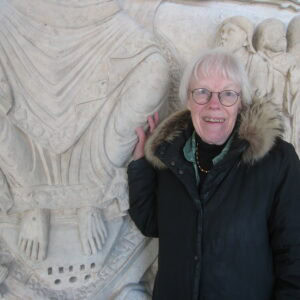
For I had known of Peggy since my first college history class, when the professor assigned “the feudalism article” from the American Historical Review. At the time, I hated it. Students have always hated it, and many professors do too. No matter the intellectual fashion or political trend, people are strangely defensive about feudalism. The revolutionary argument that Peggy made—that it never existed and that historians should stop using it—is uniquely disorienting and infuriating, especially because she is so obviously right.
Peggy didn’t just argue that there was no word “feudalism” in the Middle Ages. The problem was that historians had transformed that anachronism into the central organizing principle of the medieval world, lumping together under its banner any number of disparate phenomena that contemporary medieval writers would not have seen as related. To speak of “feudalism” is to distance oneself from the conceptual world of the Middle Ages and to do violence to its history.
After that first meeting, Peggy and I became friends. It may have been our shared love of Paris or of the French language (and similar challenges in speaking it). But mostly I suspect it was our shared commitment to the study of manuscripts.
In the archive, Peggy was a hero, a star. Librarians in France would rush to greet when she returned after an extended absence. She was an artist, and people recognized her genius. She could take the plainest, most dully administrative document and bring it to life. She never forgot that behind those scraps of parchment were human beings. When she wrote about the ruthless royal advisor Guillaume de Nogaret standing before King Philip the Fair, holding in his hand a plaintive final testament, composed in his own hand, desperate to cleanse his soul and reputation, you felt yourself standing in that room with him, a claustrophobic mixture of vulnerability and calculation closing in around you.
The last time I saw Peggy was in France, in the summer of 2023. We were participating in a symposium on conspiracy and conspiracy theory in the Middle Ages, held in a château in Brittany. The last few years had been difficult. Peggy had been battling cancer, and her circle of friends periodically braced itself to say goodbye. When the cancer returned that winter, I assumed that she would not attend. “Oh, I’ll be there,” she promised. And she was. Walking with a cane but without other assistance, she was charming, quick-witted, heavily implicated in all discussions. She offered ideas on manuscripts, historiography, nuances of historical personality and events with such facility that you didn’t even have time to marvel, “Is she really 91?”
The cancer returned a few months later, worse than ever. Still, I expected her to fend it off at least one more time. But reality sank in when I read her final email to me: “I am doing ‘poorly,’ as they say. How I hate it. But that is life. I’d love to think about getting back to France, but I am there often in my mind’s eyes as vividly almost as actually being there.”
There is much more to be said about Peggy. About her contributions to Capetian history. About her willingness to make daring, sometimes infuriating, arguments. About what a pioneer she was as a woman graduate student at Harvard University in the 1950s. About her lifelong connection with Brooklyn College, CUNY. About her term as president of the Medieval Academy of America. So many achievements, so few words. As a friend who came to her late in life and spent far too little time with her, I feel presumptuous even trying to capture a wisp of her essence. She is gone, and how I hate it. But then, there she is, often in my mind’s eyes, as vividly as actually being with her.
Jay Rubenstein
University of Southern California
This work is licensed under a Creative Commons Attribution-NonCommercial-NoDerivatives 4.0 International License. Attribution must provide author name, article title, Perspectives on History, date of publication, and a link to this page. This license applies only to the article, not to text or images used here by permission.