The Committee on Women Historians completes its fifteenth year of service to the AHA optimistic that some of the trends that portend growing equity for women historians are becoming more firmly fixed. As we turn to new and more ambitious projects, we are pleased and proud that some of the Committee’s long-standing initiatives have taken root in fertile soil. This report, then, will reflect upon on going activities as it describes the challenges to come.
Questions of equity have long been among the CWH’s primary interests and this year was no exception. One long-standing project, which reached fruition last year, continues to provoke activity. Copies of the Committee’s revised Guidelines for the Hiring of Women in Academia were sent to all department heads under cover of a letter written by Executive Director Samuel Gammon. In addition, the Guidelines are now being distributed routinely to those who place notices in the EIB.
As that project reached completion, the CWH moved to consider problems of equity on two other fronts. Concurring with the Professional Division, the CWH urged promotion of the AAUP’s Salary Equity Kit to provide departments with a way of judging whether female salaries were lower than those of comparable male colleagues. The Committee helped to draft a letter from Samuel Gammon to department chairs urging them to make use of the kit, and encouraged the AHA to advertise its availability in the pages of Perspectives.
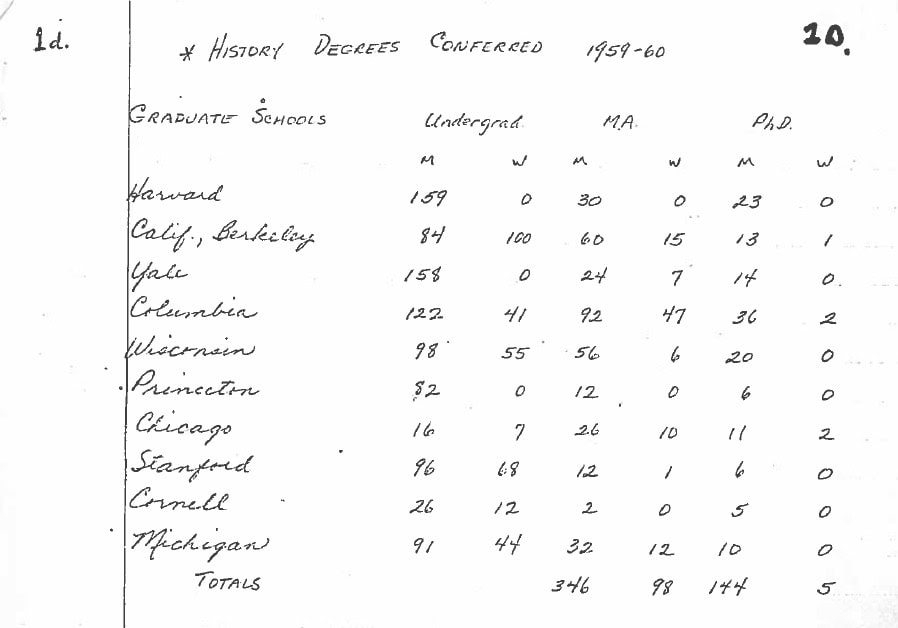
Hoping to get a firmer picture of what the future would look like for female historians, the Committee prepared a questionnaire for history departments and their graduate students. The completed survey, which was mailed to thirty top-rated universities at the end of October, should provide information on recent and current distribution of students, on financial aid patterns, and on students’ major concerns. The CWH especially hopes to uncover clues that will help us to understand why the proportion of black women among graduate students remains so stubbornly low.
Finally, in the sphere of equity, the CWH made overtures to some thirty caucuses and committees of professional women in such organizations as the Modern Language Association and the American Political Science Association. In an attempt to establish a communications network to share matters of interest across disciplinary lines, we mailed them information about the AHA and the CWH, and requested material about their interests. We await their responses eagerly.
The CWH continues to promote the practice of women’s history. At the 1984 meeting in Chicago, we sponsored two successful sessions, one on teaching black women’s history, and the second on the history of women in the historical profession. A condensed version of one of the papers delivered at the second session, prepared by Noralee Frankel and William Chafe, was printed in Perspectives in October, 1985. At the 1985 meetings, CWH sponsored one session on part-time employment, and one, including papers by Gerda Lerner and Joan Wallach Scott, on new theoretical breakthroughs in women’s history. The Committee’s commitment to exploring the boundaries of women’s history extends beyond the AHA’s annual meetings. Members of the Committee are involved in planning two major professional events. In November 1985, four members of the CWH met in Washington to plan a March 1987 conference on Women in the Progressive Era to be held in conjunction with the Smithsonian Institution. In addition, CWH member Karen Offen is working with Samuel Gammon to prepare a proposal for a “state of the art” conference on women’s history. Tentative plans call for this meeting to take place on the West Coast in 1988 or 1989. Outside our special sphere, the CWH is actively engaged in exploring ways to enhance the participation of women, and the representation of women’s history, in international historical congresses.
The importance of women’s participation in the professional life of the Association is underscored by the CWH’s continuing involvement with other AHA committees. The CWH works effectively with the Professional Division. In addition to cooperating in distributing the salary evaluation kit, it is currently working on suggesting changes for the Hackney report, in particular in the area of sexual harassment and part-time employment. The CWH also provides the Committee on Committees and the Nominating Committee with qualified women to serve on the various AHA committees. Approximately one-third of committee members are now women. We are delighted that all the women who ran for office in 1984 won their respective contests.
Last year, CWH correspondence with the Program Committee emphasized the need to reduce the number of gender segregated panels—those that conist of all men or all women. With the endorsement of then president Arthur Link, and the commitment of Program Chair John Murrin, the Program Committee achieved startling results. In 1983, 47 percent of the annual meeting’s panels were all male: in 1984, that figure declined to 42 percent; in 1985, the number of all male panels was reduced to 31.7 percent. Perhaps as a result, there were more women on the 1985 program than at any time previously. Women were 26.03 percent of the 688 participants, compared to 20 percent last year. Breaking down the figures further, 29.54 percent of the paper-givers were female; 22.52 percent of the chairs and 22.16 percent of the commentators were women. Given this encouraging progress, it may well be time for the AHA Council to adopt a rule (similar to that which prevents people from appearing on the program in two successive years) instructing its Program Committee to avoid approving sessions that are racially or gender segregated.
To maintain an ongoing file of women historians upon whom the Association can draw, the CWH authorized Noralee Frankel to begin work on an update of the Directory of Women Historians. Forms for the directory were printed in Perspectives and various other newsletters. The updated directory can be used to locate suitable candidates for employment purposes as well as to suggest names for appropriate AHA functions.
The CWH continues to encourage the AHA to take stands on broader issues that impact on the lives of women historians. Last year, for example, the CWH suggested that Council endorse the Civil Rights Restoration Act in Congress. The Council authorized Dr. Gammon to send an official letter of support on behalf of the AHA to the President and Congress. The CWH’s initiative on the National Endowment for the Humanities is still pending. As the talk given by Mary Beth Norton at our 1984 annual breakfast meeting revealed, monitoring the priorities NEH establishes for spending its funds is essential if all humanities scholars are to have fair access to its resources. In 1984, the Association’s business meeting, acting on a CWH initiative, authorized the Executive Director to meet with the new head of the NEH in order to express his concern that the Endowment not exercise undue pressure on the direction of historical studies. Because no new chair of the Endowment has been appointed as of this writing, that meeting has not yet taken place. As always, CWH helped to lobby for the passage of Women’s History Week, which was celebrated March 3-9, 1984.
Overall, this activity takes place within a context of general growth for women in academia. Women are an ever-increasing proportion of all doctorates in history: 16.6 in 1983, as compared to 16.3 in 1981. But the proportion of women who are unemployed and who are forced into part-time jobs still far exceeds that of men. The rate of female unemployment is 3.5 percent compared to 0.8 percent for men. The rate of female part-time employment is 6.3 per cent for women, compared to 1.1 per cent for men, and women still lag behind at the professorial level. Our optimism about progress for women with good jobs is tempered by concern for those women who still hover on the outskirts of the profession, as well as by increasing, though scattered, evidence that women who write about the history of women are being ghettoized into categories that exclude consideration of their credentials in the cognate fields in which they are trained.
Much of what the CWH has been able to accomplish in the last several years has been a product of the hard work of Linda Levy Peck, who served as the Committee’s chair for nearly two and a half years. Linda’s steady hand and clear head have been badly missed this year. Fortunately for us, Nancy Schrom Dye of the University of Kentucky, the Committee’s newest member, has already been harnessed into activity. With her help, and with the continuing support of Dr. Gammon as well as the unstinting labor of Noralee Frankel, the AHA’s special assistant for minority and women’s affairs, we expect to make significant progress in the areas of pay equity, employment, and respect for work on the history of women.
Alice Kessler-Harris is Professor of History, Hofstra University and Chair, AHA Committee on Women Historians