The Committee on Women Historians was established by the AHA when it adopted the recommendations of the Rose report in 1970; its purpose is to “develop the sustained attention and pressure indispensable to an advance in the status of women.” The CWH provides an annual report to the AHA Council and to the Association on the position of women in the historical profession and describes the efforts of the Committee to fulfill the mandate of the Rose report.
One of the most important tasks undertaken by the CWH since 1980 has been the development and distribution of the AHA’s “Guidelines on Hiring Women Historians in Academia” so that departments of history can measure their progress in providing equity for all members of the profession. The AHA has just distributed a revised version of the “Guidelines” prepared by the CWH in consultation with the Professional Division. In revising the “Guidelines” the Committee has greatly benefitted from the work of Karen Offen. Current statistics show that women now receive over 30 percent of the new doctorates in history. The revised “Guidelines” point out that women have composed at least 26 percent of these new PhDs, since 1975.
As a minimum goal, therefore, every fourth and ideally every third full-time tenure-track appointment should go to a woman historian. The “Guidelines” note that hiring at the entry level has, in fact, recently kept pace with these increased numbers of women PhDs. There are, however, several areas of continuing concern: in non-tenure-track positions where women are found in disproportionate numbers; amongst the unemployed and underemployed where women were also represented in larger numbers than expected and, finally, in the ranks of the tenured. Women are beginning to make progress in promotion but at a slower rate than seems reasonable. For every woman among the 1975-80 cohort who had achieved the rank of Associate Professor by 1981, over seven of her male peers had already achieved that rank. Finally minority women are still deplorably scarce among history PhDs.
The “Guidelines” call, therefore, for three priorities: 1. to equalize women’s opportunities for full time academic work; 2. to provide more rapid promotion and tenure for women historians and 3. to create a larger pool of minority women holding the PhD in history. The Committee is, of course, aware of the job crisis facing our profession, but that crisis should not serve as the opportunity to roll back the advances made in equitable hiring, promotion, and salaries in academia since the 1960s.
The data for the “Guidelines” comes from surveys of recent doctorates conducted by the National Research Council. These surveys do not get at the specific experience of women historians and the experience of those doing women’s history. The CWH drew up a questionnaire to inquire into career patterns of women historians. Sent to 223 women listed in the AHA’s Directory of Women Historians, the questionnaire elicited responses from 75 percent of the recipients. While hardly a scientific sample, our respondents were drawn from full-time academics, part-time academics, and independent scholars. Although, many thought their careers unusual because they included part-time employment, under employment, and leaving the job market in order to have a family, many among those surveyed had such career patterns.
The CWH sponsored a program at the 1984 meeting in Chicago that included an analysis of the survey and provided recommendations based upon it. In this report I noted the additional comments that our respondents took time to write. These comments support the statistical picture that women are forming a large percentage of the part-time, underpaid pool of labor for colleges and universities. At times such part-time work is chosen; most often, however, it is not. At the 1983 AHA meeting E. William Monter addressed the issue of part-time employment bluntly, pointing out that women were more likely to put up with under employment, temporary or poorly paid positions than men. The comments of our respondents who combine temporary jobs with family responsibilities, as well as the search for the next job, reenforce this conclusion,
Overt discrimination in hiring, such as that described by one writer, of the government agency and private foundation that said that they did not hire women in professional or semiprofessional positions seems to have de creased. More of a problem is the severe cutback in academic employment and difficulties in the tenure process where prejudice against women and women’s history were noted by many. Several respondents emphasized the importance of directing attention to those who have moved outside university teaching, sometimes by choice, “to speak up for a group of historians who are too often forgotten, those not directly employed in academe.”
Finally, the CWH elicited some important points about women’s history from its respondents. Many of those doing women’s history emphasized the need for other fields of specialization so as not to be marginalized within a department of history. Significantly, for those involved in creating women’s studies programs the goal has changed. In the early 1970s the goal was the integration of women’s history into historical work in general. Despite some success in “mainstreaming,” women’s history is seen to have a continuing raison d’être. “There will always be inquiries that will be better handled within an interdisciplinary women’s studies context than within a straight historical one.”
There are several conclusions to be drawn from the outpouring of comments from so many respondents. The first is that the profession needs to take the issue of part-time employment seriously, to ensure that equity is achieved in salary and benefits for all members of the profession, not just those fortunate enough to have tenured positions. We also need to define our profession more broadly (as we must do anyway with declining academic employment) to include history professionals in other areas, including archives, museums, foundations, and government, as well as independent scholars, We must make sure that departments ensure that women working in women’s history are judged by the same standards as colleagues in other fields. Most of all, it is essential that cases of discrimination continue to command the attention of the AHA and the entire profession.
The CWH tries to be responsive to the concerns of women in the profession. For more than a year we have been receiving information that NEH funding for women’s history had suffered drastic cuts. Data provided to the Committee by the Endowment itself substantiated that information. As a result we prepared a document for consideration by the AHA Council calling attention not only to cuts in women’s history but in many other areas as well, especially in interdisciplinary studies. Everyone can endorse former Chairman Bennett’s goal of excellence so long as it is not a code word signifying that important projects in women’s history, interdisciplinary history, and minority history won’t be funded, or will be regarded with a jaundiced eye. Moreover, the qualifications of some recent appointees to the NEH Council raise questions about just how serious the administration is about excellence.
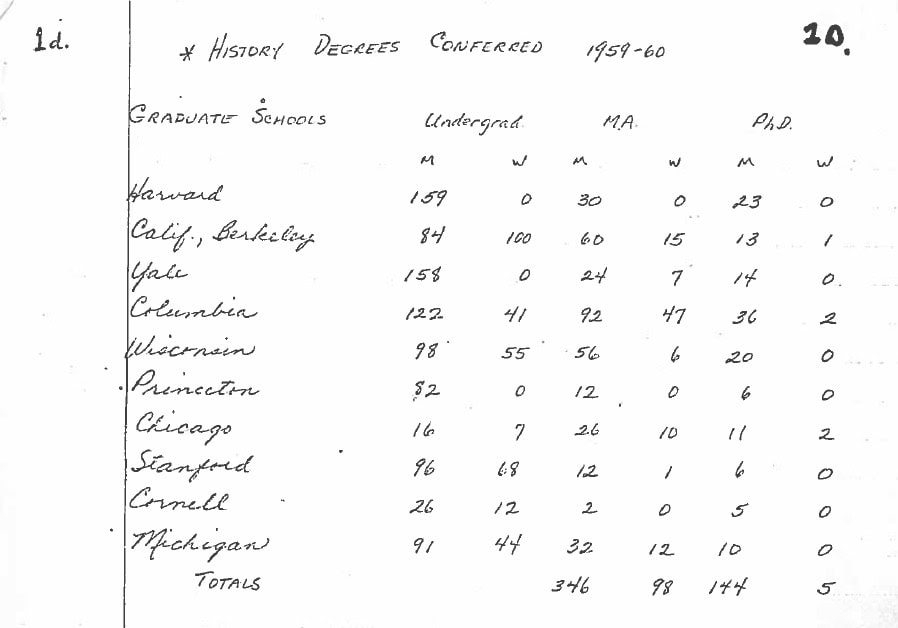
Women continue to increase their share of humanities doctorates. The Summary Report, 1983, Doctorate Recipients from United States Universities published by the National Research Council shows a redistribution of numbers of men and women PhDs. The total number has remained steady since 1977, but the number of female PhDs has increased to 34 percent of 1983 doctoral recipients. This increase is mirrored in the humanities, where women have continued in the same numbers since 1973, just about 1500 PhDs. The number of men getting PhDs in the humanities has, however, sharply declined, dropping by 49 percent. Similar figures are apparent in the historical profession. Overall the number of doctorates in history continues to decline. In 1983, 616 were granted. The percentage of women among the new doctorates continues to increase. While women made up 29 percent of new doctorates in 1982, they constituted 32.3 percent in 1983.
The profile of men and women doctorates is similar, in length of time between baccalaureate and doctorate, eleven years; in numbers with definite employment, for men 50.6 percent, for women 51.8 percent; and in numbers seeking employment, 34.8 percent of the men, 32.2 percent of the women. These statistics provide confirmation of the discouraging prospects for academic employment. Women are achieving equity in access to academic jobs just as those jobs become less available or less attractive to men. The two facts are not unrelated.
Women historians are continuing to participate actively in the AHA. They made up 24 percent of the elected officers in 1984. This is down from 32 percent or more in every year since 1981 but obviously compares favorably to zero in 1969. Moreover, women are well represented on AHA Committees, whether standing committees, ad hoc or prize committees. The Committee on Committees, President Arthur Link, and Samuel Gammon deserve credit for ensuring that women historians have the opportunity to contribute to the Association’s work. There remain certain areas of concern: at present (December 1984) there are no women on either the Professional or the Research Divisions or the Beer Prize Committee.
. . . the profession needs to take the issue of part-time employment seriously
At the AHA meeting in December 1984, 127 women historians participated making up 20 percent of the total. Since 1980 women have made up 20 percent or more of the program’s participants, a far cry from the 15 women historians on the program in 1969, of which only one commented on papers and none chaired a session. Moreover, historians whether male or female are getting the message sent by the AHA Program Committee to provide diversity among the panelists they propose. As a result gender segregation is down. This year only 42 percent of the sessions are composed entirely of male historians, better than last year’s 47 percent. Still we can do better. The AHA should instruct its Program Committee to continue to be sensitive to the increased participation of women and minorities at the annual meeting.
Similarly the AHR must increase its efforts to include work by women. In 1983 only 1 of 17 articles was by a women; only 9 percent of the book reviews were by women. This is lower than in 1982. If the CWH remains concerned that there are too few women writing in the pages of the major historical journal in the United States, we recognize that women must be encouraged to submit their work to the AHR. To that end the CWH has placed encouraging notices in the CCWHP Newsletter. In addition, the AHR and its editor are to be congratulated for devoting a special issue in 1984 to new work in women’s history. This was a significant mark of recognition for this important area of research.
The Rose report mandated the CWH to examine the progress of women graduate students. To that end we are preparing a questionnaire to get at problems in funding, employment and progress of women graduate students. We also presented an article on the problem of sexual harassment in the AHA Perspectives column (appeared March 1985), “Roses and Thorns.” Working through the Professional Division the CWH has continued to emphasize fair employment practices, especially the open advertising of jobs. In “Roses and Thorns” we have repeatedly brought this issue to the notice of our colleagues.
Our panels at the AHA’s meeting in December 1984 reflected the two-pronged concerns of CWH. Part of the AHA’s centennial, one panel, “Women in the Historical Profession: One Hundred Years of Progress?” explored equity issues. The other, the workshop, “Teaching Black Women’s History,” was part of a two-year sequence, following last year’s on new research in Black women’s history. As part of our continuing support for women’s history we have supported the passage of the bill designating Women’s His tory in March 1985.
This is my last report as chair of the CWH. I want to thank the members of the Committee with whom I have worked these past two and a half years as well as the Vice-Presidents of the Professional and Research Divisions who have supported the work of the CWH.
Special thanks are due to Dr. Noralee Frankel, Special Assistant for women and minorities at the AHA, who has worked closely with the CWH and with me throughout my tenure. We have very much appreciated the support of the AHA’s Executive Director Dr. Samuel Gammon.
Let me end with a personal note of concern. In a follow-up to last year’s report on TIAA-CREF, it should be noted that the Supreme Court has allowed a lower court decision to stand in the case of Sprit v. Long Island University requiring TIAA-CREF to pay out equal monthly sums to men and women retirees. This successful struggle for equity took 10 years. But other court decisions and lax enforcement of the Civil Rights statutes cause alarm because they signal a moving away from the principles of equal opportunity and equal access. It is crucial that the American Historical Association continue to support the search for equity for all its members. [At the request of CWH, Council, at its May 1985 meeting, adopted a resolution in support of passage of the Civil Rights Act of 1985 (S.431). This measure is to rectify The Grove City decision of the Supreme Court legislatively.] Indeed the Association must continue to stand for a pluralistic vision of history, to represent the broad range of its members’ work and viewpoints with diligence and authority.
Linda Levy Peck is Chair of the AHA Committee on Women Historians.