The CWH presented its annual report to the AHA Council in November 1983.1
The purpose of the Committee on Women Historians, as set forth in the Rose report adopted by the AHA in 1970, is to “develop the sustained attention and pressure indispensable to an advance in the status of women.” One of its tasks is to provide an annual report to the Council and to the Association on the standing of women in the historical profession, and to describe the CWH’s activities designed to fulfill the mandate of the Rose report.
In 1983 the most significant potential improvement in the standing of women in the profession stemmed from the Supreme Court’s decision in the case of Arizona Governing Committee v. Norris in July 1983. In that case, the court held that Title VII of the Civil Rights Act of 1964 as amended prohibits paying a woman lower monthly retirement benefits than a man who made the same contributions. The Court held that “this practice does constitute discrimination on the basis of sex in violation of Title VII, and that all retirement benefits derived from contributions made after the decision today must be calculated without regard to the sex of the beneficiary.” Thus TIAA-CREF, which provides the pension plans for many American colleges, will be required to pay equal benefits to all its contributors.
This struggle has gone on for more than ten years. In the 1970s, Equal Employment Opportunities Commissions in several parts of the country found that payment of differential pensions based on sex were discriminatory. Some insurance plans already provided unisex policies: others began to do so in response to these EEOC findings or, later, to the Supreme Court’s Manhart decision in 1978, which laid down the principles followed in the Norris decision. TIAA-CREF, however, fought these findings all the way to the Supreme Court, using the contributions of their female participants against whom they discriminated to do so. The CWH would like to offer congratulations to all those faculty who supported this successful struggle. Unfortunately the Court’s decision does nothing for those already retired; neither does it equalize payments in retrospect for those who have already contributed to their pension plan. These issues still remain in litigation. Another case decided this year that concerned the status of women faculty was that of Melani v. The City of New York. There, a lower court decided that women faculty at CUNY had been discriminated against in pay, and ordered a financial settlement.
These legal decisions provide hope that the economic position of women historians can be improved. Although these battles are long and difficult, they suggest that even at a time of economic retrenchment, the civil rights legislation of the 1960s and 1970s can be successfully invoked to provide equity.
In examining the statistical basis for an assessment of women’s current position in the historical profession, we find the continuation of trends highlighted in last year’s report. Women are continuing to increase their percentage of new doctorates both in the humanities in general and in history in particular. Women constituted 29 percent of the new history doctorates of 1982. It is interesting to note, however, that this percentage is at the lower end of the scale for the humanities. Of twelve different fields in the humanities, only philosophy and religion have a smaller percentage of new women’s doctorates. Overall women constitute 42 percent of all new humanities doctorates.
A survey published by the National Research Council, Departing the Ivy Halls: Changing Employment Situations for Recent PhDs (Washington, DC, 1983), pointed out that the percentage of men who earned history PhD degrees from 1970 to 1980 was nearly double that of the 1960s (52 percent v. 28 percent), but the percentage of women who earned their PhDs during the 1970s was more than three times the percentage of those who earned their degrees in the 1960s (69 percent v. 18 percent). Moreover, while the largest percentage of women PhDs (29 percent) had earned their degrees in the period 1977-80, only 15 percent of the male history PhDs had earned their degrees in the same period.
Women with doctorates continue to be an increasingly important segment of the historical profession. But if the figures for new PhDs show increasing participation by women in postgraduate education, they are not correspondingly strong in the academic labor force. A far larger number of female PhDs who received their degrees between 1973 and 1976 were employed part-time than male PhDs (13 percent v. 2 percent). Of these, 5 percent were seeking full-time employment compared to 1 percent of male PhDs. While 94 percent of male PhDs were employed full-time, only 77 percent of female PhDs were employed full-time.
Furthermore, if we examine the tenure status of 1973-76 history PhDs, we find an important differential. Of those teaching at universities, almost three times as many women as men were in nontenure-track positions (25 percent v. 9 percent). Of male historians granted PhDs between 1973 and 1976, 86 percent held tenure-track positions at universities while only 62 percent of the women historians of the same cohort held such positions. Of these, 65 percent of the male historians were tenured while only 34 percent of the women were tenured. The figures for four-year colleges were somewhat less lopsided.
Shifting the focus from tenure status to remuneration shows no happier results, according to the AAUP’s annual report on the economic status of faculty. Women historians consistently draw lower salaries on average at every rank and in every type of institution. Despite variables such as length of tenure in rank which might affect such figures, the pattern is so pervasive that they “support assertions that women occupy an economically inferior position” in college teaching.
The conclusions are clear. Now and in the foreseeable future a larger percentage of women will be at earlier stages of their career than men. The issues, therefore. will increasingly go beyond mere access to the profession where clearly women have made substantial and sustained gains. The main issues within the university will be appointment, promotion, and salary. In addition, access to grants and participation in conferences and on boards of journals will be crucial. If women are not to continue as a large pool of temporary and reserve labor—working part-time while searching for full-time employment, underpaid and invisible—it is important to sustain the momentum that has brought about their increasing participation in the profession. That means continuing to insist on fair employment practices required both by law and equity, such as open advertising of position, fair tenure review practices, equalization of salaries, monitoring of grants and participation in professional programs.
It is to these issues that the CWH has addressed itself this year. As promised in last year’s report, the CWH has been concerned to monitor the use of the AHA’s Guidelines on Hiring Women Historians in Academia, developed by the CWH, adopted by the Professional Division and distributed to all departments in 1982. This provides useful information by which history departments can measure their progress in providing equity for women faculty. We are updating the Guidelines to reflect current statistics on women doctorates and will ask the AHA to distribute and publicize them. We are sponsoring a panel at the 1983 meeting in San Francisco which will examine the practical experience of department heads and administrators in expanding the traditional composition of their facultics both in hiring and promotion.
The CWH is trying to assess the status of women in the profession and the implementation of the Association’s guidelines not only through National Research Council statistics but by direct communication with women historians. We have sent out a questionnaire to 223 women listed in the 1975 and/or 1981 AHA Directory of Woman Historians. Our object is to get at thec general employment patterns of women historians, the numbers of women teaching in various fields, their tenure and promotion patterns, and the status of those in women’s history and women’s studies. The questionnaire also includes space for further discussion of individual experiences.
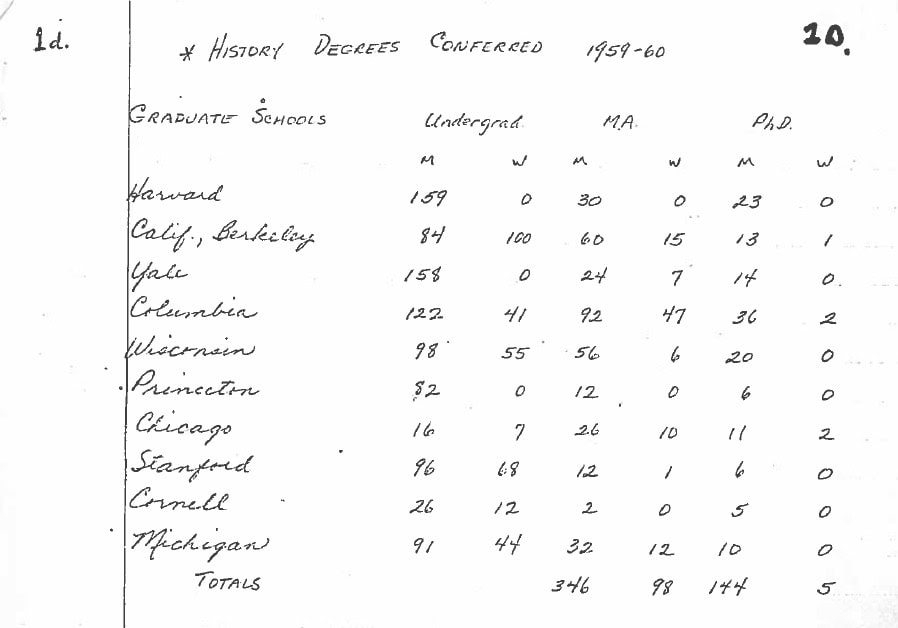
The response to the CWH questionnaire has been overwhelming: we have had a response rate of 75 percent. Of the 167 who replied, 85 were in women’s history and 82 were not; many took time to write at length about their personal experiences in academic employment. When its analysis of these responses is completed, the Committee will issue a report in the AHA’s Perspectives, and will urge the AHA to distribute the questionnaire more widely. Clearly women historians want to speak out; we need to listen to them. The CWH is also continuing to monitor the composition and promotion of women faculty at the “flagship” schools assessed in the Rose report.
The Committee has begun to contribute an occasional column to Perspectives focusing on good and bad employment practices as suggested in the Rose report. We arc particularly concerned about continuing evidence of failure to advertise positions. As a result the CWH and the Professional Division have issued another notice to the profession of the need to comply with federal regulations in this regard. It is a measure of recalcitrance and backsliding that the obvious—and the fair—has to be so frequently iterated. This new column, entitled Roses and Thorns, has also provided suggestions to ensure an equitable job search. In an upcoming issue it will discuss the problem of sexual harassment.
The role of the AHA is important in fostering participation in the profession through the annual program, the pages of the American Historical Review, and the structure of the Association itself. How is the AHA doing in meeting its commitment to women historians? Within the structure of the Association women historians continue to be recognized. They make up 32 percent of the elected officers, ranging from one-third of the Council, 40 percent of the Professional Division, and 50 percent of the Teaching Division to 25 percent of the Research Division and the Committee on Committees. Women now make up 28 percent of the ad hoc committees, 31 percent of the prize committees, and 35 percent of the standing committees. If the AHA can be pleased with these rates of inclusion, there still remains one post for which a woman has not recently been nominated. The CWH hopes the AHA will give serious consideration to those senior women who deserve to be elected to the important post of president of the American Historical Association.
In examining the participation of women historians in the American Historical Review, we found there has been some improvement. In 1982 there were three articles by women of sixteen articles published. In the Forum and Research Note sections, there was one item by a woman historian, with the rest of the year’s ten contributions by men. Women historians obviously should be encouraged to submit material to the AHR. Where the Review continues to be disappointing is in its reviews. Out of 1,058 reviews, there were 104 by women historians; just 10 percent. Although this is up slightly from 8 percent in 1981, it is progress at a snail’s pace. The Journal of American History seems to be well ahead in including women historians in its pages. The CWH will urge the editors of the AHR to increase systematically the number of women reviewers so that the Review reflects women’s increasing numbers in the discipline in general and in research in particular.
The annual program for the 1983 San Francisco meeting points up some of the residual problems of access to the profession. This year’s program has an unusually large number of sessions, 155 in all. More women historians will take part than have in the last three years. They will give 23 percent of the papers, comment at 21 percent of the panels, and chair 16 percent of the sessions. Their share of papers is down from 1981 and 1982 but their role in chairing and commenting at sessions has increased. Obviously participation in the annual program depends on geography as well as gender. What remains discouraging, however, is the continuing—and avoidable—separatism. Of these 155 sessions fully 47 percent are composed only of male historians; that is, almost half of the panels are sex segregated. With women approaching 30 percent of the profession it is unacceptable that half of the program should give no sign of it. Surely there can be few subjects in which women’s work is so scarce as to justify anything like such exclusion.
Putting together the annual program is an enormous and onerous task. It is clear that the only way to integrate women and minorities into the program is for the Program Committee to state its policy from the outset that all panels submitted will be scrutinized in order to insure that the overall program is heterogenous, making any all-male, all-female, all-white, or all-black panel subject to examination.
I am happy to say that the suggestions of the CWH with regard to the program were acknowledged by Professor Bertram Wyatt-Brown, chair of the 1983 Program Committee, and implemented by C. Warren Hollister, chair of the 1984 Program Committee. Professor Hollister has agreed to state in his call for papers that the committee strongly encourages the participation of historians of both genders in program sessions. The CWH welcomes Professor Hollister’s sensitivity and willingness to act on this issue of professional equity and President Arthur Link’s strong support for this policy.
The CWH continues to be concerned with the position of all women historians and with women’s history. In 1983 the AHA took an important step in recognizing women’s history and commemorating the role of one of its signal practitioners by establishing the Joan Kelly Prize. Much beloved and greatly missed by colleagues, Joan Kelly did pioneering work in developing women’s history as a field and in fostering women’s advance in the profession. The CWH congratulates the committee headed by Professor Sandi Cooper for proposing the prize, and the Council for endorsing it. In monitoring the sale of the AHA’s pamphlets, including the Directory of Women Historians, Approaches to Women’s History, A Survival Manual for Women (and Other) Historians, and Recent Scholarship on the History of Women, we should like to note that Gerda Lerner’s pamphlet, Teaching Women’s History, enjoys the liveliest sales. Indeed, the State of Iowa’s Commission on the Blind has recently received permission from the AHA to reproduce it in Braille.
The CWH supported the establishment by Congress of Women’s History Week, designated as March 6-12, 1983. We are concerned that this process has to be repeated each year, and suggest that it may be easier to establish Women’s History Week by presidential proclamation. We have continued to support the Seneca Falls community history project, and the project on women and reform during the Progressive era sponsored by Noralee Frankel and Edie Mayo to celebrate Women’s History Week in 1984. We have contacted the Library of Congress and the National Park Service about their programs on women’s history. We are beginning inquiries into the funding of women ‘s history and women historians by the National Endowment for the Humanities.
The CWH is especially concerned to enhance the participation of minority women in the historical profession. Dr. Bettye Collier Thomas and Ellen Furlough compiled and distributed a questionnaire to minority women historians designed to assess their position and help devise strategies for advancement. The CWH has maintained contact with the Association of Black Women Historians, headed by Prof. Nell Painter who spoke at the CWH breakfast meeting. The CWH is sponsoring a panel at the 1983 meeting on recent work in black women’s history. We have also maintained close contact with Dr. Judith Wellman, Chair of the Committee, Professor Molly Davis of the Coordinating Committee on Women in the Historical Profession, and Dr. S. Penny Kanner of the Conference Group on Women’s History.
The Committee’s goals continue to be focused on the promotion of women historians by the securing of equity in employment, salary, and promotion, and on the fostering of women’s history. In revising the AHA’s Guidelines and monitoring employment practices and government funding, we have important tasks. To fulfill them we have had the continuing aid of Dr. Samuel Gammon, executive director of the AHA, and the untiring support of Dr. Noralee Frankel, staff assistant for women and minority affairs, as well as the help of Dr. Page Miller, project director of the National Coordinating Committee for the Promotion of History. Dr. Arnita Jones of the National Research Council has provided invaluable counsel to the CWH for which we are grateful. Finally, Professor Mary Berry of the United States Civil Rights Commission and vice president of the AHA’s Professional Division has been an important supporter of the CWH’s efforts on behalf of women historians.
Over the last decade women have made important progress in the historical profession, particularly in gaining access to postgraduate education, entry-level positions, and participation in the AHA itself. Nevertheless, as the Rose report argued, sustained pressure continues to be required, mounted through the AHA. the Congress, and even the courts, to secure equal access to jobs, pay, and promotion.
Note
- The data for this report is drawn in part from the National Research Council, Summary Report, 1982 Doctorate Recipients from United States Universities (Washington, DC, 1983), pp. 10, 20, 35-39; National Research Council, Departing the Ivy Halls: Changing Employment Situations for Recent PhDs (Washington, DC, 1983), pp. 48-49, 53-54, 68; Jamil S. Zainaldin, “AAUP Releases Report on the Economic Status of the Teaching Profession,” Perspectives, December 1982, pp. 10-12. [↩]
Linda Levy Peck is Chair of the AHA Committee on Women Historians.