It was a chilly March New Hampshire night, but inside a bustling public elementary school, STEAM Night was just heating up. For two hours, the school’s pop-up science museum attracted hundreds of children aged 5 to 12, along with their parents and caregivers. But this year, there was a new exhibit. Those who walked past the microscopes in the hallway, engineering games in the gym, and a 3D printer in the cafeteria found an art classroom packed with people. There, a team of enthusiastic undergraduate and graduate students instructed kids and adults to vigorously shake small jars filled with sloshing heavy cream. They were churning butter and, in the process, realizing through sore arms and tickled taste buds that the humanities had entered the building.
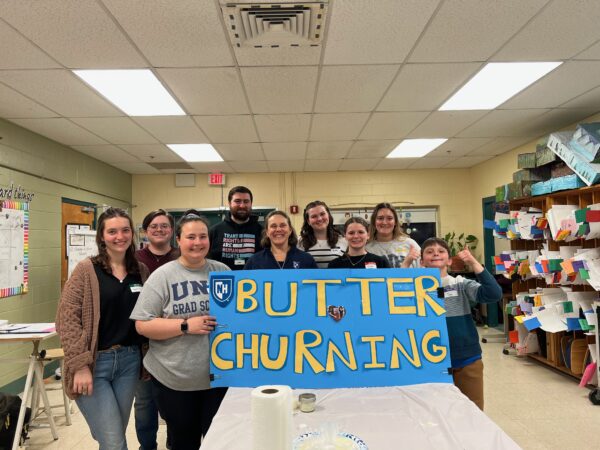
A team of University of New Hampshire history faculty, students, and alumni worked together to bring a hands-on history lesson to a local elementary school. Courtesy Jessica M. Lepler, sign design by Graye Morrison.
This spring 2025 butter-churning exhibit was an experiment aimed at injecting the humanities into the excitement around STEAM subjects (science, technology, engineering, arts, and mathematics) by teaching the public about the history of food production. When they spread their hand-churned butter on saltines, grown-ups and kids alike raved about its flavor. They felt and tasted lessons about the value of history to understanding labor, consumption, and the technology of the past, present, and future. Meanwhile, the students leading the exhibit—undergraduates, graduate students, and recent alumni from the University of New Hampshire (UNH)—witnessed the power of public history. Interacting with more than 500 kindergartners through 5th graders, they saw young minds get excited about thinking about the past. In this way, it was a double experience-based learning experiment. The public and the students learned different but important lessons about the value of the humanities.
This experiment was a community effort. Since her now 10-year-old son entered kindergarten, UNH professor Jessica M. Lepler dreamed of the humanities being included in the fun of Exeter Elementary’s annual STEAM Night. Each year as they played with the latest technological toys and games, she wondered whether the kids and their adults appreciated the change over time in ideas, institutions, trade, and labor that enabled the wonders at their fingertips. Considering her own scholarly interests in the history of culture, capitalism, and canals, she imagined how hands-on experiences of past technology might plant the seeds for future history majors, a decade or more before they applied to college. And she thought about what lessons her current students might learn by getting involved in public history directed at very young people and their families. She decided this grassroots effort in cultivating passion for history was worth a try.
When they spread their hand-churned butter on saltines, grown-ups and kids alike raved about its flavor.
In fall 2024, with encouragement from Exeter Elementary STEAM teachers Sheena Haney and Jackie Carlozzi, Lepler reached out to Kimberly Alexander, head of the UNH Museum Studies program and faculty advisor to the History Club. Alexander embraced the idea; it was exactly her type of project. For five years, she has run a hands-on Flax Project that takes students through the historical linen production process from sowing seeds to spinning thread. As of fall 2025, she and her students have processed a large enough crop to weave the thread into linen and complete the cycle from plant to clothing. The project has involved UNH’s agricultural resources, local museums, and even a documentary filmmaker. In comparison, the STEAM Night experiment seemed easy, short, and eminently doable.
Alexander proposed butter churning as a hands-on activity with relatively quick, tangible, and tasty results. The planning began well before the event. We recruited and trained a team of students and recent alumni to run the exhibit under Lepler’s direction. We sourced materials. A $500 grant from the UNH history department supported the purchase of supplies: glass jars and small plastic containers to be used for churning, eight quarts of cream, three boxes of crackers, salt, plastic tablecloths, paper plates, napkins, plastic knives, and posterboards for signs. We also gathered wooden spoons, a strainer, and an insulated cooler.
On STEAM Night, the students met Lepler at the elementary school. Alumna Olivia Mullins taught the team the easy process. Lepler then led a brief discussion about the activity’s historical lessons. The group talked about how foods like butter have not always been available for purchase in grocery stores. Before widespread access to manufactured foods, whole families worked hard so they could eat. Rural children often milked cows and powered churns. Feeding their families and creating a commodity that could be sold, children contributed to their households’ physical and financial health. Yet over the last century or so, this work changed with new technologies and societal structures. Now most cows are milked by machine, and most butter is churned in factories and sold in stores—a reminder that the way the world works now is not the way it will always work.
Soon the room was full of churning children expecting immediate results. As we know from historical scholarship, butter making takes time and skill. As some kids lost patience, caregivers took over the task of shaking the jars. They talked about memories of fresh churned butter and their appreciation for not having to do this work on a daily basis. When finally the sound of the thick slosh of cream turned thinner, kids removed the container lids and found inside bright, off-white balls of butter swimming in buttermilk. After a quick trip to the sink, a pour through the strainer, and a sprinkle of salt, they relished their fresh butter on saltines. Satisfied families left the room and spread the word. Soon, all of STEAM Night was abuzz about the butter in the art room, and we ran out of cream and containers about five minutes before the end of the event. As they cleaned, the UNH students chatted about the highlights of the event. They enjoyed the smiles, the conversations, and the exercise for their biceps. They appreciated the fun of watching people, even small kids, make historical connections.
The infusion of history learning into the night’s science-oriented events impressed the STEAM teachers, who gathered feedback from children and families. During the event, a 4th grader exclaimed, “Wow, this is like magic! I can’t believe you can make it by just shaking it. My arm’s getting tired, but it’s so cool!” One adult remarked, “The butter-churning station was fun and engaging. It had our whole family talking about butter!” The experiment had lingering effects. One child said, “Mrs. Haney, guess what I learned last night! Butter doesn’t come from the store. You can make it at home.” Some families extended the experiment further. One child glowed: “I taught my grandparents how to make butter over the weekend because of STEAM Night.” Clearly the lessons radiated out far beyond the elementary school’s art room. Haney and Carlozzi reported, “The success of the butter-churning activity at STEAM Night was a direct result of the UNH history department volunteers’ dedication and passion. Their ability to connect with participants and make history tangible underscored the importance of community engagement in fostering a love for learning.”
We are planning to bring butter churning back to Exeter Elementary next year, but we hope that the experiment spreads even further. Some graduating students asked if they could join next year as alumni; others suggested they would try to organize similar events for kids in their future communities. A local farm invited us to do a public demonstration in the spring. This is exactly the momentum our discipline needs to recruit new generations of historically interested students. While we wait for these churning children to grow and enroll in history courses, their caregivers also benefit from a reminder of the value of the humanities. Straightforward to organize and inexpensive to run (at about a dollar per person), the butter-churning public history experiment represented a real, actionable method to make tangible the importance of the humanities in people’s lives.
For years, the UNH history department has been making its case to the public. Whether it is a hands-on butter-churning demonstration at a local elementary school; planting flax with our New Hampshire community at museums, historical societies, and local farms; hosting our department’s popular History Day, which provides continuing education credits for New Hampshire teachers; or placing undergraduate and graduate students in internships, the department plays an active, interdisciplinary, and creative role in public-facing history and community engagement.
If we want a nation of historically minded thinkers and voters, we need to churn up support for the study of the past. Shaking and tasting are the types of hands-on tools of teaching that imprint historical thinking in muscle memory and make the value of history tangible. We hope this article offers a recipe for other history departments. In our time of reduced funding and hollowed-out faculties, this model can be copied by professors, teachers, and museum professionals in other communities to integrate the humanities into STEAM and bring historical change to their local communities. We hope such grassroots tactics for teaching the value of history gather STEAM!
Churning Your Own Butter
Pour room-temperature heavy cream into a canning jar with a tight lid. Fill the container no more than three-quarters full (one pint of heavy cream fits perfectly in a quart-sized canning jar). Shake the jar until cream begins to thicken. Eventually, a ball of butter will separate from the buttermilk. Once it has separated, strain the buttermilk from the butter through a sieve or strainer. After straining, press the butter in a bowl with the back of a wooden spoon or a spatula to squeeze out any remaining buttermilk. Rinse the butter under cold running water until the water runs clear. Sprinkle with salt, to taste, and turn over a few times to incorporate. Store in an airtight container. The butter will keep in the refrigerator for about three weeks or in the freezer for a few months.—Recipe by Olivia Mullins
Kimberly Alexander is director of Museum Studies and senior lecturer in the history department at the University of New Hampshire. Jessica M. Lepler is associate professor of history at the University of New Hampshire.
This work is licensed under a Creative Commons Attribution-NonCommercial-NoDerivatives 4.0 International License. Attribution must provide author name, article title, Perspectives on History, date of publication, and a link to this page. This license applies only to the article, not to text or images used here by permission.