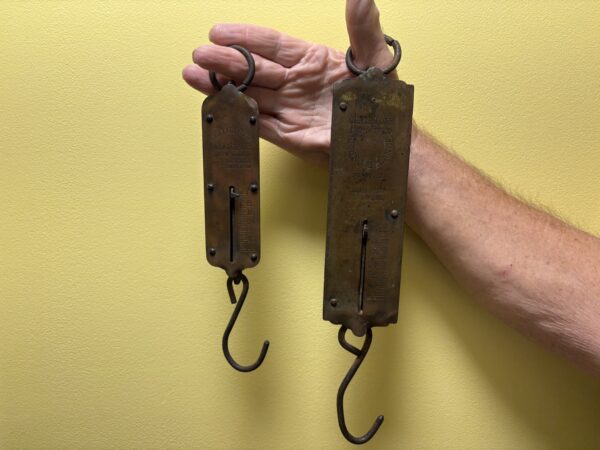
When my grandfather died in 1988, he left me his two Chatillon’s balance scales. I was 12 years old, and I had always admired them from the corner of his barn, fascinated by the engraved numbers and the way the hooks swung with a quiet certainty. He knew of my love of history, and by giving me the scales, he passed down not just the objects but a connection to the past he had lived through. They were a fragment of his life, and now, in a small way, a fragment of mine.
Henry D. Parrish Jr.
My grandfather was born in 1913 in Johnston County, North Carolina, on a small tenant farm where his parents worked. The scales originally belonged to his father, whose death in 1929 left my grandfather orphaned. They came with him when he began farming in 1938 in Wilson County, North Carolina, where he used the scales to weigh sacks of grain and produce over the next four decades.
The scales are of tarnished brass with heavy iron hooks and faceplates that bear bold inscription. On the smaller one, it reads: “Chatillon’s Balance No. 2, New York, Pat’d Jan. 6, 1891, Jan. 26, 1892.” The larger one reads: “Chatillon’s Improved Spring Balance, New York, Pat’d Jan. 6th, 1891, Jan. 26th, 1892.” Below, a small slot reveals the sliding pointer, aligned with neat increments in pounds: 8, 16, 24, 32, 40, 50.
The patina of the brass tells its own story. Warm brown mottling, darkened spots where hands once pressed, and faint traces of original shine all speak to years of careful use. The iron hook is rough with rust yet sturdy, still ready to cradle a sack of feed. Holding it, I can almost feel my grandfather’s hands, weathered and strong, lifting the scale to weigh the day’s harvest. The simple iron loop above once hung from a beam in his barn; now it hangs on my wall, carrying memory as much as weight.
There is a striking directness to the design: brass, steel, and spring. An object is hung from the hook, the spring resists, and the pointer slides down against the engraved numbers. No batteries and no circuits. Its honesty is mechanical, literal, unflinching. In that way, it feels like my grandfather, in that it is reliable, steadfast, and a quiet witness to work and life. The engraved patent dates anchor the scales to a world of horse-drawn carts and pushcarts, of livelihoods tied to fairness and accuracy. Now, in my hands, they continue to do what they were made to do, more than 130 years later.
These scales connect me to a tradition of trust. My grandfather trusted them to accurately weigh his produce for sale, and his buyers trusted his integrity in providing those weights. That sense of honesty, that moral gravity, is what draws me to them. Compared to the fragile electronics and planned obsolescence of modern devices, the Chatillon’s scales are enduring, steadfast, and permanent. Their engraved letters and durable brass declare that they were built not for a moment but for generations.
Each time I touch the cool, worn surface, I feel linked to those who came before me, especially my grandfather. The scales measure more than pounds. They measure time, continuity, and memory. They remind me that the simple, steadfast objects we inherit carry the weight of human experience. My Chatillon’s scales are not just antiques. They are a fragment of family, a witness to history, and a teacher of patience and reliability, still weighing the world with quiet grace. They are among my greatest childhood treasures.
Henry D. Parrish Jr. is an MA student in English at Southern New Hampshire University. He holds a BA in history from the University of Arizona Global Campus and a paralegal diploma from Pitt Community College.
This work is licensed under a Creative Commons Attribution-NonCommercial-NoDerivatives 4.0 International License. Attribution must provide author name, article title, Perspectives on History, date of publication, and a link to this page. This license applies only to the article, not to text or images used here by permission.