In my Modern European History course, we spend quite a bit of time discussing warfare in 18th-century Europe to understand the dramatic escalations that would come in the centuries that follow. But on one particular day, class lagged. In an impulsive effort to drive home the destruction of those long-ago battlefields, I grabbed my cannonball—which I had once acquired off eBay as it was said to have been shot into the Polish countryside during the Napoleonic Wars—told the students to follow me, and walked out onto the second-floor breezeway. Overlooking a small patch of grass, I handed the cannonball to a student and told them to throw it. They looked at me with incredulity but after further encouragement threw it to the ground.
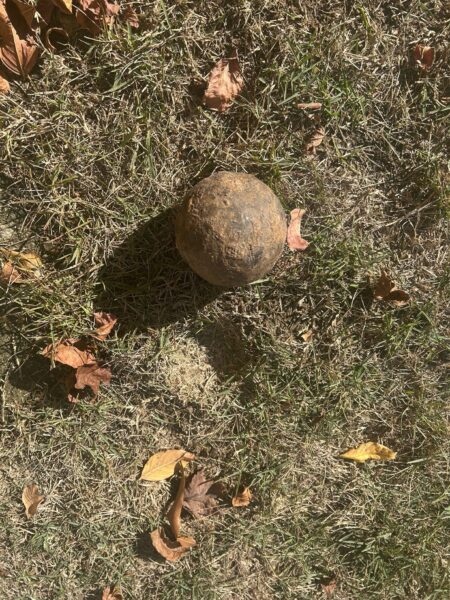
After throwing a cannonball from the second floor, students spent months discussing the surprising activity’s impact on the ground and themselves. Bryan A. Banks
The impact was much greater than the divot in the earth the iron mass left. For weeks after, students walked by the divot and came into class talking about it. They noticed the smallest changes. After a rain, the water table swelled and the impact site softened. But students’ conversations covered not only the surface level. They talked about the experience. They waxed poetic about the earth erasing human history. How battlefields, like the bit of grass, were artifacts worthy of interrogation. I made efforts to connect lessons in subsequent class sessions back to the cannonball. When warfare escalated in the era of my cannonball and still more in the 20th century, students used the cannonball’s mark as a metaphor to express complicated ideas about atomic warfare and the environment. In one course evaluation, a student answered the question “What could the instructor have done to improve this class?” with “More cannonballs.”
History classrooms need more “cannonballs,” or what I often call “mnemonic moments” in my classes. Education theorists and researchers have explored the power of mnemonic devices for encouraging the retention of complicated information. They have also shown that active learning promotes critical thinking. I define a mnemonic moment, then, as an attempt to create a hands-on experience around which a student can form a strong memory and impression. They are unique and present students with an experience to mull over beyond the individual class session. They also force the educator to consider how to intentionally make a moment that will be remembered.
What could the instructor have done to improve this class? “More cannonballs.”
There are a range of approaches to getting students to learn actively. Flipped classrooms require instructors to provide most of the information outside of class, which then allows you to spend the entire class period on an active learning exercise. Think of a lab-based course with little to no separate instruction time devoted to providing information, and you have a sense of the flipped classroom model. This requires a lot of work on the professor’s part, and students lacking the intrinsic motivation to participate in class will find this approach frustrating. Similarly, using Reacting to the Past games or making your own has mixed results. Sometimes, such games went well in my classroom. Other times, the lessons the students clung to the hardest were based on their own perspectives and lacked an adequate understanding of those people the simulation intended for them to understand.
Rather than put all my eggs in the flipped classroom basket but still determined to incorporate more active learning in the classroom, I began increasingly to integrate mnemonic moments into my classes. Sometimes my efforts were overtaxing—I carefully developed and tried to orchestrate a moment, and it fell flat. Other times, as was the case with the cannonball, I came up with it on the fly.
When a mnemonic moment works, it is a wicked experience for the students. In Creating Wicked Students: Designing Courses for a Complex World (2018), Paul Hanstedt argues that courses can and should be designed to introduce students to “wicked problems,” or complex issues with no single answer. They should also encourage students to develop wicked solutions capable of responding to the knotty complications life throws at us. Hanstedt also encourages us to think about course design that presents students with wicked world problems strategically, so that the lessons learned will be remembered. With mnemonic moments, wicked problems can be reinforced by wicked memories. These moments should be complex and challenge students to think critically.
Here are the five basic lessons I’ve learned in pursuing mnemonic moments:
Be a little wicked. The moment must be “unconventional” to subvert the expectations of the student and challenge them to engage actively. In a class on prehistoric life, we explored the Lascaux Cave paintings to think about the invention of art, symbols, and even text. Students read about the cave paintings and how scholars have interpreted them differently. To show that they understood that complexity, I had them graffiti a nearby wall on a campus building with chalk. They walked by that wall every day on the way to class, and weeks later, with no rain, the chalk faded but remained visible. The cave paintings became a metaphor for that class to think about how natural forces may accidentally preserve such art and also art’s importance for forming human bonds in early nomadic communities. The students certainly bonded over the experience as well.
Space these moments out to avoid burnout. By this I mean: Do not overuse this tool. The law of diminishing returns will lessen the impact and insight students will receive. For me, in a class broken into four units, my ideal is one per unit. This gives me time to set the stage, cover the topics needed to take advantage of the mnemonic moment fully, and facilitate reflection on the moment before it is time to move on to the next unit. One semester, I aimed at one a week. By the midterm, I had overextended myself, and the students had come to see these moments as perfunctory and therefore not as “wicked.”
Wicked problems can be reinforced by wicked memories.
Give students agency over the experience. Reacting to the Past simulations are helpful tools in the educator’s repertoire, precisely because they give students choices to make, but students can also make choices in shorter experiences as well. To teach students about how worker groups in 19th-century Europe banded together to fight for improved working conditions, I developed a game for students to play in a single class session. In this game, I own a factory and need to hire workers. Our imaginary laissez-faire government leaves me to my own devices, and the students must bid to work in my factory. If they do not bid and win the job, their life points diminish faster than if they get the job. I tell them the team that survives the longest wins. And off they go. Most of the time, they get so caught up in the competition they all starve at the same time and the game ends without a winner. Other times, they organize and demand standard wages and a social safety net. Still other times, the students protest. This game helps them to understand how revolutionary movements result from class tensions, limited resources, lack of government regulation, and so much more. They continue to reference the game and the choices they made when they encounter other topics in the class, like the rise of ethnic nationalism movements in the age of decolonization.
Not all mnemonic moments are created equal, nor should they be. Some moments may require more work than others. The factory work simulation described above took a fair amount of advanced planning. The cannonball did not. In my courses, I do not have four equally intensive exercises. When covering the Columbian Exchange, I have two students come to the front of the class to participate in a game show. I show them an image of a thing, and they must tell me if it originated in the Americans or Afro-Eurasia. Before they each choose, the audience (i.e., their classmates) must yell out what they think is the correct answer. Ranging from diseases and people to animals and plants, and always ending with the Jerusalem artichoke, the examples challenge students to rethink the human-led environmental transformation. The game consists of six to seven images, and the students guess quickly. This game took more time to prepare and work through than the cannonball, but less time than the factory simulation.
Afterward, ask students to reflect and explain why you chose to use class time for that exercise. Reflection is as important as the lessons you hope they derive about the past. If students are to understand historical methods and how historians craft narratives from evidence, then model it for them in the classroom and explain it. In my Historical Methods class, I bring students to our campus archives. One semester, I had them pick a box at random and create an entire research project proposal based off that box. They chose their box through an experience that can only be likened to the television show Supermarket Sweep. They raced through the archives, selected a box, returned to their group, and then began reading, analyzing, and constructing an argument. It was exhilarating for the student and the professor. I explain to the students that research projects are everywhere, creative methodologies exist to help unpack most questions, and archives themselves need to be engaged with critically.
The emails I have received from former students turned teachers asking about how to incorporate mnemonic moments in their own classrooms has encouraged me to keep searching for and cultivating these moments (and to share them with readers of this piece). Other students report that mnemonic moments made history relatable. Years later, those students still approach me beyond the university to talk about our mnemonic moments. Long after the cannonball’s dent in the landscape has faded, a student’s memory persists and informs their everyday life.
Bryan A. Banks is associate professor and interim dean of Libraries and the Graduate School at Columbus State University.
This work is licensed under a Creative Commons Attribution-NonCommercial-NoDerivatives 4.0 International License. Attribution must provide author name, article title, Perspectives on History, date of publication, and a link to this page. This license applies only to the article, not to text or images used here by permission.