Cyril Lionel Robert James, a descendant of enslaved Africans, died in London on May 31, 1989.
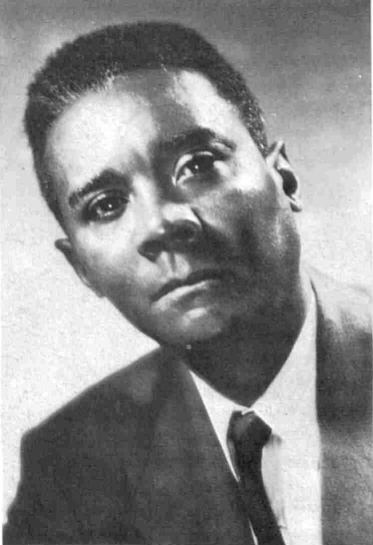
C. L. R. James
James was born in Trinidad and Tobago in 1901. His father, Robert, was a teacher, and his mother, Ida, was a homemaker and known to be a voracious reader. James, too, toiled as a teacher before departing for Britain in 1932.
Although not academically trained, James made enormous contributions to scholarship, especially with his 1938 masterwork, The Black Jacobins: Toussaint L’Ouverture and the San Domingo Revolution. His French fluency aided him enormously as he mined the archives of France to explore the world historic impact of the Haitian Revolution and the subsequent creation of a “Black Republic,” which ignited a crisis of the hemispheric slave system. He sought to write of this earthshaking Caribbean temblor in the manner in which his erstwhile comrade Leon Trotsky wrote in his epochal History of the Russian Revolution—that is, he sought to place “San Domingo” in the context of the similarly profound French Revolution and to demonstrate the connection between the two revolutionary processes. He demonstrated that the more consistent Jacobins—exemplars of liberty and equality—emerged in Hispaniola, not France. With its stunning abolition of slavery, the Haitian Revolution provided a model to be emulated eventually by the United States. Today’s many historians of the Haitian Revolution continue to be influenced by James’s book—the rare work that shapes scholarship nearly a century after its publication.
Yet The Black Jacobins was not his only contribution to contemporary intellectuals. His memoir on cricket, Beyond a Boundary (1963), inspired and benefited the emerging fields of cultural studies, Caribbean studies, and postcolonial studies. American studies also profited from his prodigiousness, especially Mariners, Renegades, and Castaways: The Story of Herman Melville and the World We Live In (1953). James, who spent years in exile in London and the United States, wrote this book while fighting deportation from the latter nation. This analysis engages Moby-Dick, the short story “Bartleby, the Scrivener,” and the lesser-known novel Pierre. Like numerous literary analysts before and since, James viewed Melville as having anticipated significant convulsions that continue to resonate in relation to capitalism, communism, and fascism.
James influenced and participated in postcolonial movements as they unfolded in the mid-20th century. In 1957, he traveled to Ghana for the independence celebration of this West African nation, which ignited anticolonialism throughout the continent. His Nkrumah and the Ghana Revolution (1977) was published well after the overthrow of the Accra regime in 1966 but remains an essential text for understanding the politics of West Africa and, most notably, the immense implications for Pan-Africanism that resulted. As an insightful journalist, James also provided raw material for historians to sift through. He returned to Trinidad in 1958 as editor of The Nation, the anticolonial newspaper and organ of Eric Williams’s People’s National Movement. Considered the founding father of the nation, Williams was likewise a scholar of note, having produced Capitalism and Slavery (1944), a protean volume that continues to repay attention. The two titans clashed, not least because of differences over the trajectory of a federation that would encompass Caribbean islands and the surrounding region. This led to James’s departure from the paper.
In the realm of fiction, his novel, Minty Alley, was published in Great Britain in the 1930s; a dramatization was broadcast on BBC Radio in 1998. This novel, too, has attracted considerable attention from literary analysts. James also contributed to theater, including a 1930s dramatization of the life of Toussaint, featuring fellow socialist Paul Robeson in the title role.
James’s continuing relevance is reflected in the fact that he has been the subject of documentary films, including the 1976 BBC production Beyond a Boundary, a 1984 Channel Four production that has him in conversation with the late Stuart Hall, and a 1983 work featuring James and E. P. Thompson. A documentary film focused on James and his impact, Every Cook Can Govern, was exhibited in 2016. Duke University Press is in the process of republishing various works by James, including a number noted above.
Gerald Horne
University of Houston
This work is licensed under a Creative Commons Attribution-NonCommercial-NoDerivatives 4.0 International License. Attribution must provide author name, article title, Perspectives on History, date of publication, and a link to this page. This license applies only to the article, not to text or images used here by permission.