
The year 2026 is a forward-looking moment in the historical discipline in the United States. The 250th anniversary of the Declaration of Independence has prompted discussions about historical memory, the history we teach, and the responsibility that historians have toward the various and diverse publics that we serve. As a discipline, we are all asking, How do we meet the moment?
At the AHA’s 139th annual meeting in Chicago, that context suffused many of the sessions and events across the weekend, even those not explicitly about the semiquincentennial. From how to effectively advocate for policy to innovative classroom instruction and the current effects of artificial intelligence, we were all thinking about what comes next for us as individuals and a community. Luckily, there were more than 500 sessions and events at which attendees could share and learn from one another’s expertise and experiences.
—Laura Ansley, Whitney E. Barringer, Brendan Gillis, Elizabeth Meggyesy, Ben Rosenbaum, and Hope J. Shannon
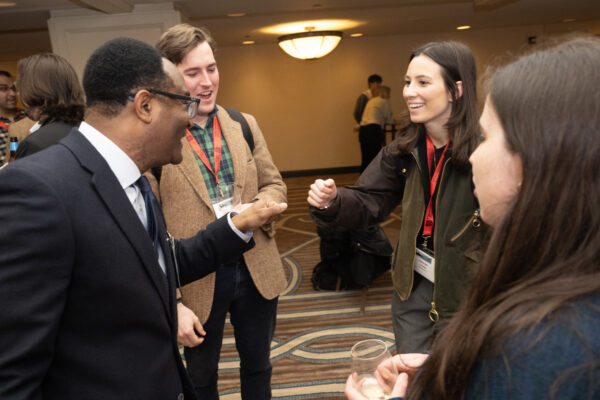
2025 president Ben Vinson III connects with fellow historians at the graduate student reception.
Historians and Their Publics
This annual meeting provided many opportunities for historians to reckon with an array of threats facing our discipline. Whether on panels, in the Exhibit Hall, at organized meetups, or over conference coffee, attendees discussed—sometimes wryly, sometimes urgently—how new ways of thinking about the past might counter shrinking resources, political pressures, declining enrollments, pedagogical challenges, and the whims of segments of the American public that seem alternately hungry for history and hostile to historians. The two evening plenary sessions struck tones of cautious optimism, emphasizing proactive engagement with the broadest possible audiences. Whether on campus or in our communities, these conversations suggest, there may yet be hope for our discipline to expand its reach and renew public trust.
Thursday’s plenary, “Let Facts Be Submitted to a Candid World”: Historians, Their Publics, and the 250th Anniversary of the US Declaration of Independence, focused on how and why historical practitioners, regardless of their specific areas of academic expertise, might capitalize on public enthusiasm around the semiquincentennial celebrations kicking off in 2026. “We need to meet this moment,” urged Jason Hanson (History Colorado). “Nothing gets people interested [in history] like an anniversary,” he explained, and this awareness allows historians and historical institutions to emphasize that all Americans share a history even if we do not always agree on its precise significance for our world today.
At the local, state, and national levels, archives, museums, historic sites, and other organizations are planning programming as varied and diverse as the communities we serve. To engage a national public, Colleen Shogan, the former Archivist of the United States, has established In Pursuit, a nonprofit initiative that will publish a series of short essays over the next year about every president and some first ladies of the United States. There are many more such initiatives at the local and state levels. More than a dozen Western states, Hanson noted, have pooled resources to develop traveling exhibits that use aspirational ideals articulated in the Declaration of Independence to frame key moments in subsequent eras in US history. In Massachusetts, to cite another example, Royall House and Slave Quarters hosts hands-on textile arts programs, including a Black weaving school and a durag workshop, to highlight the intersection of history, slavery, and fashion. It can be both valuable and empowering, the museum’s executive director Kyera Singleton explained, to start with what our communities want to talk about and then use these themes as points of entry for a richer engagement with the lives of people in the past.
The scale of public appetite for revolutionary history is immense. In 2025, thousands attended preview screenings (the first of which took place at AHA25) of excerpts from Ken Burns’s six-part documentary series The American Revolution, with millions more tuning in for television broadcasts or streaming it online. With interactive exhibits and innovative programming, museums and historic sites are preparing for a substantial increase in visitors, with several of the largest institutions expecting annual attendance in the millions. Historians, warned Jane Kamensky (Thomas Jefferson’s Monticello), ignore these audiences at their peril.
Still, a comparison between preparations for America 250 and bicentennial celebrations in 1976 results in some sobering conclusions about the extent to which a dramatically altered federal funding environment may have lasting consequences. There are over 21,000 history organizations in the United States. Of these, explained John Dichtl (American Association for State and Local History), between 30 and 40 percent were founded around 1976. Bicentennial funding, Kamensky added, helped support new fields, such as Indigenous history, and grants from the National Endowment for the Humanities supported scholarly publications, including Edmund Morgan’s American Slavery, American Freedom (1975), that helped institutionalize a more diverse and vibrant history of the revolutionary period. “What will come out of the semiquincentennial moment?” asked Karin Wulf (John Carter Brown Library). “Will there be any legacy of this?”
It remains to be seen how historians and historical institutions will fare over the next months and years. Without the scale of federal investment that defined the bicentennial and its aftermath, it may fall to individual historians and our institutions to help set the tone. “I’d love to see more synthesis coming from the history field,” Hanson explained in his concluding remarks. Many Americans struggle to make sense of competing and often irreconcilable claims about the past. They are looking to historians for help sorting all of this out and “maybe bringing some more of the unum to the e pluribus.”
History education offers additional opportunities to help shape public awareness of our discipline and its practices. Saturday’s plenary, Making History Indispensable to Your Institution, kicked off a year of AHA programming about the place of history in general education and other courses required for graduation with support from the Teagle Foundation.
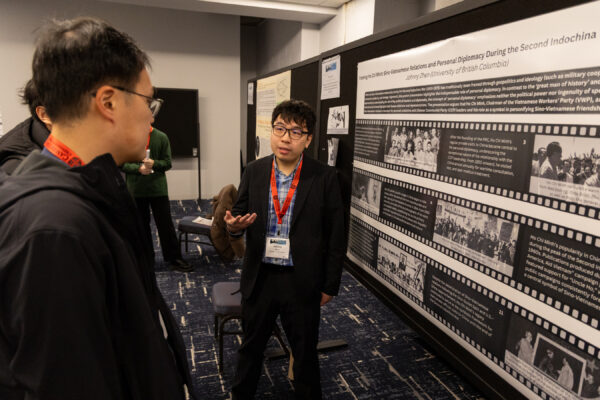
Historians presented their work in four poster sessions, including two focused on undergraduate research. Michael Baniewicz
As part of its History Gateways initiative (2019–22), the AHA supported faculty experimentation in refining introductory undergraduate courses, many of which can be used to satisfy general education requirements, to promote student success. When asked about the purpose of these courses, noted Julia Brookins (AHA), faculty generated a list of 63 goals, far more than can be accomplished in a single semester. “There’s not going to be a one-size-fits-all framework at different kinds of institutions,” Brookins added, “but our research revealed that there are many ways faculty and departments can approach making history in general education more vibrant.”
However, it can be difficult for individual faculty or departments to convince administrators or colleagues in other disciplines that students need to develop historical awareness. A declining number of institutions require all undergraduate students to take introductory history courses. Many colleges and universities use thematic distribution requirements to afford undergraduate students more choice in how they satisfy general education requirements, which can affect enrollments at the department level. As senior associate dean for undergraduate education, historian Ian McNeely (Univ. of North Carolina at Chapel Hill) helped to develop and implement the IDEAs in Action curriculum, which splits 1,500 courses approved for general education across nine “focus capacities.” Of 449 courses that UNC-CH cleared to satisfy a requirement in “engagement with the human past,” only 139 are offered through the history department. That said, history courses are also included in three other core capacities on global understanding, power and society, and ways of knowing. Nevertheless, between Advanced Placement courses and dual enrollment, a growing number of students complete these requirements before they reach campus.
In certain contexts, flexible general education requirements grounded in the liberal arts tradition have secured the foundations for history and other humanities disciplines on campus. Enrollments in history had fallen by half before Melinda Zook (Purdue Univ.) helped establish the Cornerstone Integrated Liberal Arts program, a curriculum designed to create opportunities for students to engage with transformational texts in small classes taught by full-time faculty. The runaway success of this program has resulted in an efflorescence of high-quality teaching and humanities scholarship on campus. Since 2019, Zook explained, new faculty are required to teach 50 percent of their courses in Cornerstone, but this has allowed the college of liberal arts to hire 119 new faculty. The energy around the program, she suggested, stems from the power of philosophy and great literature from around the world to inspire our students. “Gen Z students recognize that they need knowledge to succeed; above all they are seeking opportunities for edification.”
At Vanderbilt University, a core curriculum patterned after the Cornerstone model has met with similar success. “General education is a really important platform on your campus,” observed Sarah Igo, Andrew Jackson Chair in American History and Dean of Strategic Initiatives, but “you may need to reimagine it” for faculty to understand how it can enrich and deepen liberal arts education for all students. Vanderbilt’s new model sacrificed a specific general education requirement in history. “We knew we were taking a bit of a gamble,” she explained. “But our proposition is that if we get some of our best teachers and best historians into our new core [curriculum], we trust that our students will follow them into their home departments.” And many have done so.
Reforming general education or other graduation requirements can present a range of challenges. The teaching-intensive models at Vanderbilt and Purdue, several audience members observed during the Q&A, may not be feasible at smaller institutions or those with different expectations for faculty workload. Colleagues in other schools and departments do not always want to share enrollments when institutional resources are scarce.
The potential rewards of bringing our knowledge, disciplinary habits of mind, and excitement for history to general education are both clear and substantive. As with the public interest in the semiquincentennial, a renewed focus on reforming general education might allow historians to challenge some preconceptions about what historians do and why our work matters.
—BG
Live from AHA, NPR’s Throughline
On Friday, Ramtin Arablouei and Rund Abdelfatah, co-hosts of NPR’s Throughline, joined attendees to discuss their award-winning history podcast. They appeared in conversation with Daniel Story (Univ. of California, Santa Cruz), producer of the AHA’s History in Focus podcast, at one of three events in the Sinclair Workshop on Historical Podcasting, a sponsored annual meeting series focused on podcasting and historical storytelling.
Work on Throughline began, Arablouei and Abdelfatah explained, years before the first episode actually aired. The two met at NPR—he was a sound designer and she a journalist—and soon discovered a common interest in diversifying and enhancing public understanding of non-Western parts of the world. “We need to make a show that does for history what Radiolab does for science,” Arablouei proposed. They began to workshop their idea on nights and weekends around their other work. After two years of piloting “essentially in the dark,” they sent a sample to their boss. NPR green-lit the show, and the first episode aired in January 2019.
The show takes a “sound-forward approach” to production, which was new for NPR when Throughline premiered. Instead of adding music at the end, as many podcasts do, they think about sound as another character in the story. “We design in scenes; we storyboard the way you might in a show or movie,” Abdelfatah said. They want listeners to feel like part of the scene, Arablouei explained. “Entertainment is an important part of storytelling. No one wants to listen to a boring story.”
To build that story, a Throughline team member conducts extensive historical research on a topic to determine its viability as an episode subject. If they decide to move forward, they conduct more research, engage fact-checkers, and interview historians and other subject matter experts. They prioritize finding experts who can speak about their research in an engaging way. Most of the historians they interview understand that audiences are more interested in the broad strokes than the minutiae and especially interested in what their research means for today.
“People don’t remember facts; they remember how they feel.”
Abdelfatah and Arablouei also discussed the challenges facing public media and how those challenges have affected Throughline. After funding cuts, “we’re in evolution mode,” Abdelfatah said, trying to maintain the integrity of the show “in terms of research and nuance and creativity” while also seeking ways to do more with less. The audiences they reach and where and how people find and engage with content is changing too. According to NPR polling, their listener base is broader and more diverse than many podcast audiences, but those demographics have shifted as listening platforms have changed and diversified. Abdelfatah and Arablouei are also navigating a crowded and shifting information landscape, in which listeners have access to a broader array of media content and platforms than ever before.
Abdelfatah and Arablouei answered several audience questions, including one from a public historian working at a well-known historic site engaged in this year’s semiquincentennial celebrations. Stating that “bringing history to life” can be “inherently speculative” and therefore “scary for many” historians, she asked whether they could provide “advice for those of us trying to walk that line.” Abdelfatah said such narratives are being created no matter what, and the question is whether you want to be part of the conversation. If you do, “be transparent,” make clear to your audience that “there are different interpretations” of the topic, “and explain why you’re leaning toward one interpretation. The more you can incorporate the primary source materials, the more people can see and hear for themselves.” Audiences have a short attention span. Without “high stakes or emotional attachment, people are not going to pay attention.” Yet history is essential today, and “there’s a lot of competing [interpretations] from people who aren’t even making an attempt to stick to the facts.” Arablouei agreed, adding that the academy’s focus on facts and rigor means information is not reaching the populations who most need it. “People don’t remember facts; they remember how they feel,” he said, “so we have to tell these stories in a way that makes them feel something.” For the podcasters and other historians who attended the Sinclair Workshop sessions, this is a key reminder that rigor and accessibility are not opposing goals and that thoughtful storytelling is essential to ensuring expert historical scholarship reaches wider public audiences.
—HS
AI in Teaching and Research
Since ChatGPT became publicly available in November 2022, concerns about artificial intelligence (particularly the tools called large language models, or LLMs) have proliferated across academia and other scholarly communities. Sessions at AHA26 wrestled with the practical and ethical problems and the potential for AI in historical research and teaching.
As all historian-teachers know and the panelists acknowledged at the start of Rewriting the Past? AI, Interpretation, and the Future of History Education, AI has become normalized among students and has come to characterize much of the student work they now receive. Of the 850 students Steven Mintz (Univ. of Texas at Austin) teaches in a given semester, approximately 400 now submit virtually the same essay. The “crisis,” which he described as “totally unsettling me,” has arrived with “no campus conversation at all,” leaving individual professors to navigate the ways that student participation and interest in classes has eroded.
Panelists discussed how AI has changed multiple facets of their course design. Jacob Bruggeman (Johns Hopkins Univ.) now assumes that “students are using AI,” but he argued that the degree to which they cheat is determined by course design, and structured engagement with AI tools can give students an acceptable framework, and a permission structure, within which they can use AI in a history classroom. Jo Guldi (Emory Univ.) described moving to in-class writing without using AI but with “a lot of talking with human engagement.” She has found that getting students to write successfully takes much more scaffolding through multiple iterations than it used to. She also noted that some universities have taken radically different approaches to the landscape. Georgia Tech has banned AI in the first two years of its computer science classes, instead requiring that students write code using paper and pencil. Similarly, historians too should think about the goals of their assignments and redesign courses so their students can still meet the learning outcomes. Samuel Backer (Univ. of Maine) urged the audience to focus on the process of history. “More and more core research tasks are going to be automatable. What is the value added of historians? What does it mean to think historically?” History, he argued, is a “distinctive mode of knowledge—where should it be put in the world?”
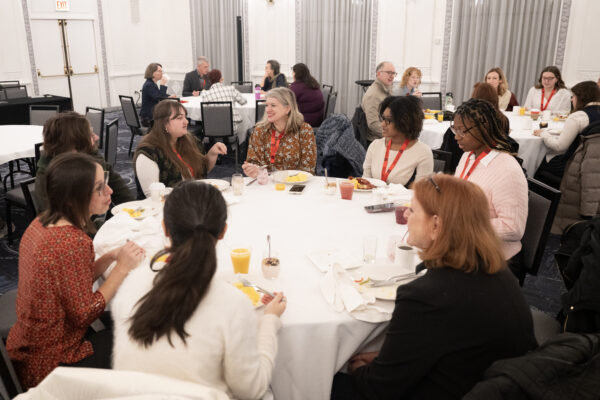
The annual Gender Equity Breakfast allowed time for conversation before a panel discussion on teaching gender and sexuality history in these troubling times.
Economic historian Louis R. Hyman (Johns Hopkins Univ.) has been thinking historically about the AI moment. The question “What is the relationship of the human and the machine?” has been an animating debate for much of the last 150 years, and it informs Hyman’s teaching. He asks students, “Are you going to cede your education to the machine? Or I can teach you to think better than the machine, write better than the machine, feel better than the machine.” Hyman also spoke to the possibilities of AI in accelerating the work students can do. In one course, he estimates that he now teaches a semester of coding, a semester and a half of statistics, and a semester of history all in one semester, because of the ways AI speeds up his students’ work. “They can do stuff that took me six months in grad school in two weeks,” Hyman asserted. Guldi concurred, saying, “You don’t need to be a linguist to write, and you don’t need to be a programmer to code.”
When it came to what AI could mean for professional historians, panelists were generally bullish while gesturing to a shrinking place for historians in the academy. Guldi articulated a vision of AI use in history classrooms and research that could help historians do the work we already do in better and more expansive ways. She offered ideas such as teaching students how to write engineering prompts for different types of archives, such as oral history, parliamentary, or visual archives, and extolled the possibilities of searching across “a hundred archives in a hundred languages” and having the AI help historians with the synthesis. Communicating AI’s value to our colleagues is also necessary. “Humanists have a very misguided idea of what AI is,” Mintz said, with many dismissing it as a “plagiarism machine.” But behind the scenes, “there are sophisticated humanists teaching AI how to research and analyze.” He believes that there are high-paying jobs for humanists working with AI, referencing an acquaintance with an English PhD who worked as a narrative analyst for Netflix, designing the story structure directions the company provides to creatives who populate the platform with their work. “The future of the American economy,” Guldi argued, “rests on solving one problem—the ‘alignment problem,’” which she suggested persists because STEM grads without humanities experience design the systems with “nobody in the room who has the ability to compare different documents.” The MacArthur and Mellon Foundations have created a joint $500 million fund to create a more “people-centered future for AI,” which Guldi said shows that there is money for humanists to be involved in the future of AI.
During the Q&A, the audience seemed generally sold on the idea that there could be use cases in research, but questions focused on the ethical, cognitive, and environmental costs of AI in and outside the classroom. As time dwindled, the panelists elected to let the audience ask questions even though there was not enough time to answer them. What about the use of water and electricity and the ways that AI currently contributes to an ecological crisis? What about AI’s erosion of our ability to think? As AI improves, how can we continue to make the case that historians are necessary, when administrators and public leaders seem ambivalent at best about the future of the discipline? Can humanists act ethically while improving the tools used by corporations like Amazon, Netflix, and Meta? There wasn’t time to answer these and many other questions, but conversations about AI continued at sessions throughout the conference.
These discussions didn’t stop with teaching. At Making AI Work for History: Tools, Workflows, and Research Possibilities in Archival Collections, librarians presented a set of case studies for AI use in the archives that show promise for making archives more accessible to researchers. Loren Moulds (Univ. of Virginia Law Library) and Lorin Bruckner, Amanda Henley, Matt Jansen, and Rolando Rodriguez (all of Univ. of North Carolina at Chapel Hill) shared the ways they have been using and training AI tools to assist in tasks such as analyzing text as data, transcribing varied handwriting, and creating alt text for archival photographs.
With Mellon Foundation funding, the UNC team has pursued several AI-assisted projects. The initial project used text mining and machine learning to identify racist language in Jim Crow laws and other legal documents. Another has been analyzing movie catalog cards from the World War I era, which requires being able to process mixed handwriting, typed text, stamps, symbols, and marginalia—all within an inconsistent structure. To improve accessibility and findability, one team has been using AI to describe photographs in the Southern Historical Collection. They tested multiple LLMs for this task, including ChatGPT, Claude, Gemini, and Llama. In all cases, humans need to check the work being done for errors or bias. In the photo project, for example, they found that the AI exhibited gender bias in describing the people pictured. Yet even with the extensive review needed, it still sped up the process of writing such descriptions.
Moulds offered another case study, in which he assisted a historian with developing an AI-assisted transcription and analysis of a 1930s plantation tourism guest register. The researcher didn’t require a letter-perfect transcription; instead, he was interested in learning about larger-scale trends such as how many visitors were from Northern versus Southern states and whether women were traveling alone. The text used different hands for each entry, different inks, and other challenges for an AI, and the tools did struggle with the messiness of the source material. But the AI also helped to clean the data and introduce a metadata schema. Moulds used not one tool but assembled a workflow to combine automation and human judgment in transcribing and assessing this primary source.
Projects like these illustrate some of the possibilities for generative AI assisting historians with research and helping archivists to maximize limited staff time and budgets. As Moulds said, “Human expertise remains essential,” but these tools have the potential to help to move human labor away from repetitive tasks like transcription to the interpretative skills that are essential to historical practice. For historians interested in projects that require large-scale research, as these tools are refined and improved, their time might one day be reallocated to higher-level tasks than even complicated transcription or data coding—though we’re not at that point yet.
—LA and WB
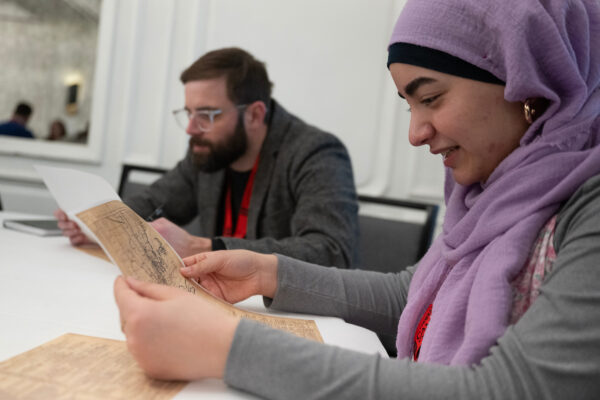
The annual K–16 Educators’ Workshop, led by Lee Ann Potter (Library of Congress), focused on primary sources on revolutionary history.
Careers for History Majors
History departments have long faced declining undergraduate enrollments and have tried to counter the popular myth that a history degree does not prepare students for employment after graduation. The data—and countless history BAs out in the workforce—tells a different story. How can historians better communicate this data, and the value of a history degree, to students? How can history departments counter these myths? And how can the student experience inform these efforts?
Attendees convened to discuss these questions at the Careers for History Majors session at AHA26. Loren Collins (Cal Poly Humboldt) began the conversation by sharing his experience as both a history BA graduate and now a director of academic advising. He recalled when, as a student, he was told by a faculty member that his degree had taught him how to “read, write, and communicate.” That moment was critical, he said, to helping him understand how to convey the value of his education to a potential employer, and that perspective informs his current work. When he first started in academic advising, he encouraged history faculty to build career curriculum directly into their courses. Some resisted, he shared, thinking this approach framed the history BA as a vocational degree. But, ultimately, positive student response to and interest in built-in career curriculum eased faculty concerns.
Jeff Crane (Cal Poly Humboldt) added his perspective as a dean and administrator, as well as a former history faculty member. He also hosts the podcast Yeah, I Got a F#%*ing Job with a Liberal Arts Degree. As a dean, he focuses on what faculty can do for students to ensure student success. What students need, he explained, is to matriculate in programs that define and build explicit skill sets over time and give students the tools to describe those skills and their value to employers when applying for jobs. He described the creation of a new applied humanities department and major at Cal Poly Humboldt that aimed to do just that. Faculty met the program’s creation with skepticism, Crane said, but it has since gained in popularity among students.
Maysan Haydar (Case Western Reserve Univ.) drew on her experience as an assistant professor of history and a former fellow at the American Academy of Arts and Sciences, where she worked on the Academy’s Humanities Indicators project. She shared data on history majors, including the industries they enter, job satisfaction compared to other graduates, and degree completion trends from 1987 to 2024. Haydar also highlighted survey data showing that employers greatly value skills central to history training, including critical thinking, written and oral communication, and evaluation of information, reinforcing Collins and Crane’s emphasis on helping students recognize and articulate the skills they gain through the curriculum.
Frank Valadez (American Bar Association) shared the story of his own career path as an example of how history BAs can articulate the value of their degrees to employers. After earning a BA and an MA in history, he became a textbook editor, then worked at the Newberry Library on teacher professional development. He later joined Chicago Public Schools as a grant writer and then led the Chicago Metro History Fair as executive director. Valadez emphasized that his history major laid a necessary foundation to build new skills at each job, which continued to expand and deepen with each position, culminating in his current work at the ABA. Employers, he noted, especially valued his problem-solving abilities: Historical thinking skills can “put anything in some kind of context,” he said, which provides insight and solutions to the kinds of complex problems faced in a professional environment.
The conversation underscored the immense value of a history degree to potential employers, as well as the need to better prepare students to speak to that value and ensure faculty have the resources they need to guide students. These and other topics are addressed in the second edition of the AHA’s Careers for History Majors booklet, published in January 2026 and including essays by Collins, Haydar, and Valadez.
—HS
Teaching Recent US History
When gathering data for American Lesson Plan, the AHA’s report on secondary US history education nationwide, the most glaring lacuna in lesson plans, curriculum, standards, and our survey of teacher knowledge was recent history—the era since 1970. Content takes a steep drop-off after the civil rights movement, with many teachers straining even to teach the Vietnam War, Reaganomics, the end of the Cold War, or September 11 and the war on terror. The data created a picture of teachers struggling against bureaucratic, political, and knowledge restraints to try to meet students’ need to understand how the modern world came to be, stuck with an outdated curriculum that mentions the cotton gin more often than the computer.
Among AHA26’s three State of the Field for Busy Teachers sessions, one addressed this tricky time period. State of the Field for Busy Teachers: Post-1970s US History brought together teachers trying new methods and materials to address the nearly 60 years of missing history in K–12 classrooms.
Students increasingly lack the historical knowledge and tools to understand the world they live in. Lightning Jay (Binghamton Univ., State Univ. of New York) set out the scope of the problem: The average students witnessing modern events cannot answer the question “Why is this happening, and how did we get here?” Jay quickly dismissed that the lack of knowledge was the fault of teachers, who are working hard under adverse conditions, or students, who are smart enough to learn the material. Instead, “these problems reflect the system.” To this point, Jay discussed a review of standards from the 30 most populous states and saw that while standards are becoming more likely to gesture to the present, with broad terms like “globalization” and “immigration,” conservative and right-wing figures, organizations, and movement events become largely invisible after the 1960s, with 14 out of 30 states mentioning political figures on the right since the 1970s. When figures are mentioned, it is often to distill them as symbols for decades and movements, like covering the 1980s through the lens of Ronald Reagan, which dramatically oversimplifies the history of the era. He called this absence a “consensus,” evidence that “we don’t talk about the right after World War II.” The overall narrative is one of teleological progress, where the civil rights movement “cleanses the sins of slavery, capitalism, and democracy” while denying a conceptual frame to understand the modern right, creating the impression that the fights for civil rights and equality are over, when “it is in fact deeply not over.”
“If [the post-1970s era] is not one-fifth of your syllabus, you are making a choice.”
Mindy Lawrence (Pace Academy) spoke to her experience as a classroom teacher, stating that the “greatest enemy is time” in the perpetual struggle to include content after the 1970s. Lawrence’s aim is to make coverage of the period meaningful and reasonably comprehensive while being realistic about teacher and student capacity at the end of the year, when “my enthusiasm has waned and so has theirs.” To counter the exhaustion, Lawrence encouraged educators to incorporate “novelty” and the “unexpected” into their classroom lessons. The post-1970s era is particularly ripe with multimedia sources, such as music and TV, that are untraditional in most history classrooms but can be used to deepen students’ connections to the material and make the information “stickier” as well.
With over 30 years of combined experience in K–12 and college settings, Sage Gray (Macalester Coll.) spoke about building “foundations” to fix “conceptual blind spots” and “oversimplification” that plague instruction on the recent past. Gray suggested that when working through the 1970s, educators focus on events in economics and technology and give students the context for how wealth has driven shifts in the US economy, particularly since the 2000s, giving the example of the monumental shift in technological primacy from IBM to Apple.
When asked about how to compensate for state standards, Jay stated that standards “will not save us” as they are “political documents” telling an agreed-on “political story.” His stark challenge to educators in the audience was to cover the post-1970s era proportionally to its share of US history, saying, “If [the era] is not one-fifth of your syllabus, you are making a choice.” For teachers struggling with oversimplified standards, Jay suggested creating “a dialogue between symbols” rather than teaching the standards as the whole story. He also pushed educators to understand “fascism” as an analytical term, not a label for politics that one can claim or disclaim, and to teach Project 2025 as a primary source in the classroom. Giving the example of letting students compare the Heritage Foundation’s EPA policy suggestions in 1980 and in Project 2025, Jay urged that the topic can be taught through a historical lens, rather than a moral one, while still giving students the tools to understand their world. Gray noted that it remains controversial to teach “harmful” documents, citing a previous generation of scholarly discussion about whether teachers should assign plantation documents and reproduce those voices. Such questions are important, but the panel made clear that history educators must actively, as a community, seek their answers, if we are to empower each student with the skills to find and stay grounded in context, even if the ground rapidly shifts beneath their feet.
—WB
Who Has Control?
“Classical education” (CE), a post–World War II education movement within the spheres of homeschooling and private schooling, has recently come to carry weight in debates about public school education and acquired powerful advocates at the local, state, and federal levels. As discussed in the panel What Historians Should Know About Classical Education, CE first entered education conversations nationwide when it became a standard-bearer for post-1960s cultural reactionaries seeking a counterargument to civil rights education reforms. As CE moves from the fringes into the mainstream, the panel sought to impart more fully what CE is, how it is and is not tied to the political right, and how to assess the threats it may present to a fractured American education landscape and to history education specifically.
Jessica Richardi (Coastal Carolina Univ.) began the session with an intellectual genealogy of CE. In 1947, novelist Dorothy L. Sayers published an essay titled “The Lost Tools of Learning,” in which she urged educators to reclaim the educational “tools” of the ancient Greeks and Romans and combine them with Jean Piaget’s theories of childhood cognitive development. William F. Buckley Jr. republished Sayers’s essay in the National Review three times (in 1959, 1960, and 1979), aiming to influence debates over public education. Douglas Wilson, an evangelical pastor, read the article and saw an opportunity to marry CE to evangelical Christianity. Soon thereafter, he created the Christian school Logos from his home in Moscow, Idaho. Richardi estimated that the number of classical schools in the United States has grown to nearly 1,700, though this does not include the homeschooling families using the model. Richardi credited Susan Wise Bauer, fellow panelist and co-author of The Well-Trained Mind (1999), currently in its fifth edition, as perhaps the most influential figure in CE among homeschooling families. After Sayers, Wilson, and Bauer, the fourth major figure of CE is Mortimer J. Adler, a philosopher, liberal education advocate, and editor of the landmark 54-volume Great Books of the Western World, which served as a model for the types of texts that should be included in a CE curriculum.
Richardi and Bauer both emphasized that the CE movement is neither politically monolithic nor even solely Christian—but there are elements of consensus. CE developed in a liberal arts tradition, inspired in part by Greek and Latin approaches to education, but according to Bauer, it is more closely related to the model of religious education of clergy that emerged in Europe between the fifth and eighth centuries. The modern CE movement joins moral and character development (interpreted mainly through the lenses of individual responsibility and self-reliance) with rigor, high but developmentally appropriate expectations, and the “quest for truth, goodness, and beauty.”
Despite these unified ideas, CE schools closely guard their autonomy, which is ideologically tied to the centrality of the family in educational decision-making. Texts may be shared within schools or networks, but the idea of a “canon” is corrosive to self-governance. As a result, the definition of “classical” becomes flexible and contingent. Bauer argued that CE reading lists are frequently “overweighted” with Western texts, but the avoidance of nudity and sex within the movement ironically reduces and narrows interaction with the classical world. As she noted, one would be hard-pressed to find Sappho on a CE reading list.
CE’s recent stretch beyond K–12 education is remarkable and requires urgent attention. In Florida, the Classic Learning Test (CLT) has emerged as an alternative to the College Board and university entrance exams, and the Department of Defense will begin accepting the CLT for service academy applications in 2027. Nathan Rives (Weber State Univ.) spoke about the CE roots of Utah’s general education reform bill SB 344 (2025), which, Rives reported, the National Review called a “game changer nationally.” It creates a Center for Civic Excellence at Utah State University under a new vice provost, who Rives said would serve as a “general education czar” with a long list of extraordinary powers, including hiring, firing, and evaluating all faculty in general education and syllabi review. The law’s focus on the humanities, “viewpoint diversity,” and an overwhelmingly Western canon puts humanities faculty under particular pressure to carry out the ideological project. Yet Rives seemed skeptical of the project’s ability to achieve its overall goals. While the content lists are ideologically inflected, requiring a work be taught is not the same as studying it in a modern university classroom. Using the example of Tocqueville, commonly found on proposed lists of required reading, Rives asked, “I wonder—will reading it have the effect they think it will?”
The speakers identified the CE movement as being, at root, about control. Rives pointed to a right-wing “obsession” with reversing the reforms of the 1960s by taking “control of content,” though he added, “It’s not clear to me that they know what content does.” For Bauer, the desire is behind the shift from an emphasis on method, which is historically central to CE, to content, which is much easier to control and monitor. Because of distrust of teacher training since the 1960s, efforts to control curriculum increasingly exclude experienced classroom teachers, and reformers in their urgency are increasingly prioritizing ideology over the science of learning. Bauer attached this urgency to “apocalyptic thinking” throughout the Christian education ecosystem, where educators seek to “save Western civilization, one student at a time.” Rives concurred, saying that the movement has “taken on a life of its own” as people reach for “whatever they think will save [them]” in an age of increasing uncertainty. While CE has implications for all areas of study in K–12 education, the humanities and social studies in particular are susceptible to CE advocates’ moves to command curriculum in institutions of public education. Historians, guided by their professional integrity, must be informed participants in these nationwide debates about curriculum reforms that have shaped and will continue to shape generations of students.
—WB
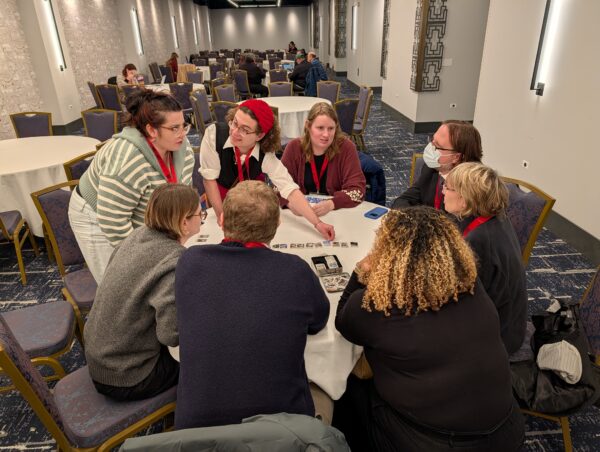
Meetups brought together attendees for more informal conversations and activities, from fiber arts to board games. Hope Shannon
History and Genocide Studies Now
About a dozen sessions across the weekend addressed the topic of Palestine, including Historians and the Politics of Genocide Studies, a roundtable sponsored by the AHA’s Research Division. This session brought together scholars to reflect on “how historians as public intellectuals have responded to cases of genocide and ethnic cleansing during the last century, and how this response has been entangled with American domestic politics, cold war, and the US foreign policy agenda.”
The session drew a large and engaged audience, matching the equally engaging panel made up of scholars of genocide and related fields. Bedross Der Matossian (Univ. of Nebraska–Lincoln) opened by describing what he characterized as a “post-truth and denial” era in the United States and globally, in which facts are less influential than opinions. In discussions of genocide specifically, he argued that people bend reality. Facts are selectively chosen to support predetermined positions, while a lack of expertise can make it difficult to distinguish reliable scholarship from misinformation. This “post-truth dynamic distorts historical memory,” he said, emphasizing that denial has serious consequences when the governments that advance this misinformation are powerful global states. This context raises urgent questions about the role of a historian in the face of genocide. He urged historians to publish on genocide denial and to situate it within a comparative framework in order to provide scholarly legitimacy.
This “post-truth dynamic distorts historical memory.”
Barry Carl Trachtenberg (Wake Forest Univ.), a historian of the Holocaust, described a recent incident in which Israeli Defense Forces raided Birzeit University and interrupted the screening of a documentary about a Palestinian child killed in Gaza. He noted a lack of condemnation from the AHA and other institutions and framed this as a broader pattern of uneven responses to global violence from historical organizations. Trachtenberg suggested that scholars face a choice in their response: Work for change from within or turn away from institutions and create new ones. He pointed to organizations such as the Liberatory Jewish Studies Network and the Genocide and Holocaust Studies Crisis Network as examples of groups seeking to interrogate why and how institutions have justified genocide and foster discussion. These conversations need to be held out loud in the open for change to happen, he said.
Gabriel Winant (Univ. of Chicago) reflected on the politics of higher education in relation to genocide. During the 20th century, American universities engaged widely with contemporary questions of violence and genocide; they helped make sense of moments of tragedy. “Now,” he said, “we are in a new crisis.” According to Winant, the response to recent student encampments illustrates the power of the oligarch class over our institutions and the hostility they have over the knowledge produced there. “They are interested in the destruction of knowledge,” he stated, suggesting that donor influence and political pressure to suppress Palestine has enabled universities to suppress other subjects. Even so, he emphasized that resistance within and beyond the university is robust, though undervalued and misrepresented. Activist organizations, legal challenges, and graduate student unions, he argued, have played a critical role in pushing back. In the moments when our universities are oppressive, he said, there are always organizers. Universities and other large institutions can inflict enormous harm, but he reminded the audience that they cannot erase power built through organizing and solidarity. He concluded, “We will look back at this time as generating a new American campus. . . . It is crucial to recognize we have resources to defend ourselves.”
The destruction in Gaza and its implications for historians were the focus of Abdel Razzaq Takriti’s (Rice Univ.) remarks. He urged the audience to consider how the targeted destruction of infrastructure that anchors society, including educational, health, sewage, and cultural institutions, is genocidal. Gaza has a long and rich history bridging Asia and Africa, and Takriti called attention to the loss of archives, cultural and religious artifacts, and educational institutions that are deeply important to the history of the Ottoman Empire, Christianity, and the Middle East region at large. He mourned the loss of 195 university professors, hundreds more schoolteachers, and even more students. To Takriti, historians have a responsibility to respond to these tragedies and use the power of their scholarship to oppose and end genocide.
Takriti also addressed the experiences of historians of Palestine like himself, who have felt marginalized within the discipline and the AHA because of what they study. Multiple panelists referenced “the Palestine exception,” a term used to describe a pattern of institutional discrimination that restricts scholarship on and advocacy for Palestine. Despite these challenges, Takriti emphasized the urgency of “taking up space” within institutions because colleagues in Gaza have asked them to do so. “It is uncivil to be silent on genocide,” he stated. He urged the AHA to show solidarity and agreed with other panelists that historical institutions should be speaking out against genocide as an abuse of history.
The Q&A period reflected the intensity of the session. Several undergraduates in the audience sought advice, asking how emerging historians can deal with feelings of overwhelm, shrinking graduate opportunities, and the perceived gap between private acknowledgment of a genocide in Gaza and institutional action in public. Session chair Mezna Qato (Univ. of Cambridge) responded that there is progress in the broader acceptance of today’s events as a genocide, but that there is often an aggressive reaction toward the messenger, which she finds “maddening.” The panelists encouraged the audience to work in this tension and to keep pushing forward. “Count victories as victories even if they are dwarfed by the scale of genocide,” a panelist stated.
—EM
How to Advocate for History
Following a year in which historians, and the historical discipline itself, were under imminent threat, conference attendees received some expert guidance in advocacy on behalf of history. In The Historian as Advocate, the AHA’s government relations consultant Jessica Venable (Thorn Run Partners) led an interactive workshop on how to most effectively reach elected officials and convince them that historians’ work is worth protecting. This includes not only their professions in history but also the varied policy issues they have studied on which they can provide valuable historical context.
Venable began by asking participants what questions they had, receiving enough to fill four sheets of chart paper placed at the front of the room. These ranged from the general, like how historians can make their work legible to policymakers or how to identify potential partners on Capitol Hill, to the particular, like how to reach specific policymakers to share expertise in areas such as climate change or reproductive health and how graduate students can participate in advocacy.
Venable emphasized the importance of shifting from being “petitioners to partners” in the policy process: Policymakers will be most inclined to work with historians if they can demonstrate value to them and their staffs. This value often comes from historians’ ability to explain the impact of past policy choices on the world. She introduced the four R’s of meaningful engagement and advocacy: relationships, respect, relevance, and reciprocity. Your ability to impact policy comes from continued, reciprocal relationships.
Venable got participants moving around the room in breakout groups working to craft an advocacy strategy, with exercises addressing different components of effective advocacy:
Translation: In order to communicate with officials, speak in terms policymakers will understand. Venable solicited some possibly difficult words and offered translations: “teaching” instead of “pedagogical,” “order of events” instead of “chronology” or “periodization.” Concision is also key, with Venable stressing the importance of paring down 30-page papers into one-page summaries, and class-length lectures into two-sentence “diagnostic history” statements. Each group created a diagnostic history statement on a historical topic, stating what the historical record indicates could happen if a particular policy is pursued. In one example, a group shared that if the US government continued to restrict student speech on campus, student movements could lead to violence, pointing to examples from the French student protests of 1968 and the shooting of student protestors at Kent State University in 1970.
Clarity and relevance: Express your concerns in stark terms. Venable asked groups to briefly explain what a “day with” and “day without” a particular policy action would look like. A historian of global reproductive health put it simply: A day with adequate funding for maternal health programs in Africa has more women living, and a day without means they die.
Tactical mobilization: A group of advocates should include a researcher, a coordinator, and a constituent. Each breakout group proposed an “advocacy pod” including these three roles to match their chosen policy area. One group challenged themselves to compose an advocacy pod only of grad students who could speak about issues on their campus to the area’s congressional representative—a clear answer to a group member’s initial question about how students can participate in advocacy.
By the end of the session, attendees had an array of tools to guide their advocacy, communicate effectively with policymakers, distill their research down to the most relevant and concise information, and form and lead groups that can have an impact on policies that concern and affect historians and our work. Multiple attendees expressed how helpful the training had been and that they wished more people could have attended—and the AHA plans to offer more advocacy trainings in the future.
—BR

A New Orleans–themed puzzle in the Exhibit Hall reminded attendees of where we’ll convene in 2027.
On to New Orleans
The 140th annual meeting will be held January 7–10, 2027, in New Orleans. While the proposal deadline has passed, we hope that you will join us next year. Even if you haven’t proposed your own session, there will be many opportunities to participate—in workshops, drop-in sessions, and other events.
This work is licensed under a Creative Commons Attribution-NonCommercial-NoDerivatives 4.0 International License. Attribution must provide author name, article title, Perspectives on History, date of publication, and a link to this page. This license applies only to the article, not to text or images used here by permission.