
Radhika Natarajan is an associate professor at Reed College. She lives in Portland, Oregon, and has been a member since 2021.
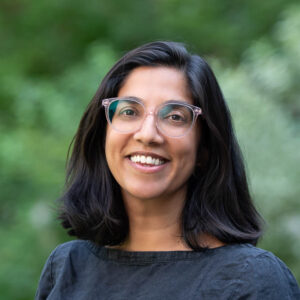
Photo credit: Nina Johnson
Webpage: https://www.radhikanatarajan.org/
Alma maters: BA, Yale College, 2002; MA, University of California, Berkeley, 2009; PhD, University of California, Berkeley, 2013
Fields of interest: modern Britain, imperialism, colonialism, race, migration, citizenship
Describe your career path. What led you to where you are today?
After college, I worked in art museums. I learned to be a teacher at the Brooklyn Museum, and I still draw on those conversations about pedagogy decades later. While I loved that experience, I realized that more than the art itself, I was inspired by the stories we could tell about the past through the artworks. I decided to attend UC-Berkeley, where I worked with James Vernon in British history, Tom Metcalf in British imperial and South Asian history, and Gene Irschick in South Asian history. My time at Berkeley helped me see how research and teaching were linked in the life of a professional historian. I joined Reed College in 2014, and working at a liberal arts college has deepened my commitment to pursuing history as both a teacher and scholar.
How have your historical interests evolved across your career?
Across my career, I have been interested in how the British Empire operated, and teaching at Reed has pushed me beyond my fields of graduate study to understand imperialism in the present. I wrote my undergraduate senior essay on aquatints of Calcutta made in the 1780s. As an undergraduate, I never took a British history course, but a course on art and the British Empire profoundly shaped how I understood imperialism, how it functioned, and how it was represented. In graduate school, engaging with the domestic histories of British society and politics shifted my questions from the 18th-century origins of the British Empire to its end in the 20th century. I became interested not only in the places Britain ruled, but in Britain itself. The process of revising my dissertation into a book has deepened my engagement with Black British cultural theory and history. In my teaching, I’ve engaged more with settler colonial and Indigenous studies and learned to connect histories of dispossession and also survivance in North America, Oceania, and Palestine. This has sharpened my understanding of imperial racial formation and the work that historians can do to challenge racism, imperialism, and ethnonationalism in the present through our study of race and racism in the past.
What projects are you currently working on?
In 2023, I co-authored a children’s history of the British Empire called Hear Our Voices. I have visited elementary and middle schools to talk about the book. It’s been an amazing experience, and with the help of two undergraduate research assistants, I have been developing lesson plans and activities to support educators using the book in their classrooms.
My first scholarly book examines how late imperial migration shaped the forms of welfare, social rights, and citizenship in late 20th-century Britain. In Empire and the Origins of Multiculturalism: Migrants, Citizenship, and Community in Britain, 1948–1982, I study encounters between migrants from the decolonizing empire, social workers, community organizations, and the state. I show how social democratic welfare programs did not challenge structural racism and how the multicultural settlement these programs produced displaced other ways of conceptualizing diversity and contesting racism.
I am developing a new project on visual economies of race in postwar Britain. This project builds on my longstanding interests in examining visual material as historical evidence. I am researching how photography was used to capture Britain’s multiracial present and argue for its multiracial future.
I am deeply invested in sharing scholarship with the public. My collaborator John Munro and I are revising our Imperialism Syllabus into an introduction to empire, its history, and present for a broad audience.
Do you have a favorite experience with the AHA?
In recent years, I have appreciated the opportunity to think about history education as a K–16 project. The attacks on history we face in higher education are magnified for elementary, middle, and high school teachers. In 2024, I participated in a panel organized by Ellen Boucher on historians and children’s books. It was great to speak with colleagues who had also authored children’s books and inspiring to talk with the audience on teaching history across K–16 education. We need to organize not only across higher ed, but in solidarity with all of us who believe that an honest reckoning with the past is necessary to build more just futures.
AHA members are involved in all fields of history, with wide-ranging specializations, interests, and areas of employment. To recognize our talented and eclectic membership, Perspectives Daily features a regular AHA Member Spotlight series.
This work is licensed under a Creative Commons Attribution-NonCommercial-NoDerivatives 4.0 International License. Attribution must provide author name, article title, Perspectives on History, date of publication, and a link to this page. This license applies only to the article, not to text or images used here by permission.