
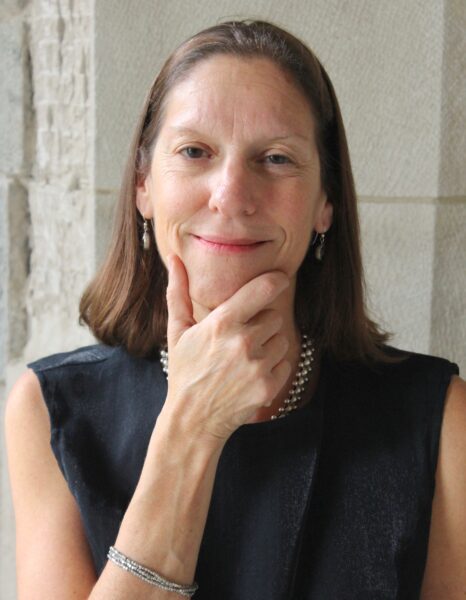
Martha Hodes is a professor of history at New York University. She lives in New York, NY, and has been a member since 1989.
Bruce Dorsey
Social Media: https://www.marthahodes.com/; https://as.nyu.edu/faculty/martha-hodes.html; @marthahodes.bsky.social; https://www.facebook.com/martha.hodes1/; https://www.instagram.com/marthahodes6/
Alma maters: BA (religion), Bowdoin College, 1980; MA (comparative religion), Harvard University, 1984; MA, Princeton University, 1987; PhD, Princeton University, 1991
Fields of interest: 19th-century United States, Civil War, race, women and gender, memory, narrative, storytelling
Describe your career path. What led you to where you are today?
Since I wanted to be a writer, I entered college a sure English major but ended up a religion major. After graduation, I spent two years working with refugees from Vietnam, Cambodia, and Laos, then returned to school to study comparative religion. A work-study job at Radcliffe’s Schlesinger Library on the History of Women inspired a shift from abstract ideas to lived experience—hence my PhD in history. To become a writer, I decided, I would become a historian, and becoming a writer is an ongoing endeavor. I recently spent one of the best years of my professional life as a fellow at the Cullman Center for Scholars and Writers at the New York Public Library, then spent two more years as Cullman Center director, learning so much from the other fellows, a mix of academics, fiction writers, nonfiction writers, translators, and poets.
How have your historical interests evolved across your career?
Reconstructing the lives of historical actors has been my abiding interest. My first three books (each one focused in a different way on race and the Civil War era) all piece together the lives of ordinary people facing adverse circumstances: risk, ostracism, violence, grief. After that, I tried something different. My Hijacking: A Personal History of Forgetting and Remembering (HarperCollins, 2023) explores a formative experience in my own life—in 1970, at 12 years old, my 13-year-old sister and I, traveling without our parents, were held hostage for a week, inside an airplane, in the Jordan desert. And yet the method was familiar: contending with adversity and weaving intensive archival work into narrative and storytelling. I like to describe My Hijacking as a deeply researched memoir.
What projects are you currently working on?
I’m currently exploring the lives of three creative women across three generations, and their relationships to expectations of domesticity. As I gather a rich trove of documents, I’m thinking about the best form to tell the story I want to tell.
What is your favorite historical site to visit?
Anyone’s home, whether a designated historical site or not, whether of a president or an ordinary person. When researching, I always look for addresses and, if possible, visit and explore: a building, a street, a neighborhood.
What’s the most fascinating thing you’ve ever found at the archives or while doing research?
Researching my first book, White Women, Black Men: Illicit Sex in the Nineteenth-Century South (Yale, 1997), I found interviews with enslaved men recounting that elite white women coerced Black men into sex, including a penciled note indicating that the information “should be suppressed.” That unusual document (in the papers of the American Freedmen’s Inquiry Commission in the National Archives) inspired me to keep searching for voices I never expected to find. Fascinating documents have never stopped surfacing, of course. Writing My Hijacking, the son of a fellow hostage sent me his late father’s unpublished narrative, which recorded a conversation with my sister and me while the hijacked plane was turning around in the sky. That document contributed to solving the book’s most vexing question about memory.
Who in your life served as a teacher or mentor and influenced your understanding of history?
My beloved PhD committee members: Christine Stansell, James McPherson, and Nell Irvin Painter, all of whom taught me the skills of meticulous research and all of whom write narrative like a summer breeze.
What do you value most about the history discipline and community?
Communing with other historians, many of them dear friends, who care about the craft of writing, including experimental forms of writing history. There are many of us out there, always eager to share ideas and inspirations. On that note, I’ve always incorporated the craft of history writing into my courses and always learn a great deal from my students.
Do you have a favorite experience with the AHA?
In keeping with finding historians who care about writing, I’ve been part of outstanding annual meeting panels over the years: a “history slam” (2001), an overflowing session on writing for readers beyond the academy (2009), a panel called Experimenting with New Dramatic Histories (2018), and a terrific roundtable on historians writing about their own families (2025). So much creativity! I also absolutely loved recording a History in Focus podcast episode about My Hijacking with the amazing Kate Brown.
AHA members are involved in all fields of history, with wide-ranging specializations, interests, and areas of employment. To recognize our talented and eclectic membership, Perspectives Daily features a regular AHA Member Spotlight series.
This work is licensed under a Creative Commons Attribution-NonCommercial-NoDerivatives 4.0 International License. Attribution must provide author name, article title, Perspectives on History, date of publication, and a link to this page. This license applies only to the article, not to text or images used here by permission.