As the nation’s political climate turns from positive incentives to encourage women’s full participation in political and economic life to a more sanguine acceptance of their capacity to function within existing rules, we are reminded once again that even relatively privileged professional women exist in a social environment of which we are sometimes beneficiaries and at other times, creatures.
This change in climate prompts us to re member that beneath the positive accomplishments of which we and the American Historical Association can be justly proud, there remain issues of importance to large groups of women. It encourages us to pay attention to the subtle barriers that can inhibit women from engaging in satisfying professional lives.
In 1986 we devoted much attention to less obvious, but potentially discriminatory is sues. For example, we worked with the Professional Division to develop new language for two sections of the Statement on Standards of Professional Conduct. With Clara Lovett, we developed a statement on part time work that asserts the right of those who find themselves in part-time jobs, or who choose or need such jobs, to be treated with the respect and some of the perquisites given to all faculty members.
The CWH also offered to the professional division a statement on sexual harassment designed to assure women, at all stages of their careers, of comfortable working environments. Though the Professional Division exacted some compromises in the language of the draft statement, the CWH believes that the statement forwarded to the Council places the AHA firmly behind a harassment free environment.
In a similar vein, the CWH proposed that the AHA adopt guidelines for gender neutral language to be used in all its publications. That proposal passed through the Research Division in the spring and is now before the Council. In the first of what we hope will be a continuing set of meetings, we met with David Ransel, editor of the American Historical Review, to explore ways in which the journal could more adequately represent the work of women historians and reflect recent work in women’s history.
In other areas, we were not quite so successful. After several years of contacting AHA program chairs to encourage gender integrated sessions (with excellent results), the CWH asked the Professional Division to incorporate a statement to that effect into the policy guidelines given to program committees. Our concern is that such a policy be institutionalized, rather than left to the good will of individual chairs and their committees. The Professional Division chose to leave the rather vague statement that now exists in the guidelines standing.
Furthermore, our efforts to encourage the AHA to re-think the date of the annual meeting have proved unavailing so far. Responding to the complaints of members who found it difficult to leave their families during the holiday season, the CWH requested members’ opinions on the traditional December 27–30 date. Of the twenty-four responses, twenty-one opposed the date, but the total number of respondents indicated no groundswell of support for a change.
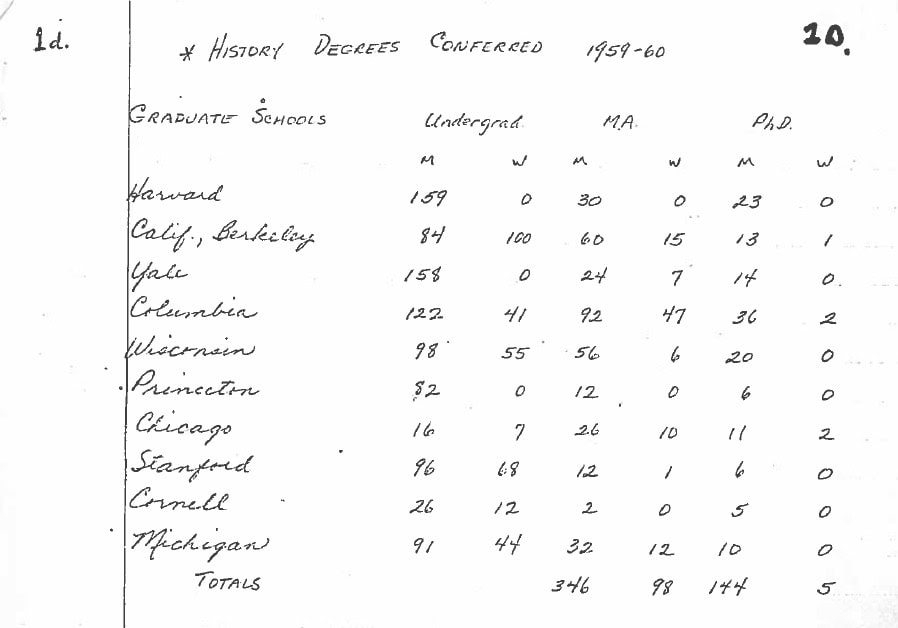
These issues underlie the continuing effort of the CWH to develop support and visibility for women in the historical profession. The CWH is moving in several directions on this front. In line with the attempt to discover how women are faring as they enter the ranks of historians, the CWH last year completed a survey of graduate students in the thirty highest rated history departments. Eighteen departments responded on such questions as enrollment of male and female graduate students, their funding, and their attrition rates.
The survey results, tabulated by Noralee Frankel, the AHA special assistant for women’s and minority affairs, indicate that enrollments of graduate women continue to increase and that for the most part there seems to be little overt discrimination against them in admissions and funding. An area of concern is the small number of minority women graduate students enrolled in history programs. Surveys from 250 graduate students are being processed by Committee member Virginia Scharff.
In view of the continuing failure of history as a profession to attract a significant number of members from the racial minorities, we have urged the AHA to undertake membership initiatives addressed to Black people in general and to Black and minority women in particular. Working with committee member Sylvia Jacobs, executive director Samuel Gammon has developed strategies designed to attract historians who are members of minority groups into the AHA. Our hope is that increased minority membership in the AHA will encourage the organization to take initiatives designed to explore the barriers that inhibit members of minority groups from training as historians.
Our Directory of Women Historians, last published five years ago, is being readied for another edition. Over 1,200 women historians responded to requests for information printed in the newsletters of the American Historical Association, the Organization of American Historians, and the Coordinating Committee of Women in the Historical Profession. We expect the directory to be available in late spring 1987.
Three conference initiatives are still in process. The CWH is helping to gain support to make women’s history a member of the Comite International des Sciences Historiques as an associated specified organization. It is working with the Conference Group on Women’s History to gather letters of support from women’s history groups around the world in anticipation of the summer 1987 meeting of the International Committee.
Furthermore, some funding has been obtained for a conference on Women in the Progressive Era to be conducted jointly with the National Museum of American History, and to precede an exhibit planned by the museum. The conference, scheduled for March 10–12, 1988, will consist of invited papers, and sessions will be open to interested people. In the meantime, various funding sources have suggested new directions for a projected “State of the Art” conference in women’s history, and the CWH is now discussing how that endeavor might be focused. Finally, in the area of visibility, the CWH submitted to the Research Division the names of three women foreign scholars for consideration as honorary members in the AHA. If any one of the three is successful, she will be only the second women so honored.
The CWH continues its advocacy work on behalf of all women. This year, we encouraged Samuel Gammon to write to the Equal Employment Opportunity Commission urging them to continue to request goals and hiring guidelines from employers found guilty of discrimination. We continued to support the Civil Rights Restoration Act, which unfortunately remains in committee, and we supported women’s history week, which once again successfully passed Congress last March.
Within the AHA, there are many bright spots, Perspectives published several “Roses and Thorns” columns in the past year. These included Nancy Schrom Dye’s perceptive statement of “What’s in a Field”; Nadine Taub’s important suggestions for historians involved in giving expert testimony; and a gender breakdown of articles that appeared in the American Historical Review.
In addition, the CWH offered roses to the AHA for continuing to support childcare at its annual meetings, and for greatly improved representation of women on most of its committees. The two sessions sponsored by CWH at the 1985 annual meeting were both rousing successes. Gerda Lerner and Joan Scott offered provocative papers at a plenary session of “Women: History and Theory”; Scott’s paper will be published in a forthcoming issue of the American Historical Review. Karen Offen chaired a panel discussion of “Problems and Prospects of Part Time Academic Employment for Historians.” In addition, the CWH’s annual breakfast drew a record number of historians to hear President-elect Natalie Zemon Davis speak. Her talk was reprinted in the CCWHP newsletter.
The year brought some changes in the composition of the Committee. Three valuable members, William Chafe, Karen Offen, and Ellen Furlough, rotated off. It was hard for me to imagine working without any one of them, and yet the three new members, Ronald Walters, Judith Walkowitz, and Virginia Scharff, have assumed central roles in a breathtakingly short space of time. As I leave the Committee in December (1986), I want to offer them my warmest thanks along with Nancy Schrom Dye, who continues on the Committee, and Sylvia Jacobs, who leaves with me. My deepest thanks, too, to Samuel Gammon for his unstinting cooperation, and especially to Noralee Frankel, sine qua non of the past two years.
A final word, when this Committee was established in 1970 it existed in the context of a viable and active women’s movement. In the mid-eighties, that movement has assumed a new shape and new directions, fostering at times a false complacency and at others a rank despair. I hope that the continuing work of the CWH demonstrates that there are alternatives between those extremes on which we can continue to work together.
Alice Kessler-Harris is Professor of History, Hofstra University and Chair, Committee on Women Historians.