
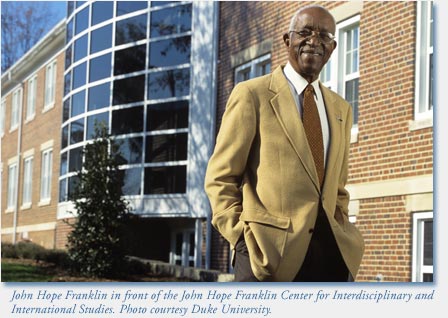
 Paul Gaston of the University of Virginia first introduced me to John Hope Franklin at an annual meeting of the American Historical Association in the late 1970s. I was starting off my teaching career as a historian. John Hope already had an international reputation as a scholar of American history, and when we shook hands and exchanged greetings and a few remarks I was overwhelmed by the occasion which lasted only a few minutes, but it has remained one of a very few cherished moments of my life. I recall the event now with pleasure and a sense of profound gratitude because John Hope personally welcomed me into the community of professional historians. He wished me success at a stage in my career when it seemed that there were so many mountains ahead that I would have to climb to get to the land of achievement and success, and this after I had somehow survived the taxing rigors of graduate school.
I also remember that when I first shook hands with John Hope he communicated to me a strong sense of human warmth, encouragement, and compassion; and for some reason my father came to mind. He too in his own way had gently insisted that I go out into the wide world and do what I had to do.
Over the years I ran into John Hope many times at professional meetings, and I was always amazed and then inspired by his familiarity with my work. I could not believe my good fortune when he eventually moved to Durham, North Carolina, and to Duke University, where we were able to interact more regularly as colleagues and as friends. His advice to me one day at lunch was to keep on writing no matter how difficult that process of creation might seem. Three other major historians came to mind then (joining us at lunch it seemed), two of whom (Eric Williams and Elsa Goveia) became my intellectual mentors, and the third (Jack P. Greene) directed my graduate studies at Johns Hopkins University. I will try to follow John Hope’s advice given that day at lunch with such good humor, while I will miss, of course, his personal guidance and example. Thank you, John Hope, for everything.
—David Barry Gaspar is professor of history at Duke University.
Tags: AHA Activities Member News
Comment
Please read our commenting and letters policy before submitting.


